



目录

  • 1 Chapter 1 – Preparing for a Leadership Career
    • 1.1 Introduction
    • 1.2 Why a Career in Hospitality and Tourism?
    • 1.3 Selecting an Industry Segment
    • 1.4 Types of Available Positions
    • 1.5 Traits of Leaders
    • 1.6 Traditional Management Styles
    • 1.7 Varying your Leadership Style
  • 2 Chapter 2 – Hospitality and Tourism Leadership
    • 2.1 Introduction
    • 2.2 21st Century Leadership Styles
    • 2.3 Leadership Development Goals
    • 2.4 Empowerment
    • 2.5 Showing Respect and Value for Diversity
    • 2.6 Global Guest Audiences
    • 2.7 Welcoming Other Cultures
  • 3 Chapter 3 – Leadership and the Guest Cycle
    • 3.1 Introduction
    • 3.2 Follow the Guest: Making the Cycle Seamless
    • 3.3 Guest Recovery
    • 3.4 Problem Solving
  • 4 Chapter 4 – Managing the Guest Experience Cycle
    • 4.1 Introduction
    • 4.2 Managing the Guest Experience: Being Inclusive
    • 4.3 Guest Experience Property Standards
    • 4.4 Managing the Guest Service Measurement (GSM) Process
    • 4.5 Guest Service Gold: Leading a Gold Team
    • 4.6 Managing Green Practices
  • 5 Chapter 5 – Leadership, Employees and Communication
    • 5.1 Introduction
    • 5.2 Purpose of the Mission Statement
    • 5.3 Communicating Employee Purpose and Role
    • 5.4 Setting Performance Goals
    • 5.5 Listening, Speaking and Writing
    • 5.6 Managing Difficult People
    • 5.7 Guest Communication
    • 5.8 Media Training
  • 6 Chapter 6 – Front Office Leadership
    • 6.1 Introduction
    • 6.2 Responsibilities of the Front Office Manager
    • 6.3 Reports: The Night Audit Paper Trail
    • 6.4 Labor Costs and the Night Audit
    • 6.5 Measuring Employee Performance
    • 6.6 Guests and the Front Desk
    • 6.7 Green Practice Programs for Guests
  • 7 Chapter 7 – Managing Housekeeping Operations
    • 7.1 Introduction
    • 7.2 Being the Executive Housekeeper
    • 7.3 Building a Budget
    • 7.4 Budgeting Labor and Linen Expenses
    • 7.5 Managing Housekeeping Performance Standards
    • 7.6 Training Housekeeping Staff
    • 7.7 Managing Housekeeping Green Practices
  • 8 Chapter 8 – Leadership and Facilities Management
    • 8.1 Introduction
    • 8.2 Function of the Chief Engineer
    • 8.3 Budgeting to Meet ADA Requirements
    • 8.4 Energy Management
    • 8.5 Emergency Systems Planning
    • 8.6 Managing the Facility’s Green Practices
  • 9 Chapter 9 – Food and Beverage Service Leadership
    • 9.1 Introduction
    • 9.2 Organization and Staffing of Food and Beverage Operations
    • 9.3 Menu Management
    • 9.4 Purchasing Supplies and Equipment
    • 9.5 Facility Design, Décor and Cleaning
    • 9.6 Managing Sanitation and Safety
    • 9.7 Labor and Revenue Control
    • 9.8 Nutrition and Sustainable Foods
  • 10 Chapter 10 – Managing Banquets and Catered Events
    • 10.1 Introduction
    • 10.2 Booking and Planning Events
    • 10.3 Reports: Preparing for Service
    • 10.4 Delivering Service
    • 10.5 After Service
  • 11 Chapter 11 – Human Resources
    • 11.1 Introduction
    • 11.2 Interview and Hiring Practices
    • 11.3 Employment Laws
    • 11.4 Managing Compensation and Benefits
    • 11.5 Corporate Social Responsibility
  • 12 Chapter 12 – Managing Operational Finance
    • 12.1 Introduction
    • 12.2 Financial Statements
    • 12.3 Operational Expenses and the Capital Budget
    • 12.4 Revenue Management
    • 12.5 Managing Labor Costs
    • 12.6 Taxes: Reporting and Remitting
  • 13 Chapter 13 – Marketing
    • 13.1 Introduction
    • 13.2 The Marketing Mix
    • 13.3 Steps of a Marketing Plan
    • 13.4 Channels of Distribution
    • 13.5 The Marketing Budget
    • 13.6 Industry Trends and Marketing
  • 14 Chapter 14 – Sales
    • 14.1 Introduction
    • 14.2 Training for Sales Success
    • 14.3 Managing a Sales Team
    • 14.4 Selling to Global Audiences
    • 14.5 Selling to Special Segments
    • 14.6 Selling to the Digital Traveler
  • 15 Chapter 15 – Safety
    • 15.1 Introduction
    • 15.2 Managing Workplace Safety
    • 15.3 Risk Management and Insurance
    • 15.4 OSHA: Following the Requirements
  • 16 Chapter 16 – Security
    • 16.1 Introduction
    • 16.2 Hotel Security: Access Control and Guestroom Security
    • 16.3 Employee Security Issues
    • 16.4 Emergency Management and Media Relations
Menu Management


The Menu in a restaurant defines an operation’s concept and communicates it to guests.  
餐厅的菜单定义运营的概念,并将其传达给顾客。
Every step in the operation starts from the menu and should be developed with guest needs and expectations in mind.
运营的每一步都始于菜单,创建菜单的时候应考虑宾客心里的需求和期望。
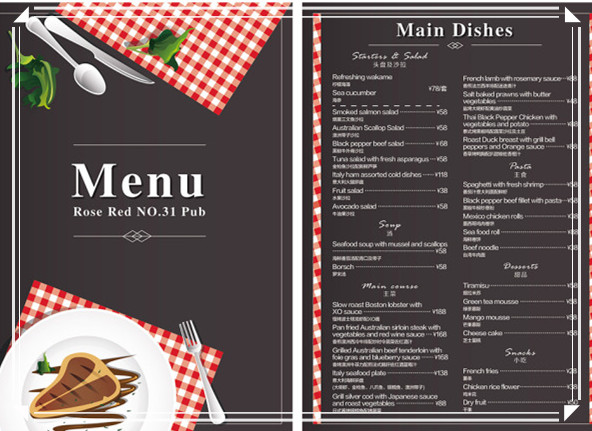
A menu is  菜单是 :

The Statement of the restaurant’s theme
餐厅主题的表述
The Plan for the entire food and beverage operation  
整个餐饮运营的计划
The way to influence guest emotions and behaviors   
能够影响宾客情绪和行为的方式

Moreover a menu should attain marketing objectives, meet quality standards, be cost-effective, be accurate and be appropriate for the operation’s facilities.
此外菜单还应该达成市场目标,满足品质标准,成本合理有效,并准确适用于运营的设备设施。

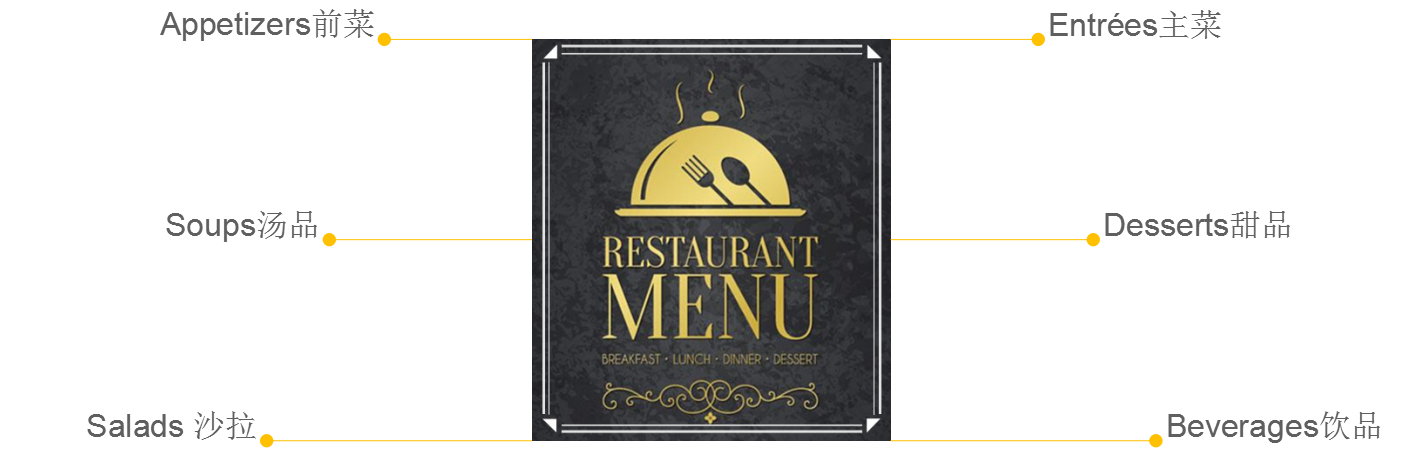
After careful consideration of market needs, guest expectations and the concept, a menu can be planned including several categories:
仔细考察过市场需求、宾客需求和概念之后,可从以下的几个方面策划菜单:

A restaurant may have several meal periods such as breakfast, lunch and dinner.
一家餐厅可能开放多个餐饮时间段,例如早餐、中餐、晚餐等。
In this case restaurants may choose to feature each meal period on a separate menu or others may have a combination menu.
这种情况下,有的餐厅可能选择不同时间段放置不同的菜单,而另外一些可能提供组合菜单。
There is also a wide range of specialty menus such as: desserts, room service, afternoon tea, poolside and many others.
还有一系列的特品菜单,例如甜品、客房服务、下午茶、泳池吧台等等。
Another way to classify menus is to determine whether they are fixed or cyclical.
另一种分类菜单的方法是确定它们是固定的还是周期性的。
Fixed menu doesn’t change from day to day but may feature daily specials.
固定的菜单并不是每天都有变化,但是可能会有每天的特色。
A cyclical menu changes daily for a certain number of days until the menu cycle repeats itself.
周期循环菜单一段时间内每天的菜品不同,菜单循环重复。
This is very common in resort hotels or cruise ships where the length of stay is longer than the average business hotels.
这种菜单常见于度假村和豪华游轮,因其宾客下榻的时间会比一般商务酒店的时间更长。

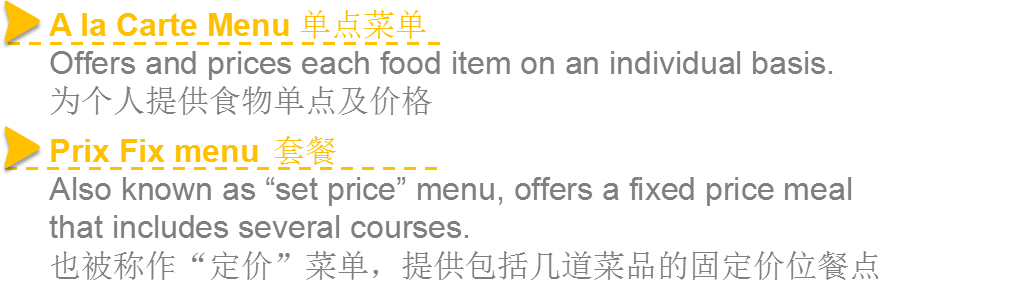
Another popular classification is based on the pricing structures of the menu.
另外一种流行的分类方式是基于菜单的定价结构
Menus are sales tools; so they must be designed to grab the attention of guests quickly, blend with the ambience, décor and theme.
菜单设计销售工具,它们应融合格调、装修和主题的设计,并迅速抓人眼球。

Some rules to follow are   一些可以运用的技巧包括:

Be descriptive by using appealing adjectives
利用吸引人的形容词充分描述菜品

Follow the rules of spelling and typography 
注意拼写和印刷规则

Use coherent colors and fonts
颜色字体要和谐一致

Explain and recommend the highlight items
详细解释并推荐重点菜品

During the restaurant operation each menu is evaluated by studying the popularity and profitability of menu items.
餐厅运营要评估每一个菜单,研究每道菜品的受顾客欢迎程度和利润率。
Popularity refers to how often the menu item is ordered by the guests.
受顾客欢迎程度是指客人点这道菜的频率。
Profitability refers to the high contribution margin of an item.
利润率则是指每道菜品所贡献的毛利。

This evaluation generally is done on quarterly basis and guides the managers to plan further adjustments in order to increase the contribution margin on each menu item.
这一评估通常每季度进行一次,其数据会引导经理作进一步的计划调整,以提高每道菜品贡献的毛利润。
After the evaluation results and consideration of other factors such as external and internal factors, managers may carefully decide to change the menu.
根据评估的结果以及一些其他内部外部因素的考量,经理会慎重决定更换菜单。
The new changes should follow the same pattern of implementation and have to be put smoothly into application without interrupting the business.
新的改变应该遵循同样的实践方式,并在不干扰生意的情况下平稳地实践出来。

We will discuss purchasing Supplies and Equipment in the next section.
下节我们将探讨用品设备。