



目录

  • 1 Chapter 1 – Preparing for a Leadership Career
    • 1.1 Introduction
    • 1.2 Why a Career in Hospitality and Tourism?
    • 1.3 Selecting an Industry Segment
    • 1.4 Types of Available Positions
    • 1.5 Traits of Leaders
    • 1.6 Traditional Management Styles
    • 1.7 Varying your Leadership Style
  • 2 Chapter 2 – Hospitality and Tourism Leadership
    • 2.1 Introduction
    • 2.2 21st Century Leadership Styles
    • 2.3 Leadership Development Goals
    • 2.4 Empowerment
    • 2.5 Showing Respect and Value for Diversity
    • 2.6 Global Guest Audiences
    • 2.7 Welcoming Other Cultures
  • 3 Chapter 3 – Leadership and the Guest Cycle
    • 3.1 Introduction
    • 3.2 Follow the Guest: Making the Cycle Seamless
    • 3.3 Guest Recovery
    • 3.4 Problem Solving
  • 4 Chapter 4 – Managing the Guest Experience Cycle
    • 4.1 Introduction
    • 4.2 Managing the Guest Experience: Being Inclusive
    • 4.3 Guest Experience Property Standards
    • 4.4 Managing the Guest Service Measurement (GSM) Process
    • 4.5 Guest Service Gold: Leading a Gold Team
    • 4.6 Managing Green Practices
  • 5 Chapter 5 – Leadership, Employees and Communication
    • 5.1 Introduction
    • 5.2 Purpose of the Mission Statement
    • 5.3 Communicating Employee Purpose and Role
    • 5.4 Setting Performance Goals
    • 5.5 Listening, Speaking and Writing
    • 5.6 Managing Difficult People
    • 5.7 Guest Communication
    • 5.8 Media Training
  • 6 Chapter 6 – Front Office Leadership
    • 6.1 Introduction
    • 6.2 Responsibilities of the Front Office Manager
    • 6.3 Reports: The Night Audit Paper Trail
    • 6.4 Labor Costs and the Night Audit
    • 6.5 Measuring Employee Performance
    • 6.6 Guests and the Front Desk
    • 6.7 Green Practice Programs for Guests
  • 7 Chapter 7 – Managing Housekeeping Operations
    • 7.1 Introduction
    • 7.2 Being the Executive Housekeeper
    • 7.3 Building a Budget
    • 7.4 Budgeting Labor and Linen Expenses
    • 7.5 Managing Housekeeping Performance Standards
    • 7.6 Training Housekeeping Staff
    • 7.7 Managing Housekeeping Green Practices
  • 8 Chapter 8 – Leadership and Facilities Management
    • 8.1 Introduction
    • 8.2 Function of the Chief Engineer
    • 8.3 Budgeting to Meet ADA Requirements
    • 8.4 Energy Management
    • 8.5 Emergency Systems Planning
    • 8.6 Managing the Facility’s Green Practices
  • 9 Chapter 9 – Food and Beverage Service Leadership
    • 9.1 Introduction
    • 9.2 Organization and Staffing of Food and Beverage Operations
    • 9.3 Menu Management
    • 9.4 Purchasing Supplies and Equipment
    • 9.5 Facility Design, Décor and Cleaning
    • 9.6 Managing Sanitation and Safety
    • 9.7 Labor and Revenue Control
    • 9.8 Nutrition and Sustainable Foods
  • 10 Chapter 10 – Managing Banquets and Catered Events
    • 10.1 Introduction
    • 10.2 Booking and Planning Events
    • 10.3 Reports: Preparing for Service
    • 10.4 Delivering Service
    • 10.5 After Service
  • 11 Chapter 11 – Human Resources
    • 11.1 Introduction
    • 11.2 Interview and Hiring Practices
    • 11.3 Employment Laws
    • 11.4 Managing Compensation and Benefits
    • 11.5 Corporate Social Responsibility
  • 12 Chapter 12 – Managing Operational Finance
    • 12.1 Introduction
    • 12.2 Financial Statements
    • 12.3 Operational Expenses and the Capital Budget
    • 12.4 Revenue Management
    • 12.5 Managing Labor Costs
    • 12.6 Taxes: Reporting and Remitting
  • 13 Chapter 13 – Marketing
    • 13.1 Introduction
    • 13.2 The Marketing Mix
    • 13.3 Steps of a Marketing Plan
    • 13.4 Channels of Distribution
    • 13.5 The Marketing Budget
    • 13.6 Industry Trends and Marketing
  • 14 Chapter 14 – Sales
    • 14.1 Introduction
    • 14.2 Training for Sales Success
    • 14.3 Managing a Sales Team
    • 14.4 Selling to Global Audiences
    • 14.5 Selling to Special Segments
    • 14.6 Selling to the Digital Traveler
  • 15 Chapter 15 – Safety
    • 15.1 Introduction
    • 15.2 Managing Workplace Safety
    • 15.3 Risk Management and Insurance
    • 15.4 OSHA: Following the Requirements
  • 16 Chapter 16 – Security
    • 16.1 Introduction
    • 16.2 Hotel Security: Access Control and Guestroom Security
    • 16.3 Employee Security Issues
    • 16.4 Emergency Management and Media Relations
Responsibilities of the Front Office Manager


The front office in a large hotel supports many positions with a considerable separation of duties.
一家大型酒店的前台支持许多职位,并有相当大的职责划分。
The front office manager position required a very specific set of skills; superior customer service skills and thorough understanding of hotel accounting and general administrative tasks.
前台经理岗位要求一些特定的技能,例如卓越的客户服务技能、对于酒店会计以及日常管理工作的深入理解能力。

The front office manager leads and manages a team of several people at varied positions; uniformed services, cashiers, night auditor, front desk agents, reservation agents and telecommunications.
前台经理领导管理来自不同职位的几人团队,包括礼宾员、出纳、夜审员、前台接待、预订员、话务员、客服和大堂经理等职位。
Depending the size of the hotel and the organization, the front office manager usually reports to the Director of Rooms or Hotel Manager or the General Manager.
依据酒店和公司结构的规模, 前台经理通常向房务总监或酒店经理或总经理汇报。

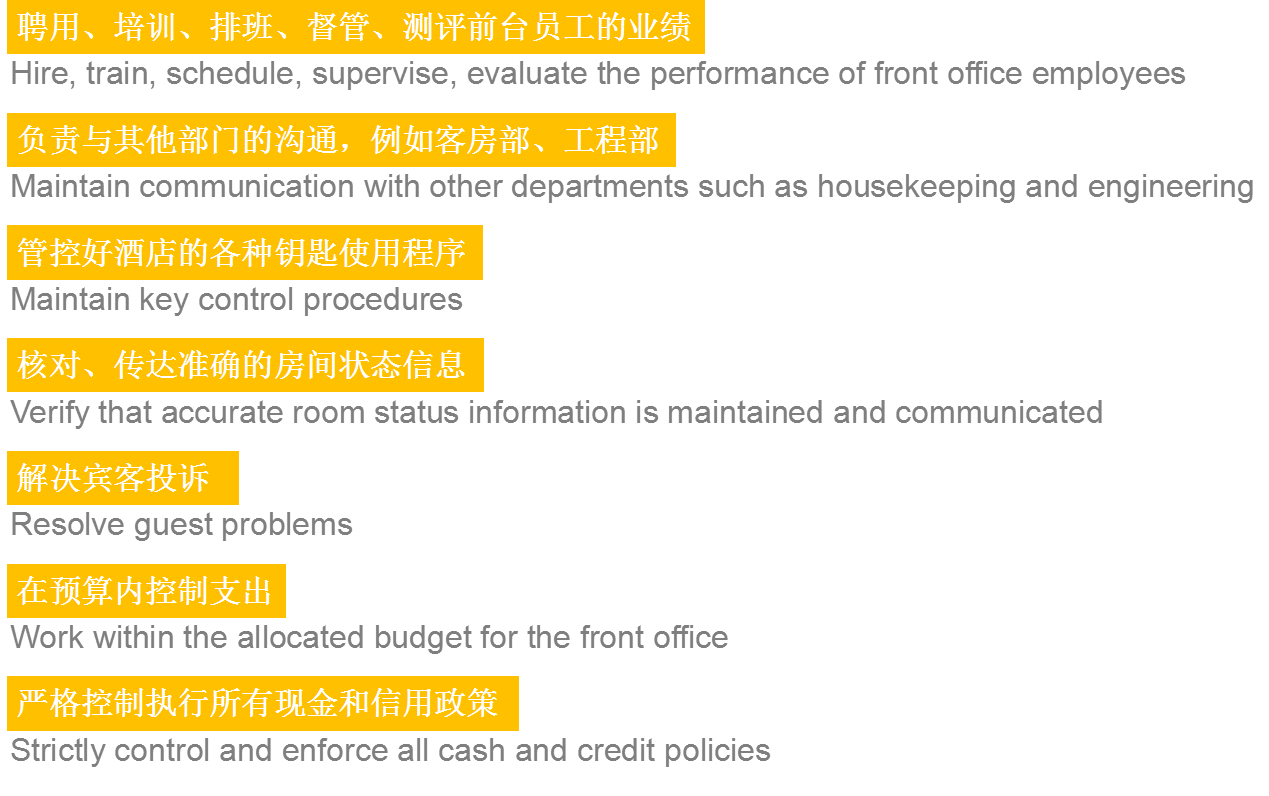
The major duties and responsibilities of the front office manager include:
前台经理的主要职责包括以下:
One of the most important functions of the front office managers is forecasting the number of rooms available for future reservations.
前台经理最重要的职能之一是预测可供将来可用房的房间数量。
Forecasting is the process of analyzing current and historical data to determine future trends, therefore, predicting the volume of business for a particular month, week or day.
通过分析当前的和历史的数据,可以确定未来的趋势,。因此, 可根据特定月份、周或日的业务量来进行预测。

Forecasting is based on the hotel’s overall business plan, market situation and political, economic, social and technological trends known as (P.E.S.T)
预测也要基于酒店的整体经营计划、市场情况和政治、经济、社会和科学技术的发展趋势(也称为P.E.S. T)进行预测。
Forecasting is a difficult skill to develop. This skill is acquired through experience and effective recordkeeping as well as analyzing several reports, charts and data provided by the PMS.(property management system)
想要预测并非易事。通过经验,保持有效记录, 以及分析酒店经营管理系统(PMS)生成的报告、 图表和数据可以不断提高预测的技能。
Data on room availability, revenue, occupancy and scheduling are of utmost importance in the front office department.
在前台部门, 可用的房间数量、营业收入、入住和排班的数据至关重要。
Forecasts will impact the whole operation; therefore, need to be as accurate as possible given the guidelines.
因为预测将影响整个运营,所以要给出尽可能准确的指引。

We will discuss the Night Audit process in the next section.
下一节我们将讨论夜间审核过程。