
旅游英语

宋代艳袁晓菲姜超滕兆娜马静静

目录

  • 1 Unit 1  Preliminary Work 前期工作
    • 1.1 New words and expressions 生词短语
    • 1.2 Types of Tourism 旅游分类
    • 1.3 Warming-up
    • 1.4 Reading A para.1
    • 1.5 Reading A para, 2 3
    • 1.6 Reading A Para.4
    • 1.7 Itinerary
    • 1.8 Booking a Tour 预定行程
    • 1.9 Travel Itinerary 行程安排
    • 1.10 Reply to an Enquiry Email 回复询问信
    • 1.11 Tourism English Writing
    • 1.12 Grammar
    • 1.13 Homework 家庭作业
    • 1.14 Listening 听力练习
    • 1.15 Speaking 口语练习
    • 1.16 Scripts 原文
  • 2 Unit 2 Receiving Tourists 接待游客
    • 2.1 New words and expressions 生词短语
    • 2.2 The procedure of receiving tourists 机场接游客
      • 2.2.1 The importanc of body language
    • 2.3 Welcome Speech 欢迎词
    • 2.4 Emergencies when receiving a tour group 接团突发情况处理
    • 2.5 Forgetting words on the way to the hotel 忘词的处理
    • 2.6 Tour presentation
    • 2.7 The practical application of the tour speech
    • 2.8 Tourism English Writing
    • 2.9 Exercises 练习
    • 2.10 Grammar
    • 2.11 Listening
    • 2.12 Speaking
  • 3 Unit 3 Check-in at the Hotel 酒店入住
    • 3.1 Words and expressions 单词与短语
    • 3.2 Check-in 办理入住手续
    • 3.3 Hotel ads
    • 3.4 Change room 换房间
    • 3.5 Hotel introduction 酒店介绍以及注意事项
    • 3.6 Confirm the itinerary 商定旅游日程
    • 3.7 Career planing
    • 3.8 Grammar
    • 3.9 Tourism English Writing
    • 3.10 Homework 课后作业
    • 3.11 listening
    • 3.12 Scripts
    • 3.13 speaking
  • 4 Food and Beverage Service 餐饮
    • 4.1 New words and expressions生词短语
    • 4.2 Dining in China 食在中国
    • 4.3 Dining in America
    • 4.4 Dinner on the table
    • 4.5 Make Meal Arrangement 餐饮服务
    • 4.6 Confirmation of Food Arrangement &  Event Order确定用餐安排
    • 4.7 Grammar
    • 4.8 Tourism English Writing
    • 4.9 Homework 课后作业
    • 4.10 Listening
  • 5 Sightseeing
    • 5.1 New Words and Expressions
    • 5.2 Famous Scenic Spots in China 国内著名景点
    • 5.3 Sightseeing观光
      • 5.3.1 Natural scenic spots tour presentation
    • 5.4 Scenic Spot Introduction景点介绍
    • 5.5 Email & Travel Guide给游客回复邮件
    • 5.6 Supplementary Reading 扩展阅读
    • 5.7 Writing Memo
    • 5.8 What's in a name?
    • 5.9 Tour presentation writing
    • 5.10 The tour guide quality
      • 5.10.1 General introduction
      • 5.10.2 Meal requirements
      • 5.10.3 Career quality
        • 5.10.3.1 The appearane of the tour guide
      • 5.10.4 Communication skills
      • 5.10.5 Professional ethics
      • 5.10.6 Service standard of the tour guide
        • 5.10.6.1 Check the tour time
        • 5.10.6.2 Hotel service
        • 5.10.6.3 Greetings
      • 5.10.7 Communication skills of the tour guide
      • 5.10.8 Offer service of local guide
      • 5.10.9 Tourism English Writing
      • 5.10.10 Grammar
    • 5.11 Listening
  • 6 Shopping and Entertainment Activities
    • 6.1 New Words and Expressions 生词与短语
    • 6.2 Souvenirs and Entertainment with Chinese Characteristic具有中国特色的纪念品
    • 6.3 Chinese Papercut中国剪纸
    • 6.4 Recommendation of  Souvenirs and Introduction of Entertainment 娱乐介绍与推荐
    • 6.5 Email & Activity Information Form回复信件
    • 6.6 合法、智慧地引导购物 Guiding shopping legally and intelligently
      • 6.6.1 相关法律法规Laws and regulations
        • 6.6.1.1 导游人员管理条例Regulations on Administration of Tour Guide
        • 6.6.1.2 旅游法Tourism Law
      • 6.6.2 案例材料 Case Material
      • 6.6.3 促进购物的方法Ways to Promote Shopping
      • 6.6.4 导游引导购物
        • 6.6.4.1 导游在游客购物活动中的作用
        • 6.6.4.2 游客购物形态
        • 6.6.4.3 旅游购物相关知识
        • 6.6.4.4 引导购物服务流程
        • 6.6.4.5 引导购物注意事项
      • 6.6.5 引导购物双语表达Bilingual Expressions
      • 6.6.6 实训练习Training Practice
    • 6.7 Grammar
    • 6.8 Tourism English Writing
    • 6.9 Homework
    • 6.10 Listening
  • 7 Seeing off Tourists 送别游客
    • 7.1 New words and expressions单词与短语
    • 7.2 Background Information背景信息
    • 7.3 Preparations for the Departure of a Tour Group送团前的准备
      • 7.3.1 A farewell speech送团告别演说
    • 7.4 Dialogues About Seeing off Tourists关于送团的对话
      • 7.4.1 departure arrangement出发安排
      • 7.4.2 luggage collection提取行李
      • 7.4.3 hotel checkout酒店退房
      • 7.4.4 check in luggage at the airport在机场登记行李
      • 7.4.5 delivering a farewell speech发表告别演说
    • 7.5 How to write a farewell speech怎样书写送团告别演说词
    • 7.6 Further reading:Matters that Need Attention at the End of a Tour旅游结束后注意事项
    • 7.7 Project Practice项目练习
    • 7.8 Tourism  Englsih Writing
    • 7.9 Grammar
  • 8 Follow-up Work
    • 8.1 New words and expressions单词与短语
    • 8.2 Background Information背景信息
    • 8.3 Six work about follow-up work六项后续工作
    • 8.4 Getting feedback from client向客户获得反馈
    • 8.5 Getting feedback from tour leader向领队获得反馈
    • 8.6 Dealing with Complaints处理投诉的一系列对话
    • 8.7 Customer service
    • 8.8 Video about how to deal with complaint phone如何处理电话投诉的微课
    • 8.9 A letter of complaint
    • 8.10 How to reply a complaint letter
    • 8.11 A complaint letter and A reply to a complaint letter
    • 8.12 Make questionnaire
    • 8.13 Tourism English Writing
    • 8.14 Project practice项目练习
    • 8.15 Grammar
Scenic Spot Introduction景点介绍


Task 1:

The local guide Zhang Li meets Mr. Smith, the tour leader, in the lobby while waiting for the tourists. Listen to the conversation between them and complete the note below.


Task 2:

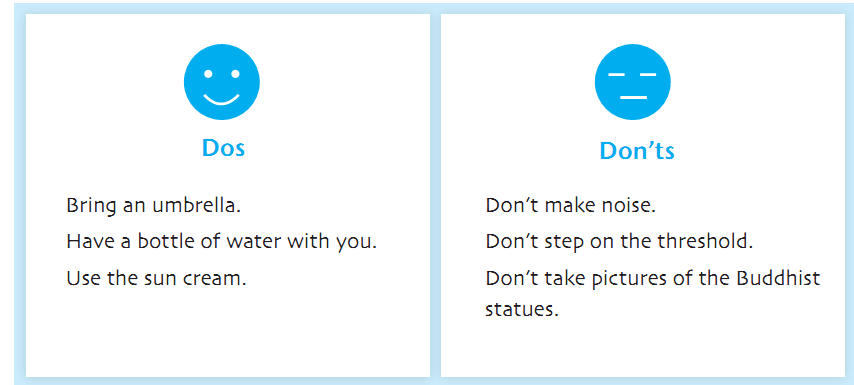
Suppose you are a tour guide. Before visiting a temple, you should tell the tourists the dos and don'ts. Practice making a brief speech according to th information below.

Task 3:

Zhang Li is telling the tourists about the Yuyuan Garden and answering some questions. Listen to the conversation and choose the best answer to each of the following sentences.


1.  Yuyuan Garden is __________old.

  A. more than 400 years    B. nearly 400 years

  C. more than 600 years    D. nearly 200 years

2._________ , Yuyuan Garden was badly damaged.

  A. In 1577   B. During the Ming Dynasty

  C. During the Qing Dynasty   D. During the Opium War

3.Visitors are often struck by the unique_________  of  Yuyuan  Garden.

  A. structure and layout    B. structure and color

  C. architecture and layout   D. architecture and color

4.  Zhang Li suggests tourists go to the________for a bird’s-eye view of the whole garden.

  A. fourth floor                                         B. top floor

  C. top of the small hill in the garden      D. pavilion of a hill

Task 4:

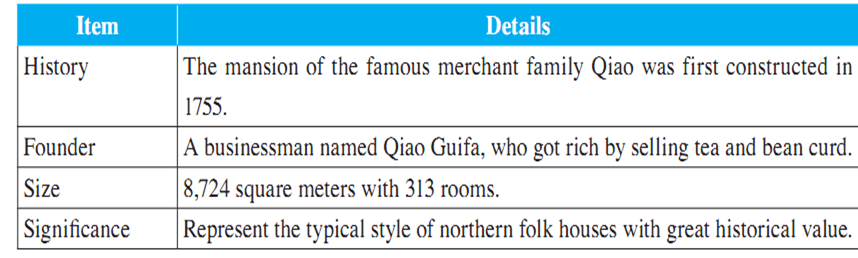
Suppose you are a tour guide, and you are introducing Qiao's Family Compound(乔家大院)to your tourists. Practicce making an introduction of the compound according to the information below.


Suggested answers:

Task 1:

Time for leaving the temple: 8:30 a.m.

Time for visiting the temple: 3:00 p.m.

The things that is not allowed in the temple: taking photographs

Things tourists should bring: umbrellas or raincoats


Task 2:

 Ladies and gentlemen, we are going to visit the Lingyin Temple tomorrow. And I'd like to take a few minutes to tell you about the dos and don'ts of visiting there. First of all, please don't make noise. When you need to talk, do lower the voice. Remember not to step on the threshold when you enter the temple. And don't take pictures of Buddhist statues. The weather in this season is changing constantly. It might be very sunny in one moment, but in the next moment rains may pour down. So, remember to bring an umbrella and use some sun-cream to protect you from the sunshine. No matter it rains or not, it will still be very hot tomorrow. So, please have a bottle of water with you.


Task 3:

Key

1. A      2. D      3. C       4.B

      Task 4:

      Ladies and gentleman, now we arrive at the famous Qiao's Family Compound. This mansion used to belong to the famous merchant family Qiao. It was first constructed in 1755. Its founder is a successful businessman named Qiao Guifang, who got rich by selling tea and bean curd. Now the whole compound covers 8,724 square meters with 313 rooms. Its architectural design represents the typical style of northern folk houses, and therefore it has great historical value.


Task 1 script:

ZhangLi: Good morning, Mr. Smith.

Mr.Smith: Good morning, Ms. Zhang.

ZhangLi: Did you sleep well last night?

Mr.Smith: Very well, thank you. May I have a look at the schedule, please?

ZhangLi: Yes, here you are.

Mr.Smith: Ah, we’ll visit the temple at 3:00 pm. I understand that people can’t take photographs in Buddhist temples. Is that true?

ZhangLi: Yes. According to local beliefs, the statues inside the temple should not be photographed, but you can take pictures outside the buildings.

Mr.Smith: All right. I’ll tell the group when we get there.

ZhangLi: Good. Also, I think we’d better remind everyone to bring umbrellas or raincoats with them because there is a rain forecast today.

Mr.Smith: Thank you. I’ll tell everybody now.

ZhangLi: So we can all have breakfast and be ready to leave at 8:30, is that OK?

Mr.Smith: Yes, see you later then.

ZhangLi: See you.

Task 3 script:

ZhangLi: Well, here we are. This garden is called Yuyuan. As I said, it was completed in 1577 which makes it pretty ancient. More than 400 years old!

Tourist:Wow, so old! Can we take photos here?

ZhangLi: Sure. You’ll find it is very photogenic.

Tourist: So apart from being old, why is it so famous? Can you tell us something of its history, please?

ZhangLi: Of course! It was constructed during the Ming Dynasty, and then it was badly damaged during the Opium War. But as you can see it has been reconstructed and repaired and now looks very beautiful again.

Tourist:  I guess it was difficult to restore?

ZhangLi: Yes. The garden is only several hectares in area—very compact. Visitors are struck by its unique architecture and layout.

Tourist:Well, it is indeed very attractive! 

ZhangLi: Look there. That’s Overlooking Hall. As you can see, it is a three-story building. Shall we go up to the top floor for a bird’s-eye view of the whole garden?

Tourist:That sounds like a good idea.