B&R and Intercultural Communication
At present, the world is undergoing a period of great change in which the trends of economic globalization and multi-polarization are continuing to accelerate. Against this backdrop, perceptions of countries are determined by a number of factors, including the state of their development and the influence of their cultures, social systems, and ideologies. The reform and opening up drive has not only brought about the enormous success of China’s development but has also fundamentally changed the way that China interacts with the rest of the world. As China’s international standing and influence continue to command greater attention from the international community, more and more countries are actively seeking to enhance ties with China. However, prejudice, misunderstanding, and suspicion are still commonplace in international perceptions of China.
What roles the Chinese college students, the future global citizens of the world, can play in international interactions to defend China's national image in the world? What should be done and who could do more to convey China's voice?
Here is a model we can follow:
Intercultural Scenario
---Media professionals could do more to convey China's voice
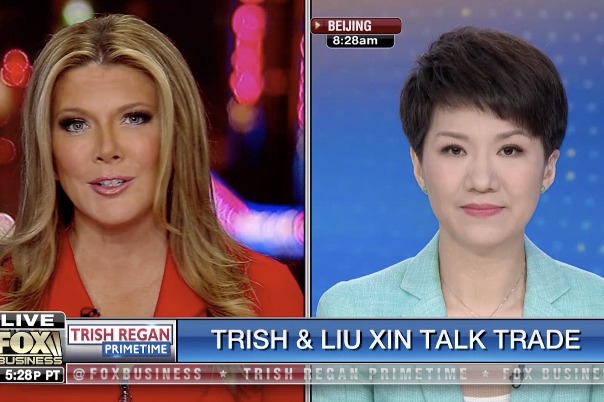
On May 30, 2019, China Global Television Network(CGTN) anchor Liu Xin joined Fox Business Network host Trish Regan on her primetime show for a live television discussion on China-U.S. trade issues.
On September 3, Liu Xin again attracted global attention by discussing hot issues with CNBC's Seem a Mody in a"Squawk on the Street" interview, during which she addressed questions regarding the Sino-U.S. trade war and Hong Kong protests with a confident and graceful presence.
This is the second time that Liu Xin has sent out her Chinese opinion on crucial issues as a guest in the American mainstream media.
Particularly after the first-time discussion between Liu Xin and Trish Regan, there have been more comments and views over Liu Xin’s performances, but not much has been evaluated in terms of the significance or effect of the television discussion.
(Highlights of CGTN anchor Liu Xin, Fox host Trish Regan discussion)
Reflecting from an intercultural perspective:
1. When Liu Xin and Tracy Regan’s discussion was broadcast live, what effect would the live discussion produce in the world, particularly in the United States?
Intercultural tips: More and more Americans would hear Liu Xin’s voices and views on the issues American people are interested in, which could help them at least perceive those issues, not from a one-sided perception. Though it would be impossible for American people to change their minds or views, however, that might be the first time for some of them to hear the other sided views, such as:
Tracy Regan might assume that all Chinese people are members of the Communist Party of China, so Liu Xin must be a member of the Communist Party. Moreover, she works for the Chinese media.
Liu Xin claims that she is here to speak for herself as a CGTN anchor, indicating she has the freedom to speak for herself, while Tracy might think China is a collectivistic country, so media people have no freedom to speak for themselves.
When Trish Regan asks Liu Xin to define state capitalism, Liu Xin defines it as socialism with Chinese characteristics, claiming we are a socialist economy with Chinese characteristics, but we are not just state-controlled, we are quite mixed, very dynamic, and very open as well.
Though it might be harder for capitalist countries to understand the new term, socialism with Chinese characteristics, scholars, however, would take it for their research topic and would try to discover what it is and how it is practiced in China, which could help them finally understand how China took 40 years to become the second world economic power in the world.
2. In order to help the world understand China, what should Chinese people do?
Intercultural tips: As Chinese scholars or students or citizens, we should explain what we are asked about any issues foreigners would like to know. If we avoid those issues, misunderstandings would occur because foreigners would take it for granted that this is the real issue China has, because Chinese people try to avoid those issues. So it is all citizens’ responsibility to present the real China to the world and help the world understand what China is. Only in this way can some misunderstandings be avoided.
The point we want to say is that China needs PUBLIC DIPLOMACY than ever before!
Intercultural Puzzle
Fu Ying, Former Vice Foreign Minister of China, once attended the conference in Washington. When she heard some negative stories about China or when she was asked about China, she would always make efforts to present real stories about China to the world. However, some American Journalists kept arguing with her, claiming their views to be evident based, though she explained some issue to them and supported her arguments with facts and figures, some journalists had no intention to listen to her. Finally one of the journalists replied to her by saying Chinese young people may know more about the world, and they would make a change in the future. Then Fu Ying replied to that journalist by saying you could ask Chinese young people. The journalist turned to her assistant (a Chinese student studying in the States, and also an assistant to her visit to the United States.) and asked for his view by saying “You have stayed in the States for some years and known China and America. Don’t you feel that China have a lot of problems”? The student responded by saying “When I was in China, I saw a lot of problems in China, but thinking the United States would be better. Now I am studying in the United States, but I still find a lot of problems here too. What I am thinking is how to solve these problems so as to make the world much better.” “This young man’s saying should let us ponder what we should do when we face problems”. Fu Ying commented.
Today when Fu Ying recalled her experience in the States and also the young man’s response to the journalist’s request, she got enlightenment that the world would see what China is when all Chinese people could do all they would to present real China to the world.(Interculturaltips: This case implies the significance of the communication between ordinary people and foreign media outlets and non-governmental individuals do matter a lot in promoting Chinese public diplomacy.)
Analyzethe issues in the case
China’s public diplomacy overview:
http://english.qstheory.cn/international/201109/t20110924_112601.htm
Additional Resource:

