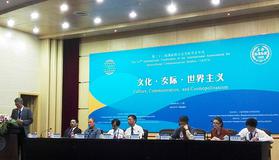
B&R and Intercultural Communication
China has a cultural heritage of opposites creating balance. For example, crisis in Chinese, 危机, consists of two characters, wei and ji, to represent ‘peril’ and ‘opportunity’. The ancient Silk Road, which extended from China to as far as Europe and Africa, made possible a boom in trade and cultural exchanges. Today, people are still exploring the legacy and rediscovering its value. This is where the BRI, the new Silk Road, gets started: promoting cultural exchange among nations and the common development and prosperity of the human race along the Silk Road Economic Belt and the 21st-Century Maritime Silk Road by inheriting and passing on the spirit of the ancient Silk Road i.e., peace and cooperation, openness and inclusiveness, mutual learning and mutual benefit.
Unfortunately, the West has not made a serious effort to understand a Chinese perspective, and to a great extent has not appreciated that an alternative understanding exists. Confucius said: “Real knowledge is to know the extent of one’s ignorance.” The West, with its Western-centric approach, through its ignorance and failure to understand China, has placed itself in peril of being left behind in a newly emerging world order. Whether it is a "peril" or an "opportunity" depends on what perspective you take.
But we know at least what we can or should do to build a more peaceful and harmonious world as intercultural learners and global citizens.
The ancient Silk Road started intercultural communications more than 3,800 years ago, and today the story is ongoing...
Intercultural Puzzle
----- One-Child Policy
Liu Yiqi is a student from China and now he is studying in the University of Southern California, in the USA. He was repeatedly asked about China's birth-control policy by his classmates. At first, he was not sure why people were so concerned with this policy and he didn't know how to answer them. Later he came to understand it. Once he was asked about the policy again, and he replied as follows:
(P for Peter, his American classmate; L for Liu Yiqi)
P: Hi, Li. Do you have any brothers or sisters at home?
L: No, I'm the only kid in my family.
P: Oh, I see. Your parents can only have one kid, as is required by your birth-control policy. It's a pity.
L: Yeah, It's a pity. But you see, when any policy is made, many factors must be taken into consideration, including its necessity and feasibility, its influence on people's life and the development of the country.When the birth control policy was adopted in China, the Chinese people were struggling for their survival and the huge population had become a burden in their fighting against poverty. So, considering the limited means of subsistence and the low productivity level at that time, the Chinese government had to adopt the birth control policy. And, by reducing the birth rate, the Chinese people did enhance their economic level and well-being rapidly in the following decades.
P: But we believe the right of life should not be deprived. People should have the right to decide when to have a kid or how many kids to have.
L: I agree with you. We do cherish the right of life. But there are also other rights to be respected. For example, as your president Roosevelt said, “freedom from want”. To a government, if it fails to guarantee the new lives the “freedom from want” in a certain period of time, why can't it choose to promote the well-being of the people first?
P: That makes some sense. But what if people do want to have more than one kid? Don't you think it's cruel to rob them of their opportunity to have their own kid? Don't you think it's ruthless for a government to force them to have only one kid?
L: Policies are not immutable and frozen. They change with the time. In fact, the one-child policy has been reformed in China. People can have more than one kid, if they choose to.
P: Oh, I'm happy to hear that.
Questions for Intercultural Understanding:
Understanding Chinese Culture: the Challenges to the West

