Intercultural Adaptation
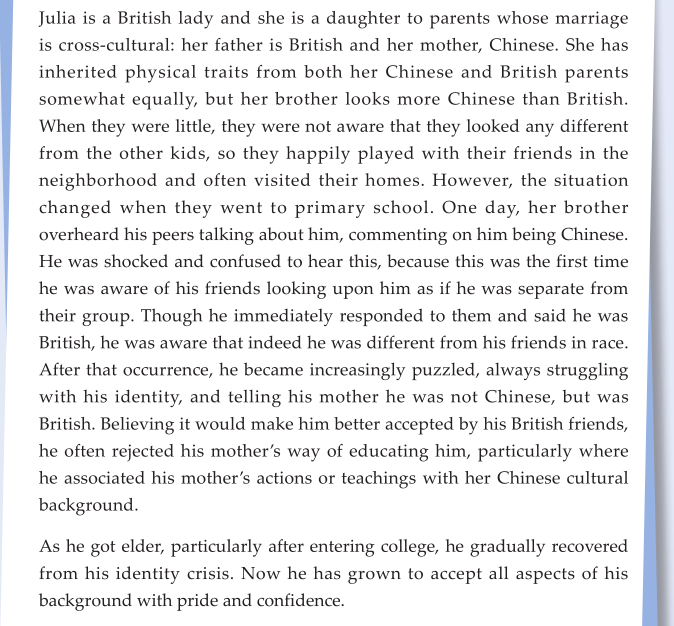
Case Analysis: Struggle for his identity in the U.K.
Check your comprehension by choosing A, B, C, and / or D. You can choose more than one choice for the appropriate answer.
Intercultural Puzzle ----Student and Teacher Role Position
Since roles are prescribed with whom, about what, and how people communicate, differences in the four-role dimensions manifest themselves in communication. Below are two intercultural interactions between a student and a teacher. Scenario A is between a student and a teacher in the United States. Scenario B is between a student and a teacher in China. In each case, the student wishes to speak to the teacher about an assignment.
Scenario A
Jeff: (approaches, Dr. Philip’s office unannounced) Hey, Doctor. P., how’s it goin’?
Dr. Philip:Hey, Jeff, what’s up?
Jeff:(steps into the office) I thought I would stop by an’see if I could talk to ya about my paper assignment.
Dr. Philip:Sure, c’mon in, have a seat. What are you thinking about?
Jeff:Well…I’m kinda havin’ some trouble coming up with a topic. Do you have any ideas?
Dr. Philip:I suggest doing something that’s very interesting to you, otherwise the assignment might bore you to death. Stay away from topics that you have very little research associated with them. Also… you might try doing a search on the Internet. Sometimes you’ll find topics that you might not ever have thought of yourself.
Jeff:Yeah … that's a good idea. If I find somethin’, can I stop by and show it to you before I get started?
Dr. Philip: Sure, just stop by or leave a message my voice mail.
Jeff: OK, yeah. OK, well … thanks a lot.
Dr. Philip:Sure.
Scenario B
Ming Wang:(approaches Dr. Ding’s office and knocks on the door) Good morning, Professor Ding.
Dr. Ding:Hello, Xiao Wang.
Ming Wang:I'm here for my appointment.
Dr. Ding: Yes.
Ming Wang:May I come in?
Dr. Ding:Yes.
Ming Wang:Thank you (enters Dr. Ding's office). I'm here to approve my topic for the research paper assignment, as you requested.
Dr. Ding:Yes, what have you decided?
Ming Wang:I would like to research the natural resources of northern India, if that is acceptable.
Dr. Ding: Yes. That topic is fine.
Ming Wang:Thank you for seeing me this morning.
Dr. Ding:Yes, you are welcome. Good day.
Questions for Intercultural Perspectives:
More readings for your understanding of the section.

