
Nonverbal Communication
Proxemics
Proxemics is the study of how human beings and animals use space in communication process.Proxemics is concerned with interpersonal communication space. E. T.Hall called this informal space and divided it into four conversational distances:(1) intimate, (2) personal, (3) social, and (4) public. Space also variesacross cultures. Usually, cultures that stress privacy, individualism and competitiondemand more personal space than collective cultures. The same is true with thereactions when the personal space is violated. People who stress individualismtend to take an active and aggressive stance. Space is one powerful part of nonverbal communication. Becoming more aware of the specific cultural norms governing territory and interpersonal communication space is an aspect of intercultural competence, while avoiding stereotypical expectations of proxemic norms in a particular culture.
How does space influence intercultural communication? Here is a story:
Conversational Distance
When a Chinese teacher did his research in the United States a few years ago, an American professor invited him to attend a party in his house.The professor lived not far away from the university, and the Chinese teacherhas been to the professor’s house before, so he got there at the appointed time. But he found only a few people there already, each being busy with the preparation for the party. Then he greeted the professor and his wife, and talked with each other for a while, soon the professor asked him to take care of himself and he went to do something else, leaving the Chinese teacher alone. Just at that moment the Chinese teacher found himself alone and awkward, and thought why they did not prepare the party earlier.
About half an hour later, the preparation was almost finished and visitors started to arrive one after another.
When the party started, everyone took food on his or her plate and found his or her place to talk to other people. The Chinese teacher went to a group of people and talked with a lady, who showed her strong interest in Chinese culture. Though they met only once on this occasion, they seemed to have known each other well. They stood chatting, all of a sudden, he noticed that they had moved to other place in the big living room. And finally he came to realize that both of them had adjusted his or her conversational distance so that each person found his or her comfort zone in conversation. The Chinese teacher noticed that the American lady was trying to keep a distance by moving forward to him, while the Chinese teacher moved backward a bit so that he would feel comfortable for conversation. Throughout their conversation, both of them tried to adjust his or her conversational distance for each other's comfort.This embarrassing and fascinating conversation experience in the United States inspired the Chinese teacher's curiosity to discover the cultural factors behind in intercultural communication.
Questions for Intercultural Understanding. Check your comprehension by choosing A, B, C, and / or D. You can choose more than one choice for the appropriate answer.
Space and Communication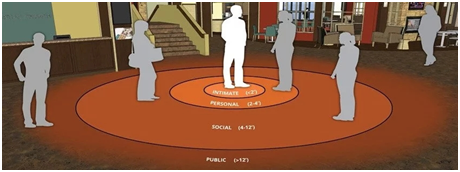
Learn more about space and intercultural communication:

