PartA Listening Practice
Dialogues
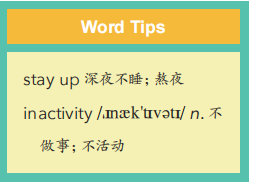

Task Listen to the short dialogues and choose the best answer according to what you have heard.
1. A) Jane may be caught in a traffic jam.
B) Jane should have started a little earlier.
C) He knows what sort of person Jane is.
D) He is irritated at having to wait for Jane.
2. A) The man is a diligent student.
B) The man has bad study habits.
C) The man has made a mess of his midterm exam.
D) The man is usually the last to hand in his test paper.
3. A) They go and climb Mount Tai.
B) They have to catch the train.
C) They should not believe weather forecast.
D) They have to set off early.
4. A) The talks can be held any day except this Friday.
B) He could change his schedule to meet John Smith.
C) The first-round talks should start as soon as possible.
D) The woman should contact John Smith first.
5. A) Procrastination is better than being lazy.
B) Procrastinator fills his day with high-priority tasks.
C) Procrastination usually involves ignoring an important task.
D) Procrastinator gets on with the important tasks already on the list.
Conversation
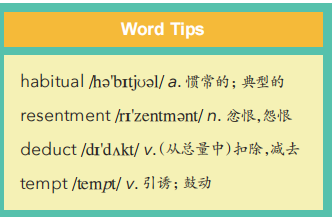
Task 1 Listen to the conversation and choose the best answer according to what you have heard.
1. What might be the reason for Mark’s problem?
A) He feels angry
B) He needs attention.
C) He’s too quiet.
D) He’s very nervous.
2. What do we learn about Mark’s unusual behavior?
A) He’s late for social occasions but not for work.
B) He’s a quiet person but likes to make grand entrances.
C) He expects others to be on time but usually late himself.
D) He loses pay for being late for work but doesn’t seem to mind.
3. What solution does the woman sometimes consider?
A) Trying to get Mark to talk about his problem.
B) Helping Mark relax and be more comfortable in a group.
C) Leaving a message to Mark instead of waiting for him.
D) Telling Mark to come earlier than the planned meeting time
Task 2 Listen to the conversation again and fill in the blanks according to
what you have heard.
1. Mark really needs to read this article in Psychology ______.
2. People who are always late often do it for a______ .
3. I think it’s because he wants to be_______.
4. What gets me is that he’s late for his friends______ .
5. Sometimes I’m______ to tell him to come at 7 and everybody else at
7:15.
Task 3 Give a short talk about your own experience with procrastination and how it made you feel.
Cues:head for serious consequences, time procrastination, stressed-out, burnt-out, survive, the most hectic time of my life.
Passage
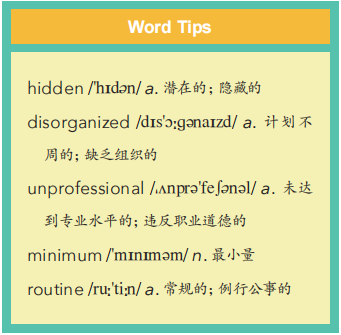
Task 1 Listen to the passage and choose the best answer according to what you have heard.
1. According to the passage, “procrastination is bad”means__.
A) we are willing to do work.
B) we are able to plan or organize well.
C) we are giving little attention to what we are doing.
D) we are behaving according to the expected standards in our
profession
2. Procrastinating can bring us some benefits EXCEPT __.
A) waiting until the last minute forces us to focus
B) lack of time makes us work faster
C) procrastinating forces us to lower our expectations
D) procrastinating makes must-do tasks seem easier
3. The passage mainly talks about __.
A) we should become more creative and efficient
B) we should learn how to overcome procrastination
C) there are times when we fear failing at a given task
D) there are times when procrastination can work in our favor
Task 2 Listen to the passage again and complete the notes by filling in the blanks.
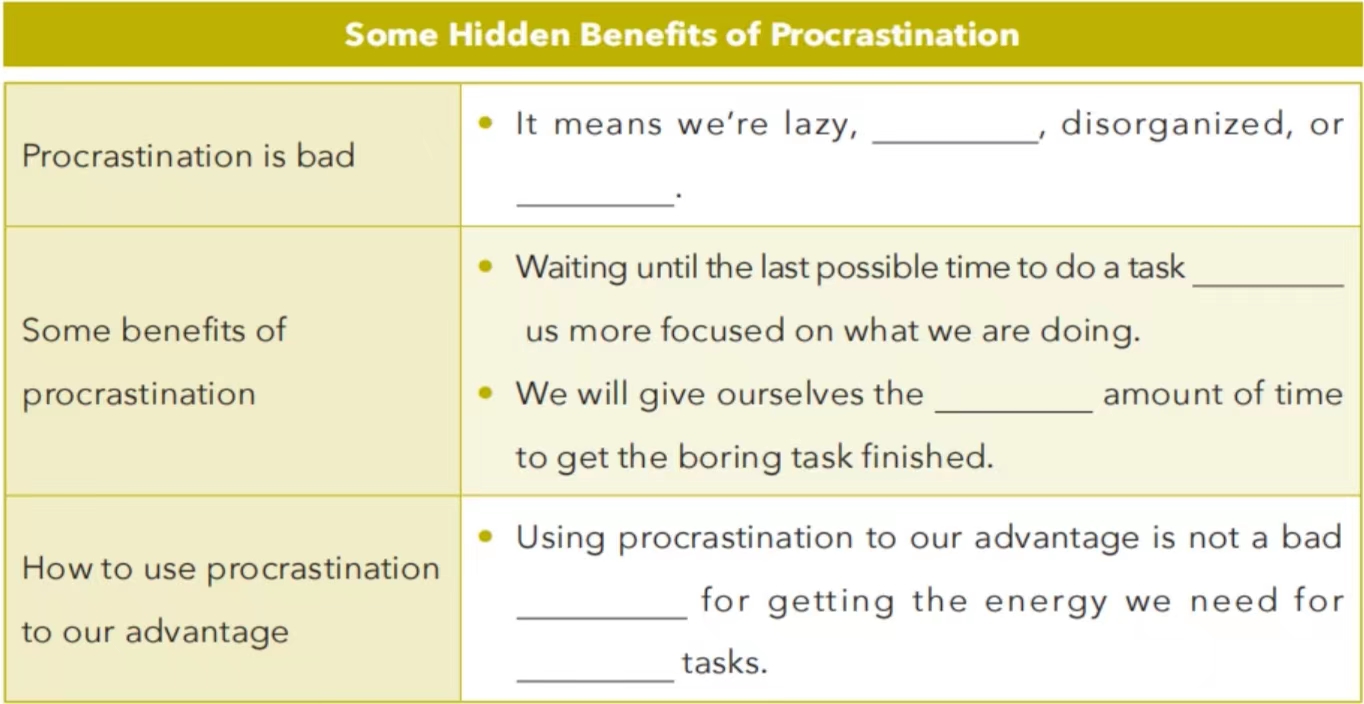
Task 3 Retell the passage according to the notes above with the help of the key words and expressions below.
Cues:be treated as a bad thing,some bright sides,wait until the last minute,focus on what we are doing,lack of time,work efficiently,make other things seem easier,lower our expectations,in one's favor,work for.

