类别:传统美术
出处:http://www.gdsqyg.com/agdfyzg/mingluinfo?mlproid=2018012961405326
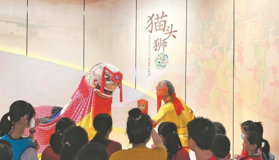
简介:和平县位于亚热带季风气候区,自古以来这里的山山水水不但滋长万物,更适宜人类生息繁衍。在数千年的历史长河中,先民们在此创造了辉煌的文明,为我们留下了丰富的历史文化遗产。据《肖家族谱》记载,公元 1444 年的兴宁肖德茂来到南坝村学东片定居,同时也将客家特色龙、狮制作技艺带到南坝,从此,肖家对此技艺传男不传女,代代相传至今。由于年代久远,加上各种历史原因,目前和平县贝墩南坝村、树华村等只有 10 多人懂此技艺,其中,肖金兰的手艺最好,他不但精于此道,还一通百通,自行摸索出一套纸马、黄龙、凤凰的制作技艺。和平县猫头狮既异于北狮,也不同于南狮,形猫似狮,狮头正额写有一个金光闪闪的“王” 字,狮面牙尖,鼻高,眼大,眉显,整个狮头上绘有七彩龙、凤、梅、兰、竹、菊、八仙的法器及海浪、浮云,使狮头在威武中透着和善,在凝练中显出生机,活脱脱彰显着客家人在不断的迁徙中积极应对自然挑战豪情。客家猫头狮制作汇聚了泥塑、绘画、裱糊等民间工艺,须具备一定的美术基础,共有取泥、塑坯、上纸、点画、上油等五道工序。和平猫头狮所用的色彩和西藏的唐卡相类似,颜料全为天然矿石、树汁提取,色泽艳丽,经久不褪。猫头狮的色彩主要以金色、蓝色、绿色、黑色等为主,线条粗犷,表情夸张,威猛之余渗透出温驯可爱的一面。和平县猫头狮曾参加 2006 年 6 月广东省首届非物质文化遗产保护成果展,实物被广东省博物馆收藏。
英译:Heping County is located in a subtropical monsoon climate zone. Since ancient times, itsmountains and rivers have not only nurtured all living things but also provided a suitableenvironment for human habitation and reproduction. Over thousands of years of history, theancestors here created a brilliant civilization, leaving us with rich cultural heritage. According to the "Xiao Family Genealogy," in the year 1444 AD, Xiao Demao fromXingning Coonty came to settle in Nanba Village of Dongpian, bringing with him the distinctiveHakka craftsmanship of making dragons and lions. Since then, the Xiao family has passed downthis craft from father to son, generation after generation. Due to its ancient origins and varioushistorical reasons, currently, there are only about ten people in Beidun Nanba Village and ShuhuaVillage in Heping County who understand this craft. Among them, Xiao Jinlan has the best skills. Not only is he adept at this craft, but he also innovatively developed a set of techniques for16making paper horses, yellow dragons, and phoenixes. The Cathead Lion of Heping County is distinctive, different from both northern and southernstyles. The lion head resembles a cat but also a lion, with the character "王" (king) prominentlydisplayed on its forehead in glittering gold. The lion's face has sharp teeth, a high nose, large eyes, and pronounced eyebrows. The entire lion head is adorned with colorful depictions of dragons, phoenixes, plum blossoms, orchids, bamboo, chrysanthemums, the Eight Immortals' magicalinstruments, as well as waves and floating clouds. This design makes the lion head exude kindnessamidst its majesty, and vitality amidst its refinement, vividly showcasing the Hakka people'sproactive response to natural challenges during their migrations. The making of Hakka Cathead Lion in Heping County combines clay sculpture, painting, andmounting, requiring a certain foundation in fine arts. The process involves five main steps: claypreparation, sculpting, paper mounting, painting, and varnishing. The colors used, similar toTibetan Thangka paintings, are derived from natural minerals and tree sap extracts, ensuringvibrant colors that do not fade over time. The lion head's colors primarily include gold, blue, green, and black, with bold lines and exaggerated expressions, combining fierceness with a gentle andadorable appearance. Heping County's Cathead Lion participated in the first Guangdong Provincial IntangibleCultural Heritage Protection Achievement Exhibition in June 2006 and are now preserved in theGuangdong Provincial Museum.

