
目录

  • 1 关于课程
    • 1.1 教学指引
  • 2 学生优秀作品展示
    • 2.1 Organ Transplant
      • 2.1.1 Organ Transplant (Group 2,临床7-8班)
      • 2.1.2 Organ Transplant (Group 1,药分9-10班)
      • 2.1.3 Cloning & Transplantation (Group2,医技1-2班)
      • 2.1.4 Cord Blood Transplantation (Group 1,临床7-8班)
      • 2.1.5 3D Printing Technology in Organ Transplantation (Group 8,医技1-2班)
      • 2.1.6 A Pig Heart (Group 2,药分9-10班)
    • 2.2 Influenza
      • 2.2.1 Influenza  (Group 1,医技1-2班)
      • 2.2.2 Spanish Influenza (药分9-10班)
      • 2.2.3 Avian Influenza  (Group 6,医技1-2班)
      • 2.2.4 The Avain Virus - H1N1(Group 4,临床7-8班)
      • 2.2.5 Swine Influenza (Group 3,临床7-8班)
      • 2.2.6 The Similarities and Differences Between Flu and COVID-19 (Group 7,药分9-10班)
      • 2.2.7 Differences and similarities (Group 3,临床7-8班)
      • 2.2.8 Cold vs Flu vs Covid-19 (Group 4,中制17-18班)
      • 2.2.9 Cold vs Flu vs Covid-19 (Group 5,药分9-10班)
      • 2.2.10 Cold vs Flu vs Covid-19 (Group 10,临床7-8班)
    • 2.3 Autism
      • 2.3.1 Autism (Group 10,临床7-8班)
      • 2.3.2 Autism (Group 3,医技1-2班)
      • 2.3.3 Autism Spectrum Disorders (Group 6,药分9-10班)
      • 2.3.4 Asperger‘s Syndrom (Group 6,医技1-2班)
      • 2.3.5 Asperger‘s Syndrom (Group 8,中制17-18班)
      • 2.3.6 Therapy for Autism (Group 9,护理1-2班)
      • 2.3.7 Treatment for Autism (Group 9,临床7-8班)
      • 2.3.8 Animal therapy for Autism (Group 3,药分9-10班)
      • 2.3.9 Care For Autistic Children (Group 8,智工11-12班)
    • 2.4 First Aid
      • 2.4.1 A Brief Introduction to First Aid (Group 2,医技1-2班)
      • 2.4.2 First Aid(Group 2,智工11-12班)
      • 2.4.3 First Aid(Group 3,临药15-16班)
      • 2.4.4 CPR(Group 6,临床7-8班)
      • 2.4.5 First Aid in Fires(Group 3,临药15-16班)
      • 2.4.6 First Aid in Water Incidents(Group 5,信管3-4班)
      • 2.4.7 First Aid in Electrical Incidents(Group 2,健管3-4班)
  • 3 Unit 1 Organ Transplant
    • 3.1 Micro-lectures
      • 3.1.1 Vocabulary
      • 3.1.2 Subjunctive Mood
      • 3.1.3 Sentence Analysis
      • 3.1.4 Coherence
    • 3.2 Text Book
      • 3.2.1 Info-storm
      • 3.2.2 Watching-in
        • 3.2.2.1 Watching-in -1
        • 3.2.2.2 Watching-in -2
      • 3.2.3 Pre-reading
        • 3.2.3.1 Pre-reading -1
        • 3.2.3.2 Pre-reading -2
        • 3.2.3.3 Pre-reading -3
      • 3.2.4 Critical Reading
      • 3.2.5 Speaking Out
      • 3.2.6 Pros/Cons
        • 3.2.6.1 Pros/Cons -1
        • 3.2.6.2 Pros/Cons -2
      • 3.2.7 Outcome
    • 3.3 More About the Topic
    • 3.4 Reading Practice
    • 3.5 Tips for CET 6
  • 4 Unit 2 Influenza
    • 4.1 Micro-lectures
      • 4.1.1 Vocabulary
      • 4.1.2 Postpositive Attributes
      • 4.1.3 Sentence Analysis
      • 4.1.4 Coherence
    • 4.2 More About the Topic
    • 4.3 Reading Practice
    • 4.4 Tips for CET 6
  • 5 Unit 3 Allergy
    • 5.1 Micro-lectures
      • 5.1.1 Vocabulary
      • 5.1.2 动名词 Gerund
      • 5.1.3 Sentence Analysis
      • 5.1.4 Coherence
    • 5.2 More About the Topic
  • 6 Unit 4 Plastic surgery
    • 6.1 Micro-lectures
      • 6.1.1 Vocabulary
      • 6.1.2 Gerunds and Present Participles
      • 6.1.3 Sentence Analysis
      • 6.1.4 Coherence
    • 6.2 More About the topic
    • 6.3 Reading Practice
    • 6.4 Tips for CET6
  • 7 Unit 5 Autism
    • 7.1 Micro-lectures
      • 7.1.1 Vocabulary
      • 7.1.2 Grammar
      • 7.1.3 Sentence Analysis
      • 7.1.4 Coherence
    • 7.2 More about the Topic
  • 8 Unit 6 HIV/AIDS
    • 8.1 Micro-lectures
      • 8.1.1 Vocabulary
      • 8.1.2 Grammar
      • 8.1.3 Sentence Analysis
      • 8.1.4 Coherence
    • 8.2 More about the Topic
    • 8.3 Reading Practice
    • 8.4 Tips for CET 6
  • 9 Unit 7 First Aid
    • 9.1 Micro-lectures
      • 9.1.1 Vocabulary
      • 9.1.2 Grammar
      • 9.1.3 Sentence Analysis
      • 9.1.4 Coherence
  • 10 Unit 8 Surrogacy
    • 10.1 Micro-lectures
      • 10.1.1 Vocabulary
      • 10.1.2 Grammar
      • 10.1.3 Sentence Analysis
      • 10.1.4 Coherence
  • 11 Unit 2 Influenza
    • 11.1 Info-storm
    • 11.2 Watching-in
      • 11.2.1 Watching-in -1
      • 11.2.2 Watching-in -2
    • 11.3 Pre-reading
      • 11.3.1 Pre-reading -1
      • 11.3.2 Pre-reading -2
      • 11.3.3 Pre-reading -3
    • 11.4 Critical Reading
    • 11.5 Speaking Out
    • 11.6 Pros/Cons
      • 11.6.1 Pros/Cons -1
      • 11.6.2 Pros/Cons -2
    • 11.7 Outcome
    • 11.8 Micro-lectures
      • 11.8.1 Vocabulary
      • 11.8.2 Postpositive Attributes
      • 11.8.3 Sentence Analysis
      • 11.8.4 Coherence
  • 12 Unit 3 Allergy
    • 12.1 Info-storm
    • 12.2 Watching-in
      • 12.2.1 Watching-in -1
      • 12.2.2 Watching-in -2
    • 12.3 Pre-reading
      • 12.3.1 Pre-reading -1
      • 12.3.2 Pre-reading -2
      • 12.3.3 Pre-reading -3
    • 12.4 Critical Reading
    • 12.5 Speaking Out
    • 12.6 Pros/Cons
      • 12.6.1 Pros/Cons -1
      • 12.6.2 Pros/Cons -2
    • 12.7 Outcome
    • 12.8 Micro-lectures
      • 12.8.1 Vocabulary
      • 12.8.2 动名词 Gerund
      • 12.8.3 Sentence Analysis
      • 12.8.4 Coherence
  • 13 Unit 4 Plastic Surgery
    • 13.1 Info-storm
    • 13.2 Watching-in
      • 13.2.1 Watching-in -1
      • 13.2.2 Watching-in -2
    • 13.3 Pre-reading
      • 13.3.1 Pre-reading -1
      • 13.3.2 Pre-reading -2
      • 13.3.3 Pre-reading -3
    • 13.4 Critical Reading
    • 13.5 Speaking Out
    • 13.6 Pros/Cons
      • 13.6.1 Pros/Cons -1
      • 13.6.2 Pros/Cons -2
    • 13.7 Outcome
    • 13.8 Micro-lectures
      • 13.8.1 Vocabulary
      • 13.8.2 Gerunds and Present Participles
      • 13.8.3 Sentence Analysis
      • 13.8.4 Coherence
  • 14 Unit 5 Autism
    • 14.1 Info-storm
    • 14.2 Watching-in
      • 14.2.1 Watching-in -1
      • 14.2.2 Watching-in -2
    • 14.3 Pre-reading
      • 14.3.1 Pre-reading -1
      • 14.3.2 Pre-reading -2
      • 14.3.3 Pre-reading -3
    • 14.4 Critical Reading
    • 14.5 Speaking Out
    • 14.6 Pros/Cons
      • 14.6.1 Pros/Cons -1
      • 14.6.2 Pros/Cons -2
    • 14.7 Outcome
    • 14.8 Micro-lectures
      • 14.8.1 Vocabulary
      • 14.8.2 Grammar
      • 14.8.3 Sentence Analysis
      • 14.8.4 Coherence
  • 15 Unit 6  HIV/AIDS
    • 15.1 Info-storm
    • 15.2 Watching-in
      • 15.2.1 Watching-in -1
      • 15.2.2 Watching-in -2
    • 15.3 Pre-reading
      • 15.3.1 Pre-reading -1
      • 15.3.2 Pre-reading -2
      • 15.3.3 Pre-reading -3
    • 15.4 Critical Reading
    • 15.5 Speaking Out
    • 15.6 Pros/Cons
      • 15.6.1 Pros/Cons -1
      • 15.6.2 Pros/Cons -2
    • 15.7 Outcome
    • 15.8 Micro-lectures
      • 15.8.1 Vocabulary
      • 15.8.2 Grammar
      • 15.8.3 Sentence Analysis
      • 15.8.4 Coherence
  • 16 First Aid
    • 16.1 Info-storm
    • 16.2 Watching-in
      • 16.2.1 Watching-in -1
      • 16.2.2 Watching-in -2
    • 16.3 Pre-reading
      • 16.3.1 Pre-reading -1
      • 16.3.2 Pre-reading -2
      • 16.3.3 Pre-reading -3
    • 16.4 Critical Reading
    • 16.5 Speaking Out
    • 16.6 Pros/Cons
      • 16.6.1 Pros/Cons -1
      • 16.6.2 Pros/Cons -2
    • 16.7 Outcome
    • 16.8 Micro-lectures
      • 16.8.1 Vocabulary
      • 16.8.2 Grammar
      • 16.8.3 Sentence Analysis
      • 16.8.4 Coherence
  • 17 Unit 8 Physical Fitness
    • 17.1 Info-storm
    • 17.2 Watching-in
      • 17.2.1 Watching-in -1
      • 17.2.2 Watching-in -2
    • 17.3 Pre-reading
      • 17.3.1 Pre-reading -1
      • 17.3.2 Pre-reading -2
      • 17.3.3 Pre-reading -3
    • 17.4 Critical Reading
    • 17.5 Speaking Out
    • 17.6 Pros/Cons
      • 17.6.1 Pros/Cons -1
      • 17.6.2 Pros/Cons -2
    • 17.7 Outcome
Info-storm

What do you know about autism?


Read the web Page ( http:/ /www. chinadaily. com. cn/ china/ 2012-04/02/ content 14972285. htm). Then answer the questions orally.


Nation marks Autism Awareness Day


Volunteers raise their arms with blue ribbons tied to them during an event to promote caring for autistic people at a school in Wenzhou, East China's Zhejiang province, April 2,2012.(Photo/Xinhua)


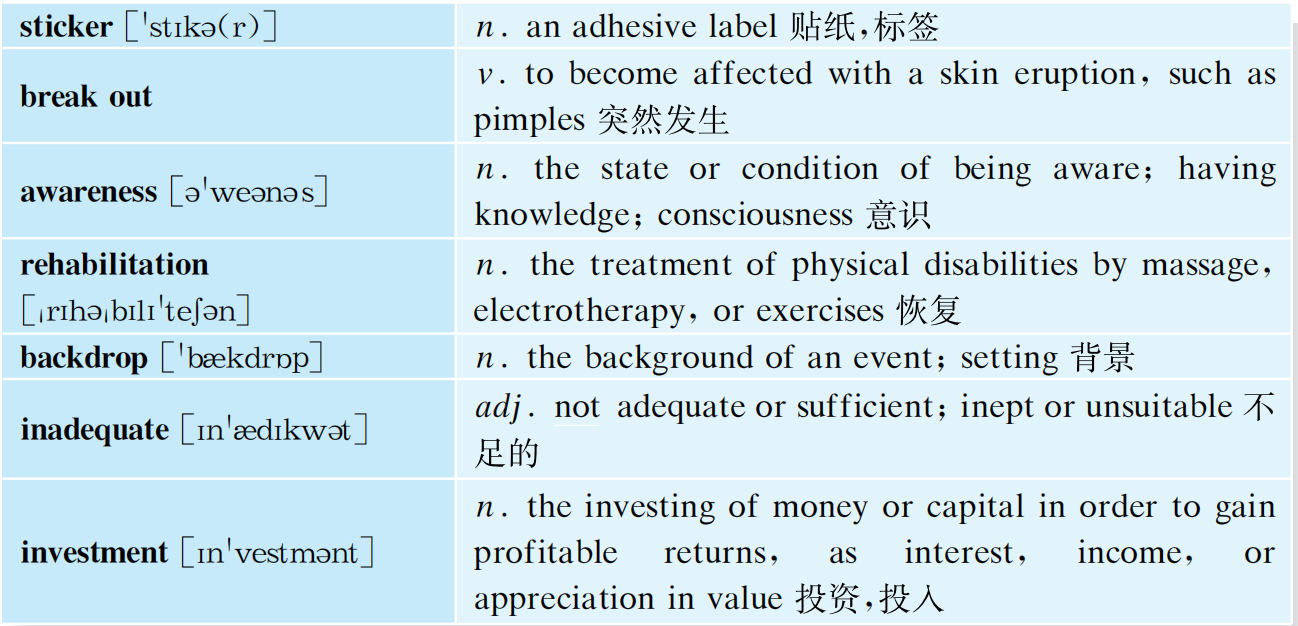
None of the children bothered to look at their stickers, however, and some even broke out in tears.


The blue stickers, worn also by Teacher Pan, are part of a series of activities across China to mark a special day for these children—the 5th World Autism Awareness Day, which took place this Monday.


The Golden Baby Special School which Pan Xuejun runs in the northwestern city of Lanzhou is one of few private rehabilitation centers across China that struggles to cater to the special needs of autistic children, against a backdrop of inadequate funding, lack of professionals, and public misunderstanding.


"Treatment for autism requires huge investments of both time and money, which many families can't afford,"said Pan, the 37-year-old former kindergarten teacher.