目录

  • 1 关于课程
    • 1.1 教学指引
  • 2 学生优秀作品展示
    • 2.1 Organ Transplant
      • 2.1.1 Organ Transplant (Group 2,临床7-8班)
      • 2.1.2 Organ Transplant (Group 1,药分9-10班)
      • 2.1.3 Cloning & Transplantation (Group2,医技1-2班)
      • 2.1.4 Cord Blood Transplantation (Group 1,临床7-8班)
      • 2.1.5 3D Printing Technology in Organ Transplantation (Group 8,医技1-2班)
      • 2.1.6 A Pig Heart (Group 2,药分9-10班)
    • 2.2 Influenza
      • 2.2.1 Influenza  (Group 1,医技1-2班)
      • 2.2.2 Spanish Influenza (药分9-10班)
      • 2.2.3 Avian Influenza  (Group 6,医技1-2班)
      • 2.2.4 The Avain Virus - H1N1(Group 4,临床7-8班)
      • 2.2.5 Swine Influenza (Group 3,临床7-8班)
      • 2.2.6 The Similarities and Differences Between Flu and COVID-19 (Group 7,药分9-10班)
      • 2.2.7 Differences and similarities (Group 3,临床7-8班)
      • 2.2.8 Cold vs Flu vs Covid-19 (Group 4,中制17-18班)
      • 2.2.9 Cold vs Flu vs Covid-19 (Group 5,药分9-10班)
      • 2.2.10 Cold vs Flu vs Covid-19 (Group 10,临床7-8班)
    • 2.3 Autism
      • 2.3.1 Autism (Group 10,临床7-8班)
      • 2.3.2 Autism (Group 3,医技1-2班)
      • 2.3.3 Autism Spectrum Disorders (Group 6,药分9-10班)
      • 2.3.4 Asperger‘s Syndrom (Group 6,医技1-2班)
      • 2.3.5 Asperger‘s Syndrom (Group 8,中制17-18班)
      • 2.3.6 Therapy for Autism (Group 9,护理1-2班)
      • 2.3.7 Treatment for Autism (Group 9,临床7-8班)
      • 2.3.8 Animal therapy for Autism (Group 3,药分9-10班)
      • 2.3.9 Care For Autistic Children (Group 8,智工11-12班)
    • 2.4 First Aid
      • 2.4.1 A Brief Introduction to First Aid (Group 2,医技1-2班)
      • 2.4.2 First Aid(Group 2,智工11-12班)
      • 2.4.3 First Aid(Group 3,临药15-16班)
      • 2.4.4 CPR(Group 6,临床7-8班)
      • 2.4.5 First Aid in Fires(Group 3,临药15-16班)
      • 2.4.6 First Aid in Water Incidents(Group 5,信管3-4班)
      • 2.4.7 First Aid in Electrical Incidents(Group 2,健管3-4班)
  • 3 Unit 1 Organ Transplant
    • 3.1 Micro-lectures
      • 3.1.1 Vocabulary
      • 3.1.2 Subjunctive Mood
      • 3.1.3 Sentence Analysis
      • 3.1.4 Coherence
    • 3.2 Text Book
      • 3.2.1 Info-storm
      • 3.2.2 Watching-in
        • 3.2.2.1 Watching-in -1
        • 3.2.2.2 Watching-in -2
      • 3.2.3 Pre-reading
        • 3.2.3.1 Pre-reading -1
        • 3.2.3.2 Pre-reading -2
        • 3.2.3.3 Pre-reading -3
      • 3.2.4 Critical Reading
      • 3.2.5 Speaking Out
      • 3.2.6 Pros/Cons
        • 3.2.6.1 Pros/Cons -1
        • 3.2.6.2 Pros/Cons -2
      • 3.2.7 Outcome
    • 3.3 More About the Topic
    • 3.4 Reading Practice
    • 3.5 Tips for CET 6
  • 4 Unit 2 Influenza
    • 4.1 Micro-lectures
      • 4.1.1 Vocabulary
      • 4.1.2 Postpositive Attributes
      • 4.1.3 Sentence Analysis
      • 4.1.4 Coherence
    • 4.2 More About the Topic
    • 4.3 Reading Practice
    • 4.4 Tips for CET 6
  • 5 Unit 3 Allergy
    • 5.1 Micro-lectures
      • 5.1.1 Vocabulary
      • 5.1.2 动名词 Gerund
      • 5.1.3 Sentence Analysis
      • 5.1.4 Coherence
    • 5.2 More About the Topic
  • 6 Unit 4 Plastic surgery
    • 6.1 Micro-lectures
      • 6.1.1 Vocabulary
      • 6.1.2 Gerunds and Present Participles
      • 6.1.3 Sentence Analysis
      • 6.1.4 Coherence
    • 6.2 More About the topic
    • 6.3 Reading Practice
    • 6.4 Tips for CET6
  • 7 Unit 5 Autism
    • 7.1 Micro-lectures
      • 7.1.1 Vocabulary
      • 7.1.2 Grammar
      • 7.1.3 Sentence Analysis
      • 7.1.4 Coherence
    • 7.2 More about the Topic
  • 8 Unit 6 HIV/AIDS
    • 8.1 Micro-lectures
      • 8.1.1 Vocabulary
      • 8.1.2 Grammar
      • 8.1.3 Sentence Analysis
      • 8.1.4 Coherence
    • 8.2 More about the Topic
    • 8.3 Reading Practice
    • 8.4 Tips for CET 6
  • 9 Unit 7 First Aid
    • 9.1 Micro-lectures
      • 9.1.1 Vocabulary
      • 9.1.2 Grammar
      • 9.1.3 Sentence Analysis
      • 9.1.4 Coherence
  • 10 Unit 8 Surrogacy
    • 10.1 Micro-lectures
      • 10.1.1 Vocabulary
      • 10.1.2 Grammar
      • 10.1.3 Sentence Analysis
      • 10.1.4 Coherence
  • 11 Unit 2 Influenza
    • 11.1 Info-storm
    • 11.2 Watching-in
      • 11.2.1 Watching-in -1
      • 11.2.2 Watching-in -2
    • 11.3 Pre-reading
      • 11.3.1 Pre-reading -1
      • 11.3.2 Pre-reading -2
      • 11.3.3 Pre-reading -3
    • 11.4 Critical Reading
    • 11.5 Speaking Out
    • 11.6 Pros/Cons
      • 11.6.1 Pros/Cons -1
      • 11.6.2 Pros/Cons -2
    • 11.7 Outcome
    • 11.8 Micro-lectures
      • 11.8.1 Vocabulary
      • 11.8.2 Postpositive Attributes
      • 11.8.3 Sentence Analysis
      • 11.8.4 Coherence
  • 12 Unit 3 Allergy
    • 12.1 Info-storm
    • 12.2 Watching-in
      • 12.2.1 Watching-in -1
      • 12.2.2 Watching-in -2
    • 12.3 Pre-reading
      • 12.3.1 Pre-reading -1
      • 12.3.2 Pre-reading -2
      • 12.3.3 Pre-reading -3
    • 12.4 Critical Reading
    • 12.5 Speaking Out
    • 12.6 Pros/Cons
      • 12.6.1 Pros/Cons -1
      • 12.6.2 Pros/Cons -2
    • 12.7 Outcome
    • 12.8 Micro-lectures
      • 12.8.1 Vocabulary
      • 12.8.2 动名词 Gerund
      • 12.8.3 Sentence Analysis
      • 12.8.4 Coherence
  • 13 Unit 4 Plastic Surgery
    • 13.1 Info-storm
    • 13.2 Watching-in
      • 13.2.1 Watching-in -1
      • 13.2.2 Watching-in -2
    • 13.3 Pre-reading
      • 13.3.1 Pre-reading -1
      • 13.3.2 Pre-reading -2
      • 13.3.3 Pre-reading -3
    • 13.4 Critical Reading
    • 13.5 Speaking Out
    • 13.6 Pros/Cons
      • 13.6.1 Pros/Cons -1
      • 13.6.2 Pros/Cons -2
    • 13.7 Outcome
    • 13.8 Micro-lectures
      • 13.8.1 Vocabulary
      • 13.8.2 Gerunds and Present Participles
      • 13.8.3 Sentence Analysis
      • 13.8.4 Coherence
  • 14 Unit 5 Autism
    • 14.1 Info-storm
    • 14.2 Watching-in
      • 14.2.1 Watching-in -1
      • 14.2.2 Watching-in -2
    • 14.3 Pre-reading
      • 14.3.1 Pre-reading -1
      • 14.3.2 Pre-reading -2
      • 14.3.3 Pre-reading -3
    • 14.4 Critical Reading
    • 14.5 Speaking Out
    • 14.6 Pros/Cons
      • 14.6.1 Pros/Cons -1
      • 14.6.2 Pros/Cons -2
    • 14.7 Outcome
    • 14.8 Micro-lectures
      • 14.8.1 Vocabulary
      • 14.8.2 Grammar
      • 14.8.3 Sentence Analysis
      • 14.8.4 Coherence
  • 15 Unit 6  HIV/AIDS
    • 15.1 Info-storm
    • 15.2 Watching-in
      • 15.2.1 Watching-in -1
      • 15.2.2 Watching-in -2
    • 15.3 Pre-reading
      • 15.3.1 Pre-reading -1
      • 15.3.2 Pre-reading -2
      • 15.3.3 Pre-reading -3
    • 15.4 Critical Reading
    • 15.5 Speaking Out
    • 15.6 Pros/Cons
      • 15.6.1 Pros/Cons -1
      • 15.6.2 Pros/Cons -2
    • 15.7 Outcome
    • 15.8 Micro-lectures
      • 15.8.1 Vocabulary
      • 15.8.2 Grammar
      • 15.8.3 Sentence Analysis
      • 15.8.4 Coherence
  • 16 First Aid
    • 16.1 Info-storm
    • 16.2 Watching-in
      • 16.2.1 Watching-in -1
      • 16.2.2 Watching-in -2
    • 16.3 Pre-reading
      • 16.3.1 Pre-reading -1
      • 16.3.2 Pre-reading -2
      • 16.3.3 Pre-reading -3
    • 16.4 Critical Reading
    • 16.5 Speaking Out
    • 16.6 Pros/Cons
      • 16.6.1 Pros/Cons -1
      • 16.6.2 Pros/Cons -2
    • 16.7 Outcome
    • 16.8 Micro-lectures
      • 16.8.1 Vocabulary
      • 16.8.2 Grammar
      • 16.8.3 Sentence Analysis
      • 16.8.4 Coherence
  • 17 Unit 8 Physical Fitness
    • 17.1 Info-storm
    • 17.2 Watching-in
      • 17.2.1 Watching-in -1
      • 17.2.2 Watching-in -2
    • 17.3 Pre-reading
      • 17.3.1 Pre-reading -1
      • 17.3.2 Pre-reading -2
      • 17.3.3 Pre-reading -3
    • 17.4 Critical Reading
    • 17.5 Speaking Out
    • 17.6 Pros/Cons
      • 17.6.1 Pros/Cons -1
      • 17.6.2 Pros/Cons -2
    • 17.7 Outcome
Critical Reading
  • 1 Influenza Tr...
  • 2 Issues and&n...
  • 3 Lexical Chun...
  • 4 Bilingual tr...

01 Read the following passage and complete the exercises that follow.


Influenza Transmission and Precaution


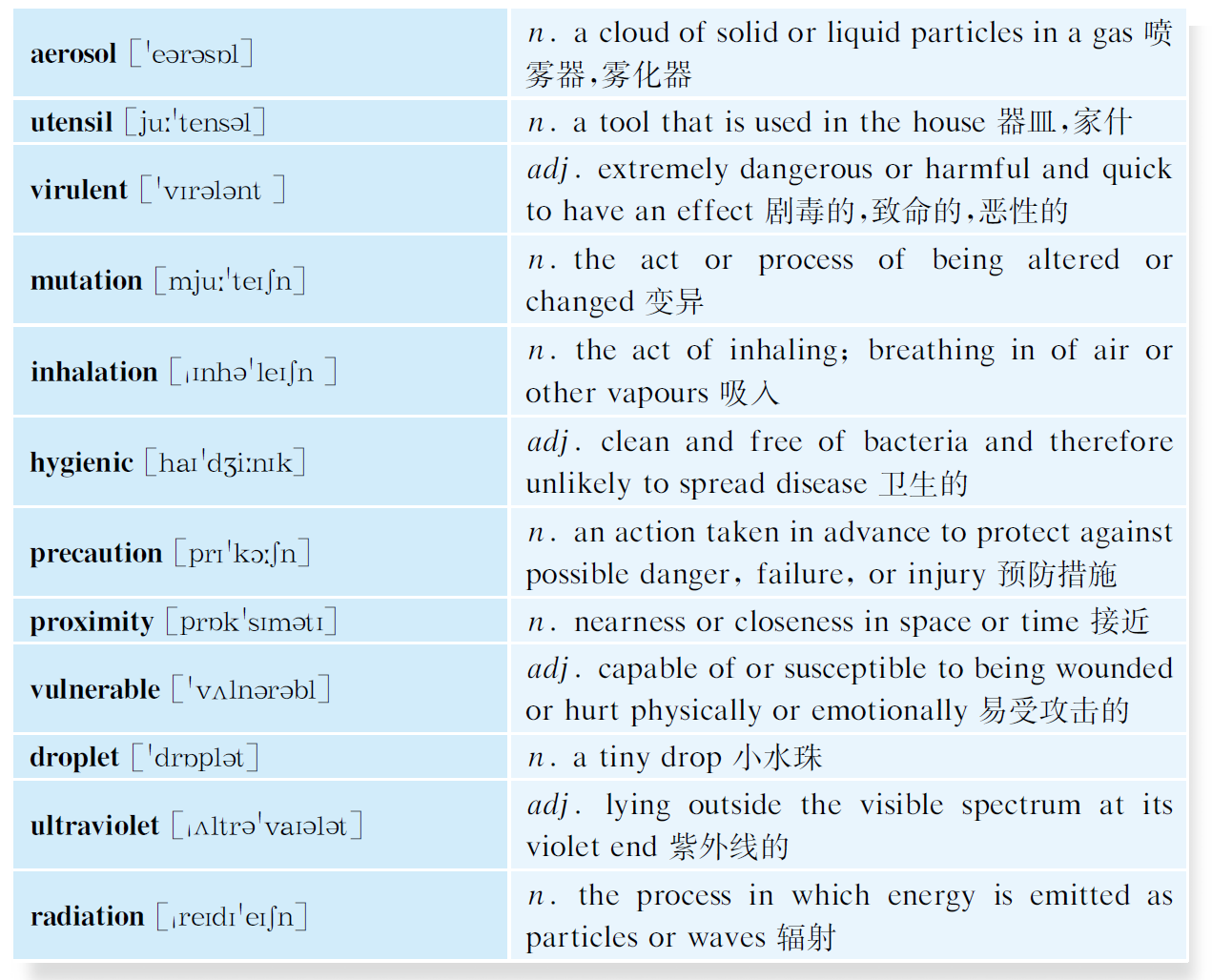
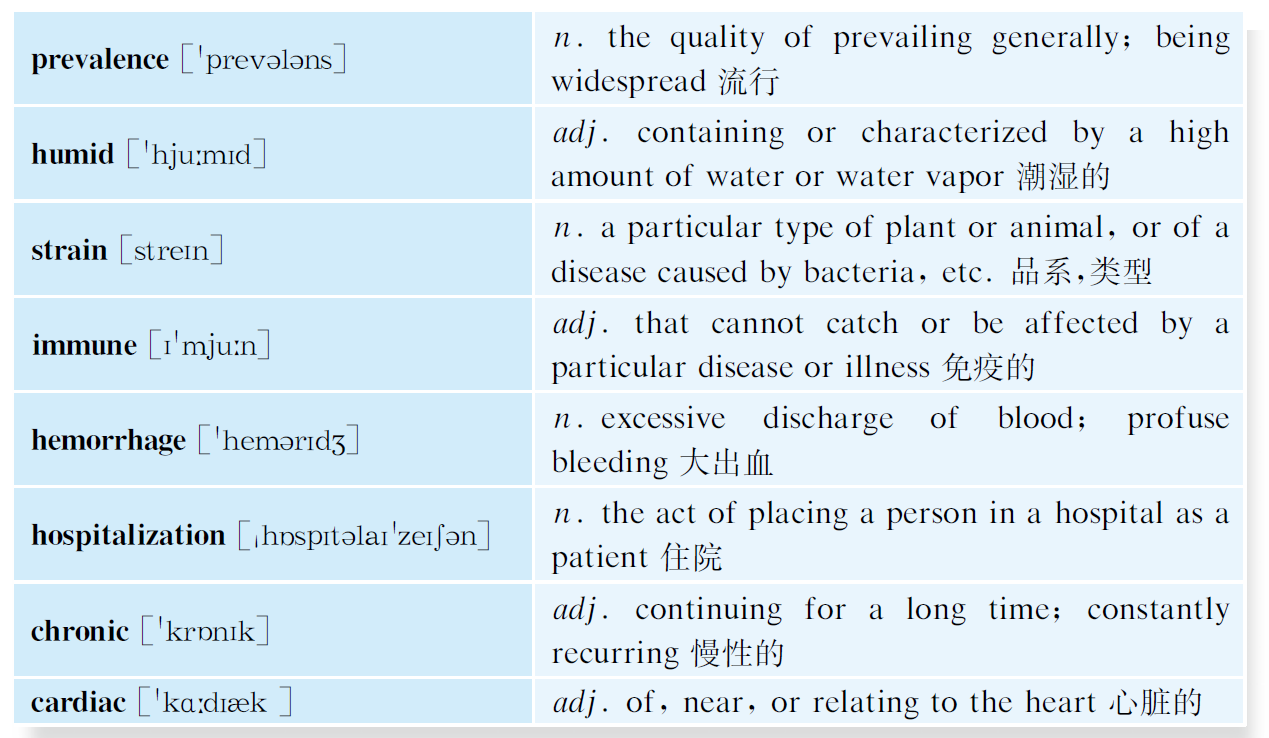
Influenza is an infectious respiratory virus spread by aerosol droplets emitted by those infected. Infection comes from direct inhalation into the lungs and exposure through the nose and mouth. The spread of influenza from one person to another can occur even before infected individuals experience flu symptoms, but is worst during the height of fever. Children spread influenza more efficiently than do adults. The virus needs moisture and will dry out quickly if exposed to ultraviolet radiation or dry air, which may account for the prevalence of influenza during humid and darker winter weather.

In moist droplets, the influenza virus can survive outside of the body for a time on things like railings, dishes, and doorknobs. Through these it is spread by hand-to-mouth contact when someone touches an object contaminated with the aerosols and then touches his or her own mouth. Sharing cups and utensils with infected individuals increases the risk of infection. For this reason, consistent hand washing with soap and water and properly washing dishes and utensils helps reduce the spread of influenza.

Two major factors in the spread of influenza depend on the strain of the virus and its rate of mutation, since flu strains constantly mutate as they compete with host immune systems. Influenza B and C are milder forms, but influenza A produces more serious cases of illness. Pandemics occur when a virulent strain of flu infects millions of people around the world, typically due to new mutations that have migrated from other animals to humans. The 1918 Spanish Flu outbreak, for instance, resulted from a mutated strain related to avian influenza that caused hemorrhage and other unusually severe symptoms.

The three kinds of influenza spread at different rates, but all of them are spread through the coughing and sneezing of infected individuals. Hygienic precautions like hand washing and avoiding proximity to sick people during the height of their infection reduces the spread of the virus. Vaccination can slow down influenza infection rates and protect vulnerable populations.

Vaccination prevents the spread of influenza in common forms, particularly of influenza B, but it does not guarantee protection from the spread of new mutations. It is recommended for the elderly, who are at greater risk of serious complications.

While how well the flu vaccine works can vary, there are a lot of reasons to get a flu vaccine each year.

●Flu vaccination can keep you from getting sick with flu.

●Flu vaccination can reduce the risk of flu-associated hospitalization, including among children and older adults.

a. A 2014 study showed that flu vaccine reduced children's risk of flu-related pediatric intensive care unit (PICU) admission by 74% during flu seasons from 2010-2012.

b. Another study published in the summer of 2016 showed that people 50 years and older who got a flu vaccine reduced their risk of getting hospitalized from flu by 57%.

●Flu vaccination is an important preventive tool for people with chronic health conditions.

a. Vaccination was associated with lower rates of some cardiac events among people with heart disease, especially among those who had had a cardiac event in the past year.

b. Flu vaccination also has been shown to be associated with reduced hospitalizations among people with diabetes (79%)and chronic lung disease (52%).

●Vaccination helps protect women during and after pregnancy. Getting vaccinated can also protect a baby after birth from flu. (Mom passes antibodies onto the developing baby during her pregnancy.)

a. A study that looked at flu vaccine effectiveness in pregnant women found that vaccination reduced the risk of flu-associated acute respiratory infection by about one half.

b. Studies show that flu vaccine in a pregnant woman can reduce the risk of flu illness in her baby by up to half. This protective benefit was observed for up to four months after birth.

●Flu vaccination also may make your illness milder if you do get sick.

Getting vaccinated yourself also protects people around you, including those who are more vulnerable to serious flu illness, like babies and young children, older people, and people with certain chronic health conditions. If flu sufferers rest at home and avoid public places until recovery, they are less likely to expose others to the virus.

Getting a flu vaccine each year is the best way to prevent the flu. Antiviral drugs are an important second line of defense against the flu. These drugs must be prescribed by a doctor. In addition, good health habits, such as covering your cough and frequently washing your hands with soap, can help prevent the spread of the flu and other respiratory illnesses.

(Source: https://en.wikipedia.org/wiki/Influenza)