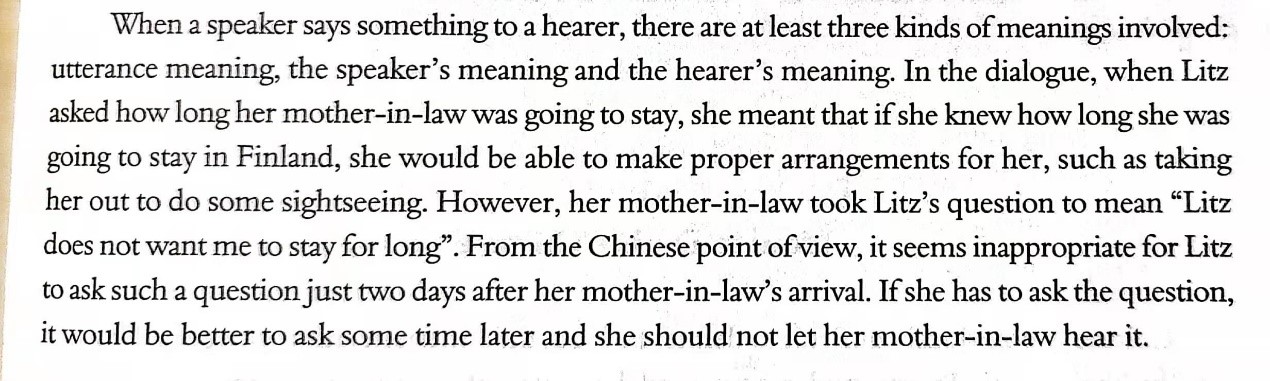
课本案例参考答案(page 3, Chapter 1 课本)

Comment:
The teacher (A) is from a low-contextculture which requires a direct communication style-everything needs to be verbalized.However, the student (B) is from a high-context culture which has an indirectcommunication style -most of the meaning is implicit in the context. Aftersaying that the mother is ill and needs to go to hospital, the student expectsthe teacher to understand that a leave of absence is required; in contrast, theteacher expects the student to verbalize the request explicitly and, when the studentfails to do so, the teacher gets upset.
课本案例参考答案(page 7, Chapter 1 课本)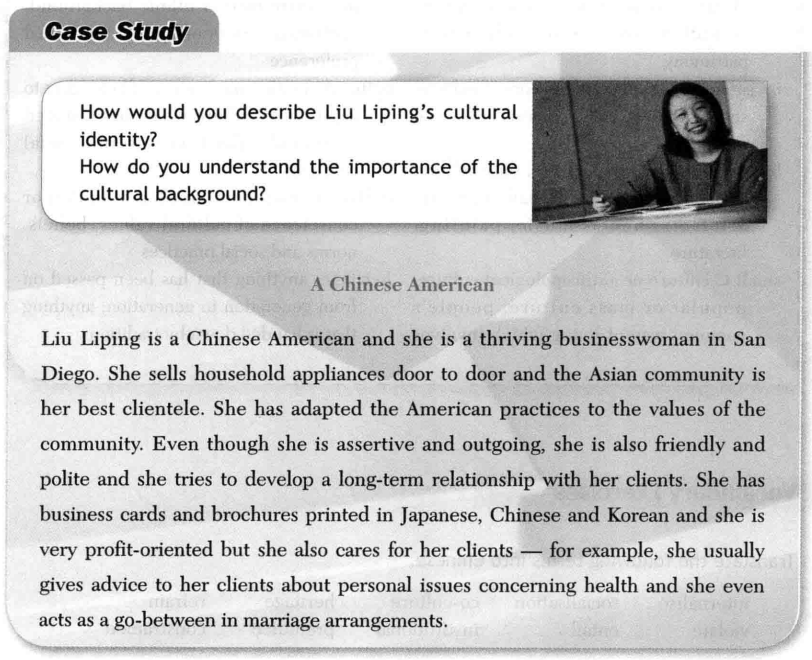
Comment:
Liu Liping is bicultural as she is ChineseAmerican. As a result, she is not only familiar with the American businesspractices (she is profit-oriented, assertive and outgoing)but she is also awareof the values in the Asian community (she is relationship-oriented, polite andfriendly). Logically, she is considered a thriving businesswoman in San Diego(the American style) who reaches out to the Asian community by printingbusiness cards and brochures in their native languages and develops closerelationships with her clientele, assuming the role of an ingroup membercapable of giving advice on issues concerning health and marriage (the Chinesestyle).
1.6 课本案例参考答案(page 14, Chapter 1 课本)
Comment:
Different cultures have differentcommunication patterns, just like they have different customs, differentfestivals, different gestures, etc. Jim is American so he is verystraightforward and he expresses his feelings directly- “I feel lie I'velearned so much about you and your culture. We really have fun together.” However,Michiko is Japanese so he is very indirect and polite. For example, Michiko isvery vague when he refers to America-he uses words like “interesting” and“nice” which are rather opaque. Moreover, he avoids giving his opinion aboutAmericans: “I don't know. Maybe I haven't been here long enough to know.”;“Well, I'd probably have to think about it. I don't really know that manyAmericans yet.”He deliberately avoids saying something that might offend Jim; hisresponse is clearly “face-saving”. Therefore, we can say that theircommunication styles are culturally determined.
1.6 First Offering案例分析参考答案
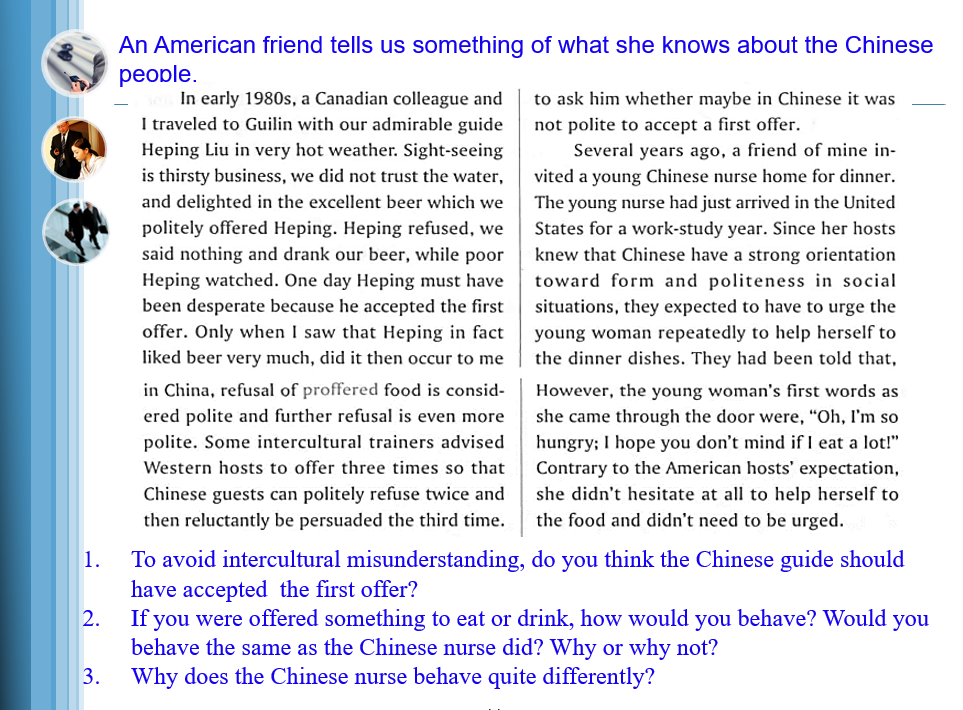
Comment:
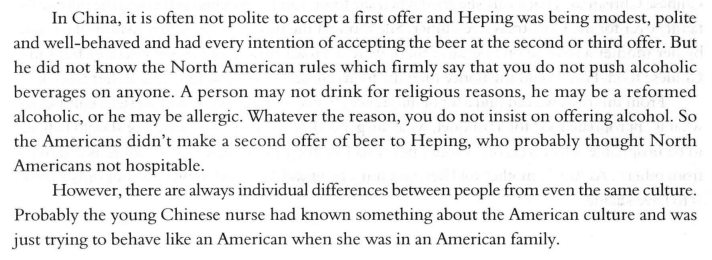
课本案例参考答案(Page 19,Chapter 2 课本)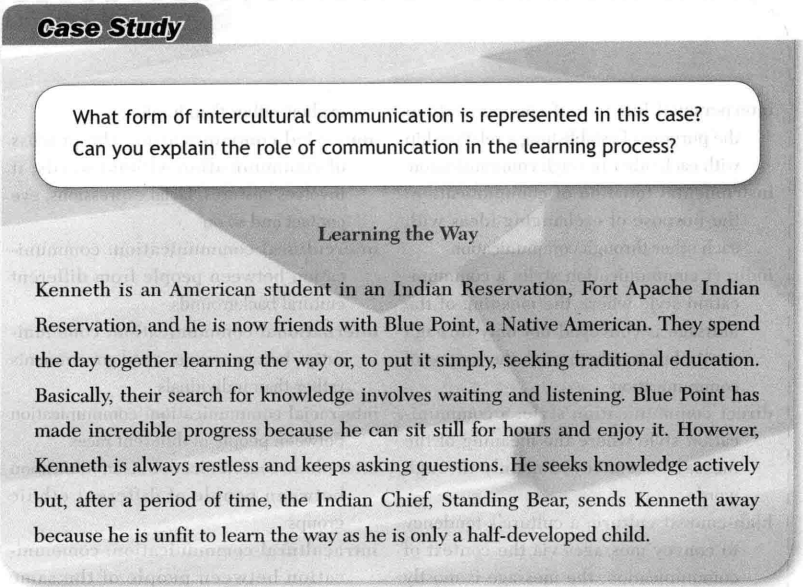
This case focuses on interethnic and interracial communication becauseBlue Point is a Native American, while Kenneth is a European American-theybelong to different ethnic groups within American society and they alsorepresent different races because one is Indian whereas the other is Caucasianwhite. They use communication differently in their learning process. Forinstance, Blue Point, as a Native American, perceives communication as implicitand contextual (high-context culture); thus, he learns by waiting andlistening. However, Kenneth, as a European American, understands communicationas explicit and evident through verbalization (low-context culture); thus, helearns by constant questioning. As a result, the Indian Chief considers Kennethunfit to learn the way.
1.9 案例分析参考答案

Comment: