目录

  • 1 Introduction
    • 1.1 Warm-up activities
    • 1.2 Introduction to teaching plan
    • 1.3 TEM-4 Writing
    • 1.4 Assignment
  • 2 UNIT 1-1  Life and Value
    • 2.1 Warm-up
    • 2.2 Critical thinking
    • 2.3 Narrative- Introduction
    • 2.4 Features
    • 2.5 Tips
    • 2.6 Case analysis
    • 2.7 Assignment
  • 3 UNIT 1-2  Description
    • 3.1 简介
    • 3.2 特点
    • 3.3 人物描写
    • 3.4 景物描写
    • 3.5 场面描写
    • 3.6 Assignment
  • 4 Unit 2-1  Characterization
    • 4.1 Warm-up
    • 4.2 Characters
    • 4.3 How to develop characters
    • 4.4 How to balance telling and showing
    • 4.5 Assignment
  • 5 UNIT 2-2  Language Study
    • 5.1 Warm-up
    • 5.2 Language Study
      • 5.2.1 词汇变化
      • 5.2.2 修辞运用
    • 5.3 Case analysis
    • 5.4 Assignment
  • 6 Unit 3-1 Setting
    • 6.1 Pre-class activity
    • 6.2 Learning the skills
    • 6.3 Assignment
  • 7 Unit 3-2 Case Analysis
    • 7.1 Warm-up
    • 7.2 Elements of setting
    • 7.3 Case analysis
    • 7.4 Assignment
  • 8 TEM-4 Writing
    • 8.1 历年写作真题
    • 8.2 专四写作技巧
  • 9 Unit 4-1 Point of View
    • 9.1 Pre-class work
    • 9.2 Learning the skills-point of view
    • 9.3 Case analysis
    • 9.4 Assignment
  • 10 Unit 4-2 Case Analysis
    • 10.1 Case analysis
    • 10.2 Shift in tense
    • 10.3 Assignment
  • 11 Unit 5-1 Theme
    • 11.1 Warm-up
    • 11.2 Learning the skills
    • 11.3 The Stages of Writing
    • 11.4 Assignment
  • 12 Unit 5-2 Language study
    • 12.1 figure of speech
    • 12.2 Assignment
  • 13 Unit 6-1 Plot
    • 13.1 Review
    • 13.2 Learning the skills
    • 13.3 Case analysis
    • 13.4 Assignment
  • 14 Unit 6-2 Language study
    • 14.1 Unity
    • 14.2 Coherence
Learning the skills

    1. Definiton of plot

https://quizlet.com/322705108/elements-of-plot-and-plot-structure-flash-cards/

https://literarydevices.net/plot/

https://penandthepad.com/five-elements-plot-conflict-4472.html


   2.Learning skills (Watching the MOOC


Elements of plot

https://www.icourse163.org/learn/WHUT-1206358803?tid=1206676203#/learn/content?type=detail&id=1212042419


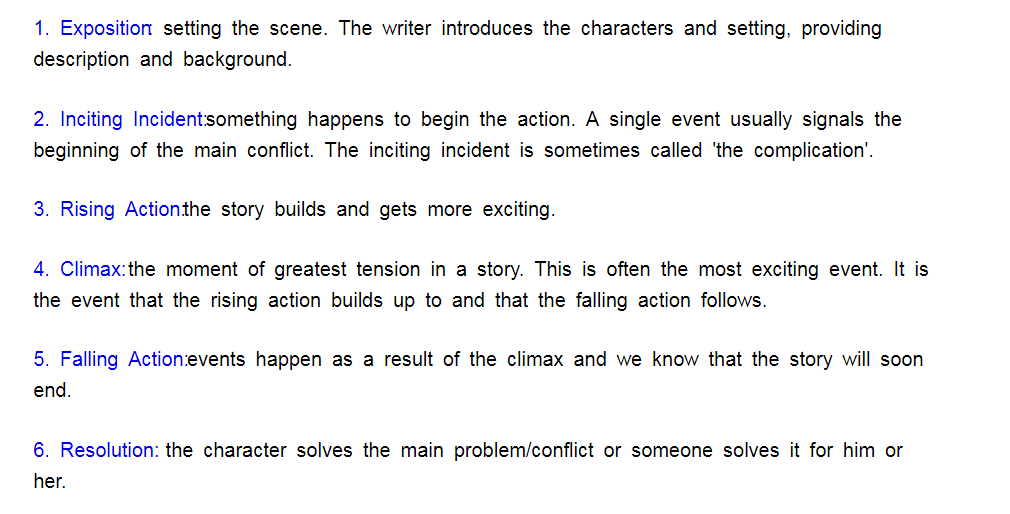
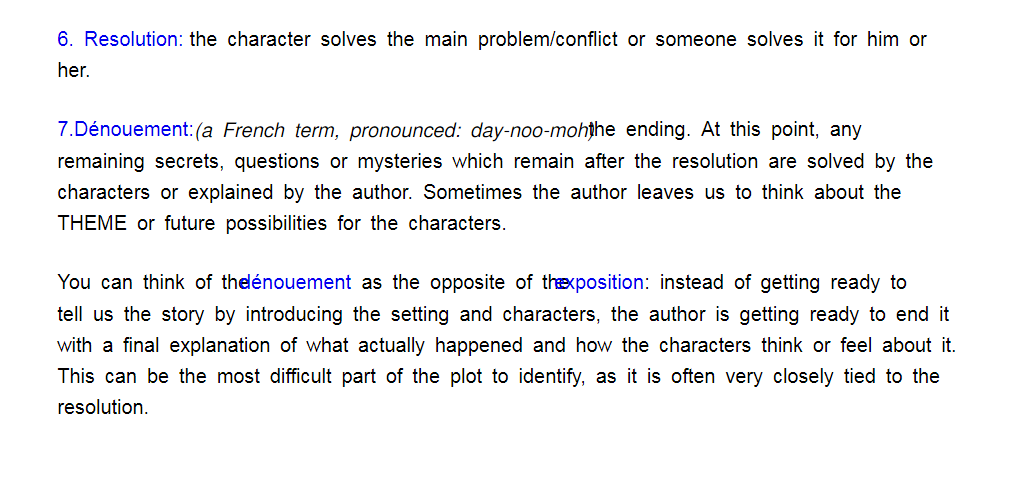
Exposition.In the exposition, the author explains who the characters are, particularly themain character or protagonist; where the events take place; and other relevantbackground information. In addition to providing descriptions, the authoroften introduces a conflictobstacle or incident thatwill propel the story and make it interesting. The conflict could be theprotagonist in conflict with another person, with society, with nature, withGod, or with himself.


Rising Action. In this stage, events that lead to the climax of the story aredescribed. In this stage the obstacles that the protagonist experiencescan be explained in more detail. Tension and excitement build as thestory moves towards the climax.


Climax. Theclimax is the most exciting part of a story. It is the climax or peak ofconflict(s) that have been building since the exposition. In the thirdpart of movie adaptation of The Lord of the Rings, for example, the climaxwould be Frodo and Gollum wrestling for the ring as it falls into the lavapool.


Falling Action and Denouement. The final two elements of the story are thefalling action and denouement (French for “untying” or “unraveling.”) Inthese two closely linked phases, the aftermath of the events that form theclimax is explained. Tension is released as the conflict of theprotagonist is resolved, whether the story has a happy (Cinderella) ortragic (Romeo and Juliet) ending. Loose plot ends and mysteriesare tied up and the story concludes.


4.