
'It's horrible': Hospitals cancel surgeries because of coronavirus, leaving Americans in pain
USA TODAY
DENVER — Gary Sloane Jr. was counting down the days until his planned surgery: April 22, 2020.
But with just over a month to go before his surgeons were set to repair a massive hernia caused by his liver transplant, the coronavirus outbreak prompted them to delay the surgery they deemed elective.
"If you could see a picture of this hernia, it goes from my where my ribs are and hangs completely down. You can touch my belly and feel my intestines(肠子) on the inside. It's horrible," said Sloane, 45, who lives near Buffalo, New York.
Margie Thompson, 64, was supposed to be having her hip replaced April 6. Bad knees and an active lifestyle left the Denver-based associate professor in chronic pain and anxiously awaiting her surgery. Like Sloane, Thompson saw her procedure delayed indefinitely.
"It's just hard to live everyday life. It's hard to teach, I often have to sit down," she said. "This has really limited my physical activity."
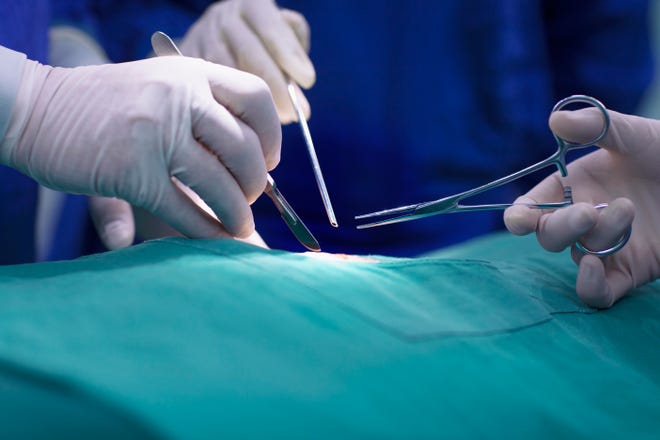
As the coronavirus outbreak began spreading last month, doctors across the country cancelled tens of thousands of non-urgent surgeries so that hospitals and medical professionals could begin clearing bed space and freeing up staff to prepare for the now-growing number of coronavirus patients.

Surgeon General Jerome M. Adams on March 22 called on hospitals to cancel or delay nonessential elective procedures, including dental procedures. He said deferring procedures would also preserve much-needed masks, gloves and gowns for emergency use.
"Deferring elective procedures does not mean they cannot or will not be done in the future once we see our COVID-19 response needs decrease," Adams wrote in USA TODAY. "We are at a critical point in our global and national response to an unprecedented pandemic, and it will take sacrifice and an all-of-America effort."
White House predictions say as many as 240,000 people may die from the virus, with hundreds of thousands more predicted to get sick and require lengthy hospitalizations.
Surgeries covered by the cancellations run from knee replacements to cancer biopsies, reconstructions following mastectomies and tummy tucks and face lifts.

While the surgery cancellations might have seemed overly aggressive at first, what we're seeing today as coronavirus caseloads skyrocket proves it was the right move, said Dr. David Battinelli, chief medical officer of Northwell Health, the largest healthcare provider in New York.
Right now, the system has about 2,500 COVID-19 patients, with 600 in intensive care, Battinelli said, and workers there are reeling from the recent coronavirus death of one of their own senior physicians. That doctor's death has brought home to the Northwell community just how serious this fight is.
Battinelli said Northwell is now using more specific language to describe surgeries: Emergent, urgent (which can be delayed for up to a month), planned (which can be delayed for three to six months), and cosmetic(整形手术), which can be indefinitely postponed. Battinelli said urgent could include things like cancer biopsies, while knee replacements might fall into the planned category.
Like many health care systems, Northwell used the delay between cancelling surgeries and the increase in coronavirus patients to assess which rooms could be used for critical care(重症监护), which ones could be doubled-up with patients, and which ones could be equipped with ventilators(呼吸机) to create makeshift(临时的) ICU beds.
本篇翻译练习要求全篇翻译(包括:标题、导语、正文等等),经小组讨论交流后,由每组组长把定稿译文以Word形式发送到邮箱 :xwby2020@126.com(截止日期为下周上课前一天的晚上12点之前,请按时发送),文件命名为:班级+组名(组长名字),如:广电1801第1组(×××)、新闻1801第1组(×××)、新闻1802第1组(×××)。在译文呈现之前,附上组内成员的基本信息(姓名学号)。
本周第四组展示内容为这篇新闻的翻译,由于篇幅较长,所以本周展示框架改为:挑选重点内容进行分享。
分享内容涵盖:1.新闻翻译要点(包括:标题的翻译、导语的翻译、新闻主体部分的翻译、引语翻译、被动句的翻译、直译意译、转换译法等等,但不局限以上这些)2.内容语法词汇知识(包括本篇新闻报道中出现的生词难词、短语、长难句的分析等等)3.通过本篇新闻翻译的练习所获得的一些翻译启示(enlightenments)
展示视频还是在学习通上面私发给我(视频+PPT),时间最晚是下周上课前一天的晚上12点之前。
本周学习通上面不再布置作业。

