
Chapter 8 Aggregate Demand and Aggregate Supply
LECTURE VIDEO学习视频(4):
1. The Aggregate-Supply Curve
Definition of aggregate-supply curve: a curve that shows the quantity of goods and services that firms choose to produce and sell at each price level.
The relationship between the price level and the quantity of goods and services supplied depends on the time horizon being examined.
In other words, the slope of the AS curve depends on the time horizon:
In the short run, the aggregate supply curve is upward-sloping. (“SR” = “short run”).
In the long run, the aggregate supply curve is vertical. (“LR” = “long run”)
2. Why the Aggregate-Supply Curve Is Vertical in the Long Run
In the long run, an economy’s production of goods and services depends on its supplies of resources along with the available production technology.
This is review from the chapter25 “Production and Growth.” Y=AF(L,K,H,N): production depends on labor, physical capital, human capital, natural resources, and technology.
According to the classical dichotomy, nominal variables and real variables are separate, not related.
Hence, in the long run, economists believe that an increase in the price level does not affect these determinants of output in the long run, in other words, the output in the long run is regardless of the price level and the long-run aggregate-supply curve is vertical.
The vertical long-run aggregate-supply curve is a graphical representation of the classical theory.
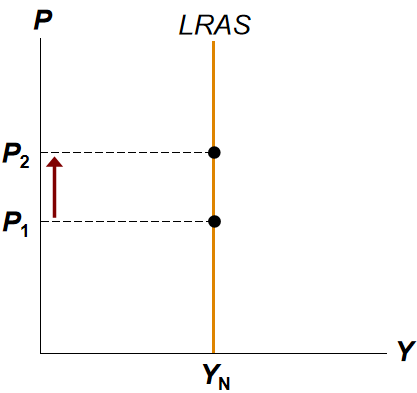
The position of the long run aggregate-supply curve occurs at an output level sometimes called the natural rate of output.
Definition of natural rate of output: the production of goods and services that an economy producess in the long run when the labor market achieves full employment and unemployment is at its natural rate.
3. Why the Long-Run Aggregate-Supply Curve Might Shift
Since the long run level of output depends on labor, capital, natural resources, and technology, shifts in the LRAS curve can arise from any changes in labor, or capital, or natural resources, or technology.
(1) Shifts Arising from Changes in Labor
Increases in immigration increase the number of workers available. Then, the production of goods and services will increase. The long-run aggregate-supply curve would shift to the right.
When the government raises the minimum wage substantially, a larger surplus of labor results, thus increasing the natural rate of unemployment. The production of goods and services will decline in the long run. The long-run aggregate-supply curve would shift to the left.
(2) Shifts Arising from Changes in Capital
When the firms reduce their investment in factories and machines, the economy's stock of physical capital decreases. A decrease in the economy’s physical capital stock decreases productivity and thus shifts long-run aggregate supply to the left.
When More people get college degrees, the economy's stock of human capital increases. An increase in the economy's human capital stock increases productivity and shifts the LRAS curve to right.
(3) Shifts Arising from Changes in Natural Resources
A discovery of a new mineral deposit increases the economy's stock of natural resources, thus increasing the long-run aggregate supply.
When a changing weather pattern makes farming more difficult, the production of goods and services decreases in the long run, thus shifting the LRAS curve to left.
When political turmoil reduce the supply of crude oil flowing from the Middle Eastern countries, the price of oil rises around the world. It makes some countries unable to purchase the imported oil and the production of goods that rely on the oil inputs will decrease, shifting the LRAS curve to left.
(4) Shifts Arising from Changes in Technological Knowledge
The invention of a faster production line has allowed the firms to produce more goods and services from any given level of resources. As a result, it has shifted the long-run aggregate-supply curve to the right.
The government passed regulations preventing firms from using some production methods, to address national secrets. As a result, the productivity of the firms will be lowered and thus the LRAS will decrease.
4. Using Aggregate Demand and Aggregate Supply to Depict Long-Run Growth and Inflation
Two important forces that govern the economy in the long run are technological progress and monetary policy.
Technological progress shifts long-run aggregate supply to the right.
The Fed increases the money supply over time, which raises aggregate demand.
The result is growth in output and continuing inflation (increases in the price level).
Hence, the model of AD-AS provides a new way to describe the classical analysis of growth and inflation.
Although the purpose of developing the model of aggregate demand and aggregate supply is to describe short-run fluctuations, these short-run fluctuations should be considered deviations from the continuing long-run trends developed here.

