
Chapter 8 Aggregate Demand and Aggregate Supply
LEARNING OBJECTIVES学习目标:
Understand three key facts about short-run economic fluctuations
Examine the sources for shifts in the aggregate-demand curve and the aggregate-supply curve
Explain how these shifts can cause short-run economic fluctuations
Analyze actions policymakers might undertake to offset recessions
LECTURE VIDEO学习视频(1):
1. Three Key Facts about Economic Fluctuations
Fact 1: Economic Fluctuations Are Irregular and Unpredictable
Fluctuations in the economy are often called the business cycle.
Economic fluctuations correspond to changes in business conditions.
These fluctuations are not at all regular and are almost impossible to predict.
Fact 2: Most Macroeconomic Quantities Fluctuate Together
Investment spending falls during each recession just as real GDP does.
This is true of other variables as well: When the economy is in recession, real GDP which measures total income corrected for inflation of everyone in the economy fall, so do personal income, corporate profits, consumer spending, investment spending, industrial production, sales and so on.
Because recessions are economy-wide phenomena, they show up in many sources of macroeconomic data. Hence, most macroeconomic quantities fluctuate together.
Fact 3: As Output Falls, Unemployment Rises
Changes in the economy’s output level will have an effect on the economy’s utilization of its labor force.
When firms choose to produce a smaller amount of goods and services, they lay off workers, which increases the unemployment rate.
Conversely, during expansions, we see the unemployment rate falling—as firms increase their output, they need more workers.
2. Explaining Short-Run Economic Fluctuations
A.The Assumptions of Classical Economics
The classical dichotomy is the separation of variables into real variables and nominal variables.
According to classical theory, changes in the money supply only affect nominal variables.
B.The Reality of Short-Run Fluctuations
Most economists believe that the classical theory describes the world in the long run but not in the short run.
However, when studying year-to-year fluctuations in the economy, the assumption of monetary neutrality is not appropriate. In the short run, most real and nominal variables are intertwined.
3. The Model of Aggregate Demand and Aggregate Supply
Definition of model of aggregate demand and aggregate supply: the model that most economists use to explain short-run fluctuations in economic activity around its long-run trend.
The AD-AS model focuses on the behavior of two variables: output of g&s(real GDP), and the price level (CPI or GDP deflator).
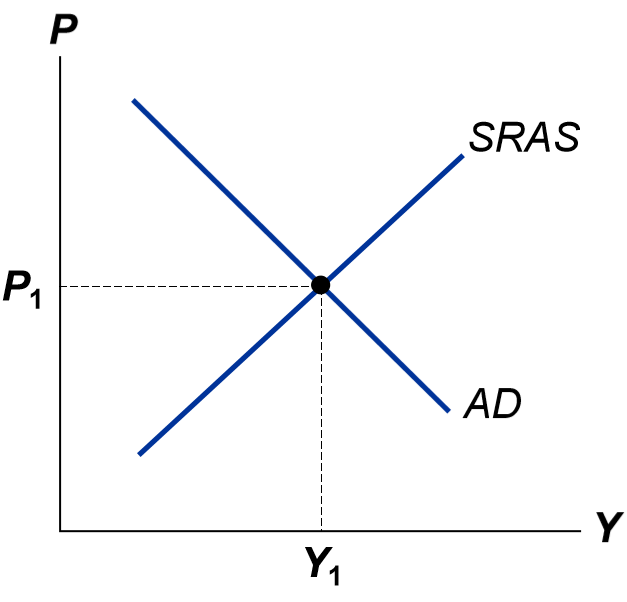
The variable on the horizontal axis is total quantity of goods and services produced by all firms in all markets in the economy, as measured by real GDP.
The variable on the vertical axis is the average level of prices in the economy, as measured by the CPI or the GDP deflator.
Definition of aggregate-demand curve: a curve that shows the quantity of goods and services that households, firms, and the government want to buy at each price level.

