
Chapter 5 Unemployment
LECTURE VIDEO学习视频5:
Explaining Frictional unemployment
Job search is the process of matching workers with appropriate jobs.
Because Workers have different tastes & skills, and jobs have different requirements, it is often difficult for workers to match with the appropriate job.
Frictional unemployment often occurs because of a change in the demand for labor among different firms.
Workers in declining industries will find themselves looking for new jobs, and firms in growing industries will be seeking new workers, known as sectoral shifts.
When consumers decide to stop buying a good produced by Firm A and instead start buying a good produced by Firm B, some workers at Firm A will likely lose their jobs.
New jobs will be created at Firm B, but it will take some time to move the displaced workers from Firm A to Firm B.
The result of this transition is temporary unemployment.
The same situation can occur across industries and regions as well.
This implies that, because the economy is always changing, frictional unemployment is inevitable.
The faster information spreads about job openies and worker availability, the more rapidly the economy can match workers and firm. Government programs can help to reduce the amount of frictional unemployment.
Govt employment agencies provide information about job vacancies to speed up the matching of workers with jobs.
Public training programs aim to equip workers displaced from declining industries with the skills needed in growing industries.
Unemployment Insurance:
A govt program that partially protects workers’ incomes when they become unemployed.
Unemployment insurance reduces uncertainty over incomes and gives the unemployed more time to search, resulting in better job matches and thus higher productivity.
However, many studies have shown that more generous unemployment insurance benefits lead to reduced job search effort and, as a result, more unemployment.
Because people respond to incentives. When an unemployed takes a job, he or she will no longer enjoy the unemployment insurance. Therefore, workers have less incentive to search or take jobs in order to be eligible to receive UI benefits.
Explaining Structural Unemployment
Anytime a wage is set above the equilibrium level for any reason, the quantity of labor supplied is greater than the quantity of labor demanded, thus resulting in the surplus of labor force, known as structural unemployment.
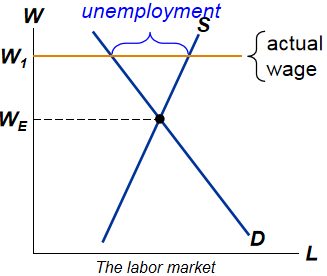
Structural Unemployment occurs when wage is kept above equilibrium.
Three possible reasons for structural unemployment are minimum-wage laws, unions, and efficiency wages.
(1) Minimum-Wage Laws
The minimum wage is a price floor. If the minimum wage is set above the equilibrium wage in the labor market, a surplus of labor will occur.
The minimum wage may exceed the equilibrium wage for the least skilled or experienced workers, causing structural unemployment.
The majority of workers in the economy have wages well above the legal minimum wage.
Minimum wage laws therefore have the largest effect on the least skilled and least experienced members of the labor force, such as teenagers.
So the law doesn't prevent most wages from adjusting to balance supply and demand and can’t explain most unemployment.
(2) Unions
Union is a worker association that bargains with employers over wages, benefits, and working conditions.
Unions try to negotiate for higher wages, better benefits, and better working conditions than the non-union firms would provide.
Collective bargaining: the process by which unions and firms agree on the terms of employment
Strike: the organized withdrawal of labor from a firm by a union.
Economists have found that union workers typically earn 10% to 20% more than similar workers who do not belong to unions.
This implies that unions raise the wage above the equilibrium wage, resulting in unemployment.
Unions are often believed to cause conflict between insiders (who benefit from high union wages) and outsiders (who do not get the union jobs).
Outsiders will either remain unemployed or find jobs in firms that are not unionized.
The supply of workers in nonunion firms will increase, pushing wages at those firms down.
Are Unions Good or Bad for the Economy?
Critics of unions argue that unions are a cartel, which causes inefficiency because fewer workers end up being hired at the higher union wage. Firms cannot afford a higher union wage so as to lay off some workers. Unemployment results. Those workers went to non-union labor maket, pushing down the non-union wage.
Advocates of unions argue that unions are an answer to the problems that occur when a firm has too much power in the labor market (for example, if it is the only major employer in town). In addition, by representing workers’ views, unions help firms provide the right mix of job attributes.
(3) Efficiency Wages
The theory of efficiency wages: Firms voluntarily pay above-equilibrium wages to boost worker productivity.
Efficiency wages raise the wage above the market equilibrium wage, resulting in unemployment.
Why a firm may pay efficiency wages:
a. Worker health
Better-paid workers can afford to eat better and can afford good medical care, thus become healthier and more productive.
while, This is more applicable in less developed countries where poor nutrition can be a significant problem.
b. Worker turnover
A firm can reduce turnover by paying a wage greater than its workers could receive elsewhere, so as to reducing the high hiring and training costs of new workers.
This is especially helpful for firms that face high hiring and training costs.
c. Worker quality
Offering higher wages attracts a better pool of applicants.
This is especially helpful for firms that are not able to perfectly gauge the quality of job applicants.
d. Worker effort
Again, if a firm pays a worker more than he or she can receive elsewhere, the worker will be more likely to try to protect his or her job by working harder.
This is especially helpful for firms that have difficulty monitoring their workers.

