2. Identification of entrepreneurial risks
Entrepreneurs face multiple risks such as bankruptcy, financial risk, competitive risks, environmental risks, reputational risks, and political and economic risks.
Entrepreneurs must plan wisely in terms of budgeting and show investors that they are considering risks by creating a realistic business plan.
Entrepreneurs should also consider technology changes as a risk factor.
Market demand is unpredictable as consumer trends can change rapidly, creating problems for entrepreneurs.
Financial Risk
An entrepreneur will need funds to launch a business either in the form of loans from investors, their own savings, or funds from family. The founder will have to put their own"skin in the game." Any new business should have a financial plan within the overall business plan showing income projections, how much cash will be required to break-even, and the expected return for investors in the first five-year timeframe. Failure to accurately plan could mean that the entrepreneur risks bankruptcy, and investors get nothing. Every decision, big or small, has a significant impact on profit and a company’s financial position which is why it is very important to be careful.
Strategic Risk
An impressive business plan will appeal to investors. However, we live in a dynamic and fast-paced world where strategies can become outdated quickly. Changes in the market or the business environment can mean that a chosen strategy is the wrong one, and a company might struggle to reach its benchmarks and key performance indicators (KPIs). Entrepreneurs need to have foresight so that they can plan properly. Plus, an entrepreneur may not have knowledge about every aspect of a business; hence he or she should seek help from relevant departments.
Technology Risk
New technologies are constantly developing, particularly in the era of theFourth Industrial Revolution. Some of these changes are characterized as"paradigm shifts" or "disruptive" technologies. To be competitive, a new company may have to invest heavily in new systems and processes, which could drastically affect the bottom line. What’s in today goes obsolete tomorrow. It is difficult for entrepreneurs to be able to gauge the future properly.
Competitive Risk
An entrepreneur should always be aware of its competitors. If there are no competitors at all, this could indicate that there is no demand for a product. Entrepreneurs with new ideas and innovations should protect intellectual property by seeking patents to protect themselves from competitors. New businesses have to face this risk to a higher degree because they face stiff competition from already established businesses. However, reputable businesses are not immune from this risk either.
Market Risk
Many factors can affect the market for a product or service. The ups and downs of the economy and new market trends pose a risk to new businesses, and a certain product might be popular one year but not the next. For example, if the economy slumps, people are less inclined to buy luxury products or nonessentials. If a competitor launches a similar product at a lower price, the competitor might steal market share. Entrepreneurs should perform a market analysis that assesses market factors, the demand for a product or service, and customer behavior.
Reputational Risk
A business's reputation is everything, and this can be particularly so when a new business is launched and customers have preconceived expectations. If a new company disappoints consumers in the initial stages, it may never gain attraction. Social media plays a huge role in business reputation and word-of-mouth marketing. Reputational risk can be managed with a strategy that communicates product information and builds relationships with consumers and other stakeholders.
Operational Risk
The risk associated with administrative procedures is called operational risk. This includes outdated systems, poor supply chain, and disorganized record keeping. These problems result in big issues for the company as having the wrong records would not give a true picture of the company’s growth and may lead to poor decisions. It is important for businesses to run continuous checks and keep an eye on everything to ensure that this risk factor is minimized. It must be understood that risk is a part of a business. It cannot be completely removed. However, every entrepreneur should take measures to minimize the damage. The key lies in being careful and making decisions with care.
Environmental, Political, and Economic Risk
Some things cannot be controlled by a good business plan or the right insurance. Earthquakes, tornadoes, hurricanes, wars, and recessions are all risks that companies and new entrepreneurs may face. There may be a strong market for a product in an under-developed country, but these countries can be unstable and unsafe, or logistics, taxes, or tariffs might make trade difficult depending on the political climate at any point in time. Also, some business sectors have historically high failure rates, and entrepreneurs in these sectors may find it difficult to find investors. These sectors include food service, retail, and consulting.
Entrepreneurial Risk Management
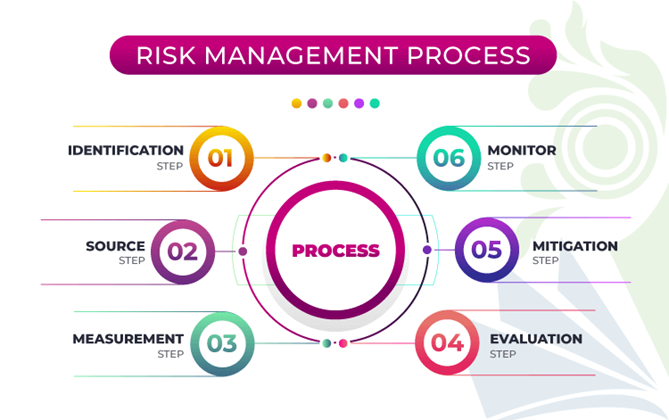
Every business or entrepreneur faces risks. Risk management is the practice of using processes, methods, and tools for managing risks. It focuses on identifying risks, evaluating risks, and implementing strategies to deal with those risks.
A risk management process involves:
Methodically identifying the risks surrounding your business activities
Assessing the likelihood of an event occurring•understanding how to respond to these events
Putting systems in place to deal with the consequences
Monitoring the effectiveness of your risk management approaches and controls