 Part four Language at work
Task 1 Phrase Match
You are required to find out the items equivalent tothose given in Chinese in the table below.
| 1 团队合作与沟通 ( ) 2 表现主动 ( ) 3 矛盾处理 ( ) 4 自我控制 ( ) 5 创新思路 ( ) 6 行为目的 ( ) 7 信息分享 ( ) 8 情绪失调 ( ) 9 激励队友 ( ) 10 完成目标 ( ) 11 解决问题 ( ) 12 截至到期 ( ) |
A creating idea B emotional self-control
C behavioral intention D motivationcolleagues
E presenting information F emotional dissonance
G conflict management H teamwork and collaboration
I meeting deadlines J solving problem
K achieving objectives M showing initiative
Task 2 Put the letters in bracketsin the right order to find words that match these definitions.
1. to suggest an idea: put forward (URPFOTWRDA)
2.general agreementbetween people: (OENSCSNUS)
3.choice or alternatives: (PIOSOTN)
4.assess/judge : (EVELAUAT)
5.an argument or open conflict: (AOTONROFNCNTI)
6. give/agree to something to get something: (OOMCPRIESM)
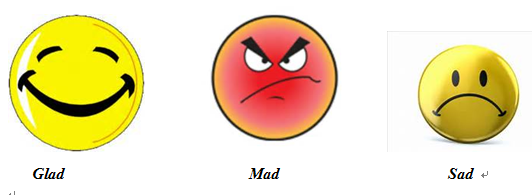
Task 3 Do you know the three words ? Please match the words with their explanation
1.Identify a personal experience around each of the following strong emotions:
– Anger,
frustration, rage, hostility.
– Sense of loss, depression, helplessness, unhappiness, or disappointment.
– Pride in an achievement, giddy excitement, joy, supreme satisfaction.
2. Reflect on how feeling each of these strong emotions affected you, either
positively or
negatively.
__________________________________________________________________________
__________________________________________________________________________
__________________________________________________________________________
Task 4 Fill in the blanks with the correct word or
expression from the list below.
well-groomed / mature / reliable / strengths / motivated / neat / flexible/ creative / punctual / thorough / energetic /organized / patient/cooperative/ resourceful / accurate
1. A person who can adapt to change easily is___________________________.
2. Mary is a very ____________________ person. I can always depend on her.
3. Artists and musicians are usually very _________________ people.
4. It is important for an accountant to be ____________________ in his/herwork.
5. You don’t have to be very _________________________ if you work onconstruction. It is different if you are working with the public.
6. He is rarely on time. He is not a very _____________________ person.
7. An ________________________ person plans things carefully and keeps things in order.
8. A __________________________ student likes to learn and doesn’t have tobe pushed to do it.
9. She is a very _____________________ worker. She completes everythingand pays attention to every detail.
10. He is not very __________________. He doesn’t work well with hisco-workers.
11. His desk is never ___________________. He can never find anything onit.
12. She is a very _______________________ cook. If she doesn’t have one ofthe ingredients, she just substitutes something else.
13. He hates waiting in lines. He is not a very _________________ person.
14. He is a very _______________ person. He can work long hours and nevergets tired.
15. Even though he is still a teenager, he is very __________________ andresponsible.
16. When an interviewer asks you about your __________________, he wantsto know about your good qualities.
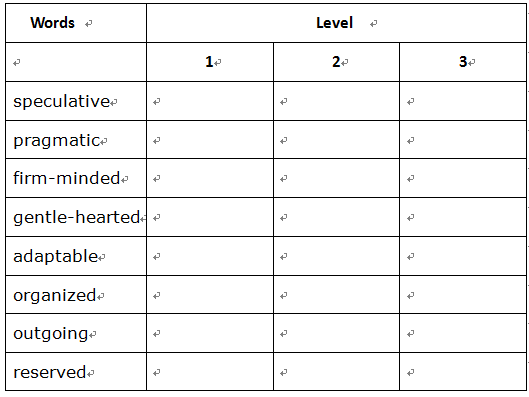
Task 5 Which words arethe best describes the way you see yourself? Tick √ from 1-3
Task 5 Translation
1 一个身心健康的工作团队能在各方面会让整个公司健康运行
2 一个善于支持和理解员工的老板,会减少员工患高血压和与压力相关疾病的机会。
3 摊上个坏老板可能会对你的心脏不利
4 研究团队发现对老板抱有敬重态度的工人身心比较健康,很少有心脏问题发生。
 Part Five Classroom Activities
Activity One
Circle behaviors you think are inappropriate for the workplace.
1. Arriving to work 15minutes late.( )
2. Bringing a doctor’s note to work after you have called in sick( ).
3. Offering to help your coworker with a project.( )
4. Instant messaging your friends when you don’t have any work to do( ).
5. Complaining to yourcoworkers about your boss.( )
6. Asking your boss if youcan talk to them about a problem you’re having in the office.( )
7. Calling in sick because you were up late the night before.( )
8. Telling your coworker you can’t help them because it’snot part of your job.( )
9. Waiting until your lunch break to talk to your coworker about your plans for the weekend.( )
10. Asking your boss if you can help with anything when you have finished your work.( )
Activity two Emotion Testing
Please choose one answer you think is reasonable and then compare your answer with your partner.
1 Do you like being with and meeting newpeople?
A Yes B No
2 How many friends do you have?
A A few close friends B Many friends and acquaintances
3 Which is more interesting toyou?
A Knowing how people think B Knowing how people feel
4 Whichis more productive for you?
A Play now / work later B Worknow / play later
5 Which slogan better captures your point ofview?
A He who hesitates is lost. B Lookbefore you leap.
6 At a party, you _________
A talk as much as you listen. B listen more than you talk.
7 Doyou remember what you had for dinner yesterday?
A Yes B No
8 Which statement are you more likely tomake?
A If I enjoy a particular activity, I'llengage in it frequently enough to do it well.
B Once an activity is familiar to me, I want to change it or try something new.
9 Do you usually take things personally?
A Yes B No
10 Which statement characterizes your generalapproach to life?
A Just do it B Check out thealternatives
11 When you disagree with people ___________
A it is difficult for you to tell them. B you like to speak out.
12 Whichsport do you prefer to do when you need some exercise?
A Swimming or jogging B Basketball or tennis
13 When you are on vacation, you are morelikely to _________
A forget about your everyday routine andconcentrate on having fun.
B think about things you need to prepare forwhen the vacation is over.
14 Which is more important to you?
A Competence B Relationships
15 Do you often wait until a deadline is near before focusing on completing atask?
A Yes B No
Activity three
How to develop good communication skills? Do you think the following statements are true or false?
• Maintaineye contact. T □ F □
• Bodylanguage, gestures and facial expressions are more important than the words youuse T □ F □
•Be receptiveto what others say T □ F □
• Don’t sentmixed messages T □ F □
•Be positive T □ F □
• Goodcommunication cannot be taught T □ F □
• Being agood listener is more important than being a fluent speaker T □ F □
• Don’t to beaware of what your body is saying just use your words T □ F □
• Know what communication really is not important T □ F □
• Have courageto say what you think T □ F □