
目录

  • 1 第一单元 Company Knowing
    • 1.1 Listening
    • 1.2 Speaking
      • 1.2.1 Tell your company
    • 1.3 Reading
    • 1.4 Language at Work and Class Activity
      • 1.4.1 Extra Learning -body parts in business
      • 1.4.2 Real Estate Problem
    • 1.5 Writing
  • 2 第二单元 Job Hunting
    • 2.1 Listening
    • 2.2 Speaking
      • 2.2.1 Job
    • 2.3 Reading
    • 2.4 Language at Work and Class Activity
      • 2.4.1 Extra Learning Job Titles
    • 2.5 Writing
      • 2.5.1 Letter of application
  • 3 第三单元 Office Activities
    • 3.1 Listening
    • 3.2 Speaking
      • 3.2.1 Extra speaking practice - Phone call
        • 3.2.1.1 Phone Call
      • 3.2.2 telephone glossary
    • 3.3 Reading
    • 3.4 Language at Work and Class Activity
    • 3.5 Writing
  • 4 第四单元 Effective Work
    • 4.1 Listening
    • 4.2 Speaking
      • 4.2.1 Extra Speaking Practice - Report
    • 4.3 Reading
    • 4.4 Language at Work and Class Activity
    • 4.5 Writing
  • 5 第五单元 Workplace Safety
    • 5.1 Listening
    • 5.2 Speaking
    • 5.3 Reading
    • 5.4 Language at Work and Class Actuvity
    • 5.5 Writing
  • 6 第六单元 Workplace Emotion
    • 6.1 Listening
    • 6.2 Speaking
      • 6.2.1 Diplomatic language to express criticism
    • 6.3 Reading
      • 6.3.1 Extre Reading
      • 6.3.2 Mixing Business and Pleasure
    • 6.4 Language at Work and Class Activity
      • 6.4.1 Sentence Making
      • 6.4.2 Read & Answer
    • 6.5 Writing
      • 6.5.1 Letter of Complain
  • 7 第七单元 Produt Introduction
    • 7.1 Listening
      • 7.1.1 listening practice 2
    • 7.2 Speaking
      • 7.2.1 Extra Speaking - Presentation
    • 7.3 Product Presentation
    • 7.4 Reading
    • 7.5 Language at Work and Class Activity
      • 7.5.1 Comparing products
      • 7.5.2 grammar review
      • 7.5.3 Translation
      • 7.5.4 Advertising and prodcutt
      • 7.5.5 Vocabulary
    • 7.6 Writing
      • 7.6.1 Extra Writing Practice
  • 8 第八单元  Career Development
    • 8.1 Listening
    • 8.2 Speaking
      • 8.2.1 Extra speaking practice
    • 8.3 Reading
      • 8.3.1 Extra Reading
    • 8.4 Language at Work and Class Activity
    • 8.5 Writing
  • 9 职场文字沟通能力训练
    • 9.1 Writing  (1)
    • 9.2 Wrting (2)
  • 10 职场英语阅读能力训练
    • 10.1 Reading with Vocabulary
    • 10.2 Reading
  • 11 职场沟通听力能力训练
    • 11.1 Listening
    • 11.2 Audio-Visual and Speaking
    • 11.3 翻转课堂
    • 11.4 机械专业英语图解 Extra Learning
  • 12 课程标准
    • 12.1 课程标准内容
  • 13 授课计划
    • 13.1 授课计划内容
Reading


                                   Part Three Reading 

                       Working Safely with and around Electricity

Electricity is a strong invisible force that gives power to machinery, lights, heaters, air conditioners, and many other forms of equipment that we have come to depend upon. However,electricity can be very dangerous, too. Accidental contact with electricalcurrents can cause injury, fire, extensive damage and even death. It is very important to remember that working with and around electricity requires yourfull attention and respect.

    Electrical safety involves more than just ensuring that electrical equipment is in good working order, it also involves ensuring that you can get to the main power source as quickly as possible without climbing over obstructions in the event of an emergency. Keep theaisles and walkways clean and clear of garbage, and make sure all flammable liquid, such as gases or chemicals, is stored away from the area where any electric tool will be operated. Many electric tools produce sparks, which could ignite the flammable liquid’s fumes and cause extensive damage.

    Asmentioned, water and electricity do not mix. In fact, water is an excellentconductor of electricity, and if water is thrown on an electrical fire, it willonly spread the fire. Instead, use a chemical fire extinguisher. Make sure you know how to operate a chemical fire extinguisher and where the nearest one isin case of emergency. If you have questions or have difficulty locating anextinguisher, ask your supervisor for help.


Task 1 Mutiple Choice :

1.)    This article talks about how__________

a.       electricalequipment should be in good working order.

b.      you shouldproperly extinguish a fire.

c.       dangerouselectricity could be.

d.      a, b, c, & d are all correct

2.)    Contact withelectrical currents can cause_________

a.       your hair tocatch on fire              b.      death

c.       energy to one’sbody                    d.      injury

e.       b & d


3.)    Putting water onan electrical fire can_________

a.       extinguish thefire

b.      cause the fire tospread

c.       stop the fire orspread the fire, depending on the wind

d.      cause an accident

4.) A worker must always know where the fire extinguisher is located.

a. True

b. False

5.) Conditioners, Heaters, Machinery, Lights all require________

a. electricity                                   b.water

c. gas                                            d.air

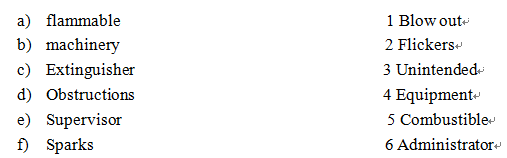
Task 2 Matchthe following synonyms from the article.
Task 3 

Match the following phrases from the article(sometimes more than one combination is possible)

a.       strong invisible force

b.      .cause extensive damage

c.       electricity requires your full attention and respect

d.      water and electricity do not mix

1.      powerful force that cannot be seen

2.      causea lot of damage

3.      not to be walking over barriers

4.      they are not complimentary elements

5.      mandatory that someone is alert and watchful.