
Parttwo Open your mouth 
Task three
Talking about your company (group task )
Building " a Company " by groups in class and then introduce your company .
You may need to present your company to visitors, potential investors or partners, or new suppliers and clients. Here is some useful English vocabulary to learn that will help you talk clearly, concisely and positively about what your company does.
Giving the history of your company
We were founded / set up / established in 2017.
We merged with X company in 1990.
We set up a subsidiary in the UK.
The subsidiary was sold off two years after and the remaining company was split into five different divisions.
We floated on the stock exchange last year, and we are now listed on the London Stock Exchange.
Talking about your products and services
We make / produce packaging material.
We manufacture car engines.
We supply paper products.
We launched a new washing powder last month. It has revolutionised the washing process. We have pioneered new ways of reducing energy costs in domestic appliances.
We are researching new products for the home entertainment industry. We hope to roll them outearly next year.
We are developing new software for the internet. Our R&D department is working closely with ourinternational partners.
Company performance
We are the market leaders in three countries.
We have expanded our operations.
Our company has grown by one-third.
We make annual profits of $1 million.
Our turnover is in excess of $2 million.
Company structure
At the head is the President, or CEO.
Below the President is the Managing Director, who has overall responsibility for the day-to-day running of the company.
The company is divided into different departments, each with its own director. The Marketing and Sales department consists of the sales team, and customer services. The Administration department also includes Human Resources.
We employ more than 2000 people worldwide.
Responsibilities
I report to the Marketing Manager.
I deal with customer enquiries.
We work closely with the sales team, who are in charge of customer accounts.
We co-operate with our offices worldwide.
We have more than one branch in some countries.
We are responsible for our own markets.
Task Four Tell your ideal company .
1 Work with a partner. Look at the criteria for an ideal company and talk with your partner.
My ideal company:
• has a female CEO
•gives six months’ paid maternity leave and one month paid paternity leave
• has a crèche facility
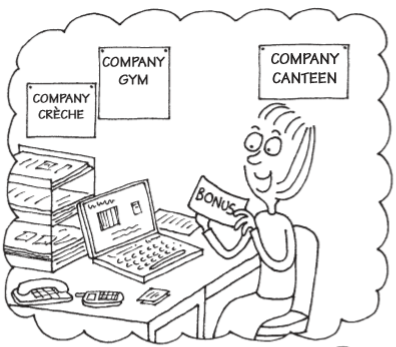
• has a good quality canteen
• gives equal pay to women and men
• gives employees a laptop computer and mobile phone for business and personal use
• has opportunities for promotion and personal development
• awards bonuses and gives fringe benefits to employees
•provides at least six weeks’ training a year
• has an annual staff party

• has a generous company pension scheme
• allows women with three children to retire at 55
•has a gym and sports facilities
• pays one month extra salary to employees who have a new baby or who get married
2 Make sentences about your ideal boss from the prompts below using the adverbs of frequency in the box. Then compare your sentences with a partner.
My ideal boss:
•reads my e-mails
• lets me make personal calls at work 
•takes me out to dinner
• has regular update meetings with me
• sends me on trips • calls me by my first name
• phones me at home to discuss work
•leaves me to get on with my work
•chats about his/her family and other non work-related topics
• brings me coffee
•sets regular deadlines and targets
• lets me leave work early
• says thank you • praises me
•gives me lots of responsibility
• lets me work from home
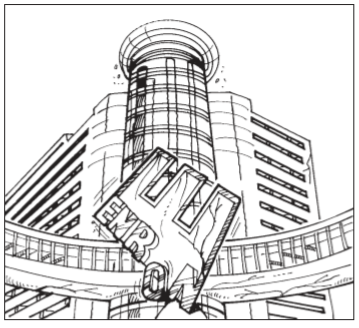
Task Five The rise and fall of Enron
1 Work with a partner. Put the events in Enron’s history into the correct order. The first one has been done for you.
___A Ken Lay, boss of Houston Natural Gas, was immediately appointed CEO of the newly-formed company.
___B When it didn’t receive answers, the regulator launched a formal investigation into Enron’s
investments. As a result, Enron’s Chief Financial Officer resigned.
___C During the 1990’s, Enron continued to expand and diversify at an incredible rate. It invested $2 billion in a power plant in India, bought a water company in the UK and acquired an electricity company in Portland, Oregon.
___D Enron was founded in 1985 when two gas companies, Houston Natural Gas and InterNorth, merged to create the first national natural gas pipe network.
___E Finally, the company was declared bankrupt, but the directors had already sold their shares and walked away with the profits.
___F Three years after its creation, Enron opened its first offices abroad as part of a strategy to take advantage of newly-privatised markets.
___G By the end of 2000, annual revenues had reached $100 billion, making Enron the sixth-largest energy company in the world. Most of this was from trading activities.
___H However, Enron was not satisfied with revenue just from gas trading, so it also moved into electricity trading, establishing a trading centre in London. This became the company’s most profitable activity.
___I The first evidence of false accounting came in the first few months of 2001 when Enron admitted it had lost $570 million. Its share price fell, causing a cash and credit crisis.
___J In July, the regulator started asking Enron to give more details about its financial performance.
___K At the same time as opening offices overseas, Enron began trading natural gas in North America.
___L By the turn of the century, a highly competitive work culture had developed. Each year 15% of Enron’s employees were sacked and replaced with younger, ambitious graduates.
___M The investigation found that the company and its accountants had lied to its shareholders and employees about $2 billion of debt.
2 Discuss with your partner what you think was the main reason for Enron’s failure.
• It grew too quickly.
• Its trading business was based on trust, not on capital assets.
•It was not open about its accounts.
• It diversified too much.
• Its directors were only interested in profits for themselves.
• It exploited the deregulation of energy markets and made existing companies jealous.

