
Style translation is the focus and goal of traditional translation theorists in China.
风格翻译是我国传统翻译理论家讨论的重点和追求的目标。
Thus the viewpoint of“Language Is the Basis Of Style Translation”is agreed upon by both groups which hold the point of Translatability or Untranslatability.
由于文学是语言的艺术,语言是文学的第一要素,无论是可译派还是不可译派都承认风格翻译的基础在于语言。
Study of Style Translation, particularly of the Translation of Style in Fiction, remains remarkably traditional, as Shen Dan states that it is characterized by general and impressionistic comments on style or by an intuitive analysis with a notable lack of sensitivity to subtle stylistic devices.
风格翻译问题是文学翻译学里较难的问题,也是文学翻译艺术生成的关键问题。
通过语言的分析来判断作品的风格,是风格翻译的基础。
By style as choice is meant that style “results from a tendency of a speaker or writer to consistently choose certain structures over others available in the language” (Traugott and Pratt, 1980)
The choice is not always conscious, sometimes it is intuitive or even habitual.
For example:
As though a rose should close (shut) and be a bud again. —The Eve of St. Agnes—Keats
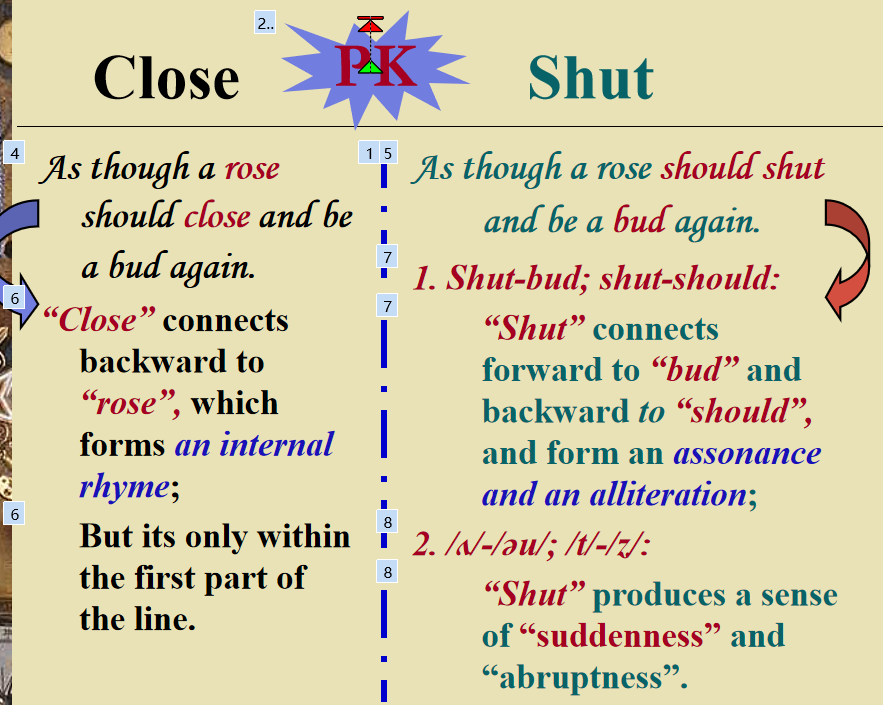
Thus, from General, linguistic-oriented aspect, we can say
Style is:
Manners indicating prominent linguistic features, devices or patterns, most (or least) frequently occur in a particular text of a particular variety of language.
1. stylistic markers in phonology
Suprasegmental features (phonological features above the sound segment level)
These features include stress, duration, pitch, juncture, transition, pause, intonation, rhythm, etc.
They can help to express the attitude or feeling of the speakers.
Phonetic devices
Onomatopoeia : Onomatopoeia can be employed to describe concrete objects to make the language be full of sound and color, dramatic and more impressive; Onomatopoeia plays an important part in playing up certain circumstances and conveying the feelings of characters; It helps to achieve rhyme and beauty in music.
Sound Patterning:referring to the matching of identical or similar sound (s) between two or more words. English words may consist of one or more syllables.
Sound patterning is not only a source of aesthetic satisfaction, but also a phonological means of emphasis. The device is exploited in prose, particularly in newspaper headlines, advertising jingles, etc. as well as in poetry.
(1) Alliteration: Alliteration is the repetition of the initial consonant cluster in stressed syllables. 头韵 Alliteration is usually used to form a connection of similarity or a connection of contrast.
(2) Assonance: Assonance is the repetition of identical vowel or diphthong in stressed syllables. 腹韵(元音迭韵)Assonance is much used in poetic language as an aspect of sound patterning and cohesion to achieve a particular effect of euphony.
(3) Consonance: Consonance is the repetition of the final consonant (cluster) in stressed syllables. 尾韵,辅音韵,假韵
(4) Rhyme 韵,押韵
In the general sense, "rhyme" can refer to various kinds of phonetic similarity between words, and to the use of such similar-sounding words in organizing verse.
The general function of rhymes is to get the texts more organized and to bestow ‘music’ to the text. Rhymes may also be used to bind lines which are closely associated in content.
Phonological deviation
Phonological deviation is most frequently used in poetry. For the sake of creating rhyme and meter, the poet can omit certain syllables, change the stress and pronunciation of a word.
(1)Omission (Aphesis [æ'fɪsɪs] – the omission of an initial part of a word 非重读词首音的脱落;Syncope [ˈsɪŋkəpi] – the omission of a medial part of a word 字中音省略;Apocope [əˈpɒkəpi] – the omission of a final part of a word 字尾音消失)
The omissions change the pronunciations of the original words so that the poet may be better and more easily arrange sound patterns to achieve their intended communicative effects.
(2)Mispronunciation and Sub-standard pronunciation
The employment of the deviant phonological features adds vividness to the happening as if it was the live transmission of the scene.
(3)Special Pronunciation
For convenience of rhyming, the poet may give special pronunciation to certain words.
Sample analysis P245-247
Robert Frost's Stopping by Woods on a Snowy Evening
刘长卿 《逢雪宿芙蓉山主人》
2. stylistic markers in lexis
词语标记显示作者的用词倾向(idiolect)。
1)语义标记,包括词汇的感情色彩,抽象度,动态度及习语化程度等。
2)语域标记:包括正式度,专业度及标准程度。
3)词汇的冗余度。
3. stylistic markers in syntax
西方人:注重细节,讲究个体成分的独立作用,强调形式分析和逻辑推理
东方人:倾向于整体,习惯于综合概括
英语重形合,注重句子结构形式的完整和逻辑的推理
汉语重意合,句法关系主要靠词序和语义关系表达
表现为各种有特色的句法形式,反复使用于某一上下文中即形成风格的句法标记。句法标记大致应包括:
1)语气标记:如陈述语气,祈使语气,疑问语气等。
2)结构标记:如简单句/复合句,并列句/主从句,松散句/圆周句,主动句/被动句,倒装句/非倒装句等。
4. stylistic markers in rhetoric (figures of speech)
Figures of speech have to with the way words are made to mean other than what they would normally imply. They are ways of making language figurative.
A knowledge of these figures is of help to us not only in deepening our understanding of what we read, but also in appreciating more fully the finer points of writer's style.
(1) metaphor
like a simile, also makes a comparison between two unlike elements, but unlike a simile, this comparison is implied rather than stated.
(2) personification
a figure of speech that gives human form or feelings to animals, or life and personal attributes to inanimate objects, or to ideas and abstractions.
The moans of the autumn wind.
The wind whistled through the trees.
你不理财,财不理你。《理财周刊》
她工作,你休息。(洗衣机)
(3) repetition
Repetition is restricted to mean the case of exact copying of a certain previous unit in a text, such as word, phrase or even a sentence, which subsumes immediate repetition and intermittent repetition.
The repetition serves to combine the lines together and give unity to the idea expressed.
5. stylistic markers in text
古代汉语律诗通常由一个相当规范的创作构思——起 承 转 合,这种构思模式对诗歌创作起到积极的指导作用。它精巧简练,结构完美,既有很强的艺术性,又切合人类的思维逻辑。

