
When talking about equivalence, Catford said that "translation equivalence depends on the interchangeability of the source language and the target language in the same context." Interchangeability is related to the communicative function of the text in the context, that is to say, "in order to establish translation equivalence, both the source language and the target language version must be connected with the contextual features of functional relevance". Catford emphasizes the relationship between translation and language function. What are the main functions of language? There are three main functions of language: cognitive and expressive function, cultural function and artistic function. Among them, cognitive function is the most fundamental and obvious feature of language. In order to facilitate analysis, we replace cognitive function with language function. In this way, we get three levels of equivalence: linguistic equivalence, cultural equivalence and artistic equivalence
1. linguistic equivalence
Because of the commonness of human thinking and the objectivity of the world, the expressions of different languages have many identities, which makes translation exist and communication continue. There are two levels of language equivalence in Translation: surface meaning equivalence and deep meaning equivalence.
a. Surface meaning equivalence = literal translation
从原语表层结构转换成译入语中相应的表层结构,意义不变。直译,形式不变,字面意义对等(p190)
e.g. castles in the air 空中楼阁
as thin as stick 骨瘦如柴
pour oil on the fire 火上浇油
缺点:误译
All that glitters is not gold.
误译:所有闪光的都不是金子
正译:闪光的并非都是金子
We cannot praise the hero too much.
误译:我们不能赞美英雄太多
正译:我们无论怎么赞美英雄都不为过
b. Deep meaning equivalence
译入语中选用与原语的喻意相同相似的对等语。
1. 部分表层意义对等+深层意义对等
to spend money like water 挥金如土
Money makes the mare go 有钱能使鬼推磨
2. 仅做深层意义对等 (对表层意义做出变通)
She expects loyalty, not fidelity.
她期待(丈夫)对她在名分上始终保持不变,而并非对她在性关系上专一。
Albright is on a first-name basis with Primacor.
奥尔布赖特与普利马科夫已不拘礼节,相互直呼对方名字。
Hanoi romanced its Asian neighbors for six years before winning itsmembership in ASEAN.
河内对其邻国进行了六年的亲善努力后成为东盟的一员。
2. Cultural equivalence
Translation is mainly a social and cultural activity. What translation requires is not only to be able to understand two (or more) languages, but also to be familiar with two (or more) cultures.
Li bai's
《静夜思》
Moonlight before my bed
Could it be frost instead?
Head up, I watch the moon
Head down, I think of home.
你认为此译文如何?是否做到了文化等值?
I suspected she might be right and I wrong: but I would not ponder thematter deeply: like Felix, I put it off to a more convenient season. (Bronte, Jane Eyre)
【译文一】我想,也许她是对的,我错了。可是我不愿意深入思考这个问题,只好把它留到以后,有机会时我会仔细想想的。(长春版《简·爱》)
【译文二】我疑心也许是她对,是我错了,可是我又不愿意深入地思考这个问题;像费力克斯一样,我把它留到以后方便的时候再去考虑。(上海译文版《简·爱》)【译文三】我怀疑她是对的,而我错了,但是我不想把这问题深究下去,也像费力克斯一样,我把它暂且搁下,以后再说。(脚注——费力克斯《圣经》中一个遇事拖延的法官。)(人民文学版《简·爱》)
你认为以上三种译文如何?哪一个译文较好地做到了文化等值?
以上例子中给出了一个“文外补偿”的方式保持文化对等。
现在更流行的是文内注释,更方便阅读。
译文四:可能她对了,我错了。我不想究。我跟《圣经》中爱拖延的法官费力克斯一样,暂且搁置,以后再说。
教材说文外补偿最能保持翻译中的文化等值,你是否认同?
3. Aesthetic equivalence
Language is the carrier of information. In addition to semantic information and cultural information, language information also includes artistic information, that is, the aesthetic meaning expressed through language forms. For language symbols, it is mainly reflected in two aspects: sound and form. As we know, language is a convention formed by people through long social practice. Different nationalities have different language symbol systems. The uniqueness of language in form and structure makes the artistic equivalence of translation an insurmountable obstacle.
a. Phonetic features
海水朝朝朝朝朝朝朝朝落;
浮云长长长长长长长长消。
对联中的“朝”和“长”,都是同形异音异义。“朝”(zhao),作今日解,
如“今朝”;朝(chao)音“潮”,作潮水解。“长”(chang)为长短之“长”,
长(zhang)作生长之“长”。
可念作:海水,朝潮,朝朝潮,朝潮朝落。
浮云,长长,长长长,长长长消。
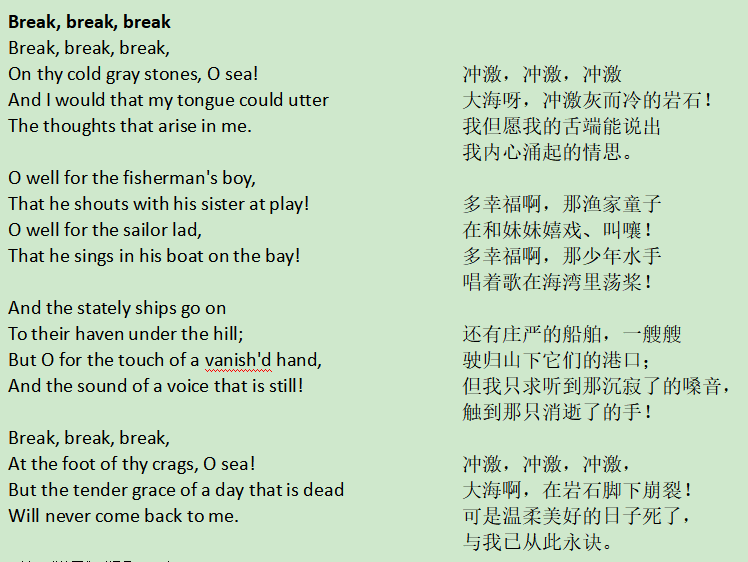
长元音和双元音往往用来展现低沉、深远、连绵不断的感情。如英国诗人阿尔弗雷德·丁尼生(Alfred Tennyson)的《拍岸曲》(Break, Break, Break)中使用了大量的长元音[i:]和双元音[ei],以表达诗人对英年早逝挚友的怀念和哀悼。
短元音和某些辅音则常常表达轻柔、滑动、悦耳的声音,如[s],[n],[w],[m],[l]。还有一些辅音如[t],[z],[dz],[k],[g],[ts]等往往暗示剧烈、不和谐、粗暴的动作。
b. Morphological features
丁尼生的这首诗巧妙地运用了许多带字母“o”的单词,从上至下,大小不一,犹如海水冲击出的泡沫,再配以长短不一的诗行,横看恰似高低起伏波浪,使整首诗仿佛沉浸在汹涌的大海之中,给读者以强烈的视觉冲击。

