1. There’s no pot so ugly it can’t find a lid.
Literal translation: 再丑的罐儿也不愁配个盖儿。
Or:罐儿再丑,配个盖儿不犯愁。
Free translation:再丑的姑娘也不愁找不到婆家。Or:丑女不愁嫁。
2.Little fish does not eat big fish.
Literal translation: 小鱼吃不了大鱼。
Free translation: 胳膊拧不过大腿。
3.What the tongue says, the neck pays for
Literal translation: 舌头说话,脖子还帐。
Free translation: 舌头闯祸,脖子遭殃。
4.What was hatched a hen must not try to be a rooster!
Literal translation: 孵出来是母鸡就别想冒充公鸡!
Free translation: 生就是个女人就别想冒充男人!
5.A gift is the key to open the door closed against you.
Literal translation: 礼物是打开把你关在门外的房门的钥匙。
Free translation: 大门把你关在外,礼物送到门自开。
The above illustrations can not be translated literally, otherwise, the Chinese rendition would make no sense at all, let alone the original meaning.
More often than not, literal translation and free translation may be alternately used in the process of translation.
直译和意译兼用也被看作是 “平行式转换” (Paralleling)。这中翻译方法是指在翻译过程中将直译和意译二者结合,交替使用。
1.我在学堂里坐着,心里也闷,不如给人家放牛。
I feel sitting in school boring anyway. I’d rather look after our neighbor’s buffaloes.
2.他一边写着,一边注视着窗外,防止被巡查的人员看见。
While writing, he would keep an eye on the outside of the window for fear the the guard on duty would see him.
3.雨可能会停,但带把伞又何妨呢?
The rain may hold off, but it won’t hurt you to take an umbrella with you.
4.接着走过三个人来,头戴方巾,……都是四五十岁光景,手摇白纸扇,缓步而来。
Behind him came three men in scholar’s square caps, … all some forty to fifty years old, fanning themselves with white paper fans, they advanced slowly.
直译加注释LITERAL+NOTE
当意译文本承载太多原文文化信息的句子的时候,为使读者正确清晰理解该文本,译者可以采用加注释的方式,用注释性翻译解释清楚。
bean curd--- toufu, a kind of Chinese food made of beans and shaped squre, colored white
dumpling--- jiaozi, a dumpling-like snack made of a flour wrapper with meat stuffed inside and severed with soup
继“long time no see(好久不见)”
“people mountain people sea(人山人海)”
“no zuo no die”(不作死就不会死)美国在线俚语词典“城市词典”(Urban Dictionary)录入
"you can you up"(你行你上啊)
"no can no BB"(不行就别乱喷)
“tuhao(土豪)”“dama(大妈)”和“hukou(户口)”
等中文拼音也被“高大上”的牛津英语词典相中,并有望于今年入选。
“世界是英文的,也是中文的,但归根结底会是拼音的。”
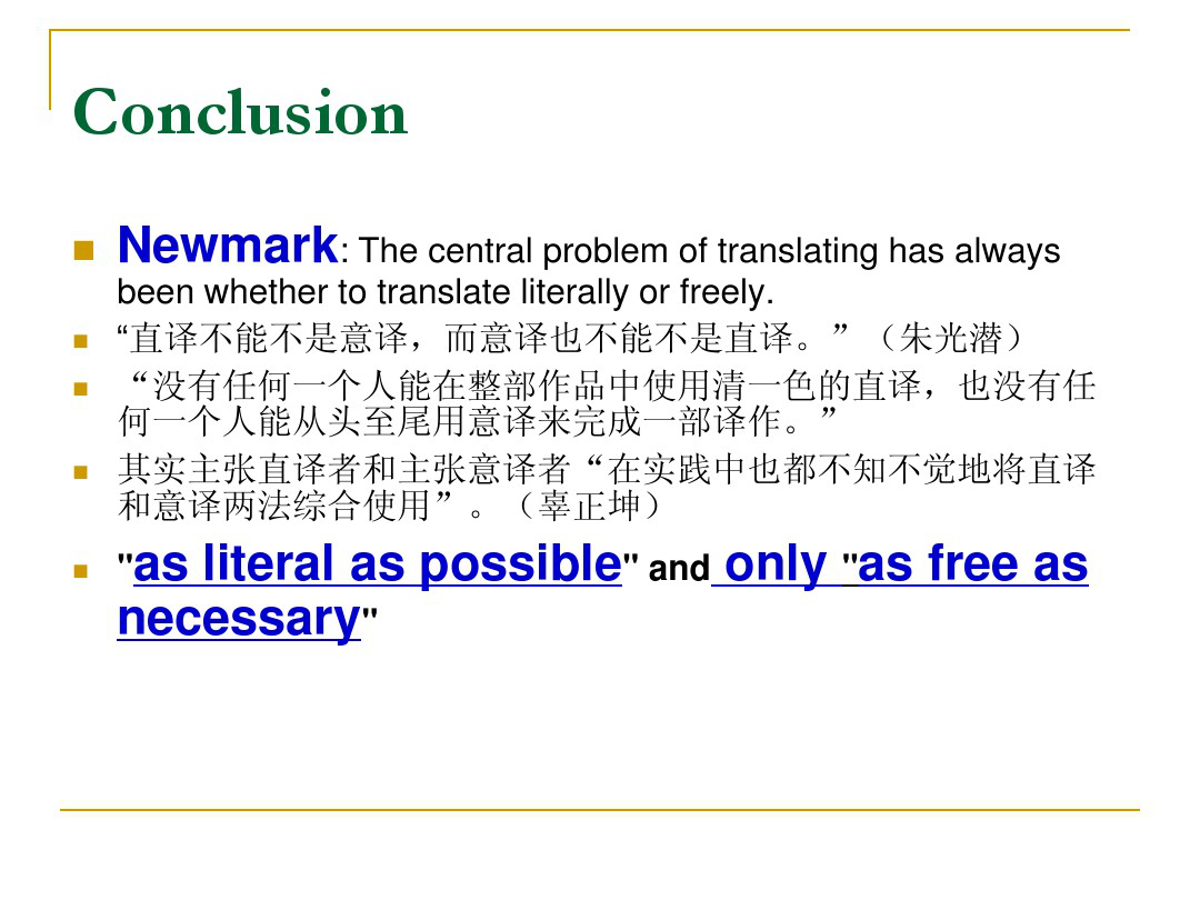
Literal translation and free translation, however, are two relative concepts. In other words, there is no absolute “literal”, nor entirely “free” version in the practice of translation, and overemphasizing either of them would result in ridiculous consequences.