目录

  • 1 Introduction: What is translation
    • 1.1 Translation VS translating
    • 1.2 Translation is a science & an art
  • 2 Chapter 1   Understanding of Translation from different perspectives:Translation & translators- The process of translation
    • 2.1 Descriptions of translation from the perspective of  the role of the translators
    • 2.2 Descriptions of translation from the perspective of  the process of translating
    • 2.3 Summary
    • 2.4 Assignment
  • 3 Chapter 2 The Principles of Translation
    • 3.1 Principles or Criteria of Translation
    • 3.2 Principles proposed by Chinese translators and scholars
    • 3.3 Principles proposed by foreign translators and scholars
    • 3.4 A systematic summary of principles of translation
    • 3.5 Summary
    • 3.6 Supplementary material: The schools of translation theories
    • 3.7 Assignment
  • 4 Chapter 3 Translation and Culture
    • 4.1 Review of the schools of translation theories: cultural translation
    • 4.2 Language & culture
      • 4.2.1 The relationship between language and culture
      • 4.2.2 Cultral infiltration in translation
    • 4.3 Culture differences and translation
      • 4.3.1 Differences between Chinese and western languages
      • 4.3.2 Cultural transmutation in translation
    • 4.4 Summary
    • 4.5 Assignment
  • 5 Chapter 4 The Professional quality of a translator
    • 5.1 Responsibilities of a translator
    • 5.2 Qualities of a translator
    • 5.3 Unique qualities of an interpreter
    • 5.4 Summary
    • 5.5 Assignment
  • 6 Chapter 5 The Creativity of translation
    • 6.1 Translation is an intelligence activity
    • 6.2 The challenges that translators face
    • 6.3 Sample analysis
    • 6.4 Summary: Creative ideas and being faithful
    • 6.5 Assignment
  • 7 Chapter 6 The purposes of translation
    • 7.1 Translation is a type of communication
    • 7.2 Translation purpose and translation strategy
    • 7.3 The influence of translation on language development
    • 7.4 The function of cultural transmission and integration in Translation
    • 7.5 Assignment
  • 8 Chapter 7 The Classification of translation
    • 8.1 Specific vs. Genera translation
    • 8.2 Literary vs. non-literary translation
    • 8.3 Translation vs. interpretation
    • 8.4 Variant translation
    • 8.5 Assignment
  • 9 Chapter 8 Machine Translation
    • 9.1 What is machine translation?
    • 9.2 Principle of machine translation
    • 9.3 History and Prospect
    • 9.4 Summary and discussion
    • 9.5 Assignment
  • 10 Chapter 9 The Process of Translation
    • 10.1 Introduction
    • 10.2 The process of translation
    • 10.3 Understanding is the premise of translation
    • 10.4 Understanding and expression
    • 10.5 Assignment
  • 11 Chapter 10 Literal translation and free translation
    • 11.1 Introduction to  Literal Translation &  Free Translation
    • 11.2 The differences between  literal translation and  word-for-word translation
    • 11.3 The definitions of free translation
    • 11.4 Different functions of  literal translation and  free translation
    • 11.5 Combination of  literal translation and free translation
    • 11.6 Assignment
  • 12 Chapter 11 Equivalence
    • 12.1 Equivalence in translation
    • 12.2 Different Levels of equivalence
    • 12.3 Similarity in translation
    • 12.4 Translatability and untranslatability
      • 12.4.1 Further reading
    • 12.5 Assignment
  • 13 Chapter 12 Domestication and Foreignization
    • 13.1 The concept and history of domestication and foreignization
    • 13.2 How to understand domestication and foreignization correctly
    • 13.3 The functional strategy for domestication and foreignization
    • 13.4 Assignment
  • 14 Chapter 13 Hypotaxis and Parataxis &
    • 14.1 Definition of parataxis and hypotaxis
    • 14.2 Features of parataxis and hypotaxis in English and Chinese
    • 14.3 parataxis and hypotaxis in C-E translation
    • 14.4 Summary
    • 14.5 Assignment
  • 15 Chapter 14 The Styles of Translation
    • 15.1 Style and translation
    • 15.2 What is style?
    • 15.3 Can style be translated?
    • 15.4 The expression means of style
    • 15.5 Style shift
    • 15.6 Assignment
  • 16 Chapter 15 The Effect of Translation
    • 16.1 Losses in translation
    • 16.2 Gains in translation
    • 16.3 Assignment
The definitions of free translation
  1. the definition of free translation


我国学者张今认为,“意译是指在译文中另外寻找新的表现法,来表达原文的逻辑内容或形象内容。”这个定义主要强调意译的文字同原文相比,采用了“新的表现法”。

范仲英则是这样定义意译的:“意译······从意义出发,只要求将原文大意表现出来,不注意细节,译文流畅自然即可。”其定义的侧重点在于译文表达的“自然流畅”。

孙致礼认为意译法不拘泥于原文的表现形式,而应以传达原文的深层意思为主旨。这里的重点在于传达原文的精神主旨。

在许渊冲看来,只要是翻译,不管采用何种方式,忠实于原文都是最起码的要求,否则即不成为翻译了。

在西方,同样有很多学者对意译做出过定义。

英国翻译理论家卡特福德(J.C.Catford)认为,意译的“等值关系可以在上下层次间变动,但趋于较高的层次,有时是在比句子更大的单位间进行”。

在卡特福德的理论体系中,层次是指从语素到句子等各种不同大小的语言单位。

苏联翻译理论家巴尔胡达罗夫(Barkhudarov)将意译界定为“超出必要层次使内容不变并遵守译入语规范”的翻译。

在沙特尔沃斯和考伊看来,意译指“侧重于使目标文本读起来自然流畅,而不是完整保留原语文本措辞的翻译类型”。

在罗宾逊(Douglas Robinson)看来,意译是“一个无所不包的范畴,它包含任何不忠实于原文的翻译。······基本上,任何不属于有确定规范的可接受的翻译都可以称为意译,即使所谓的偏离原文的译文事实上同原语文本是紧密相关的”。

It is worth noting that although many western scholars did not use the term free translation, they put forward other terms. 


These new terms had a lot in common with free translation, such as 

Nida's "dynamic equivalence" and "functional equivalence"

Newmark's "communicative translation"

Gideon Toury's “acceptability”

Mildred L. Larson's “idiomatic translation”
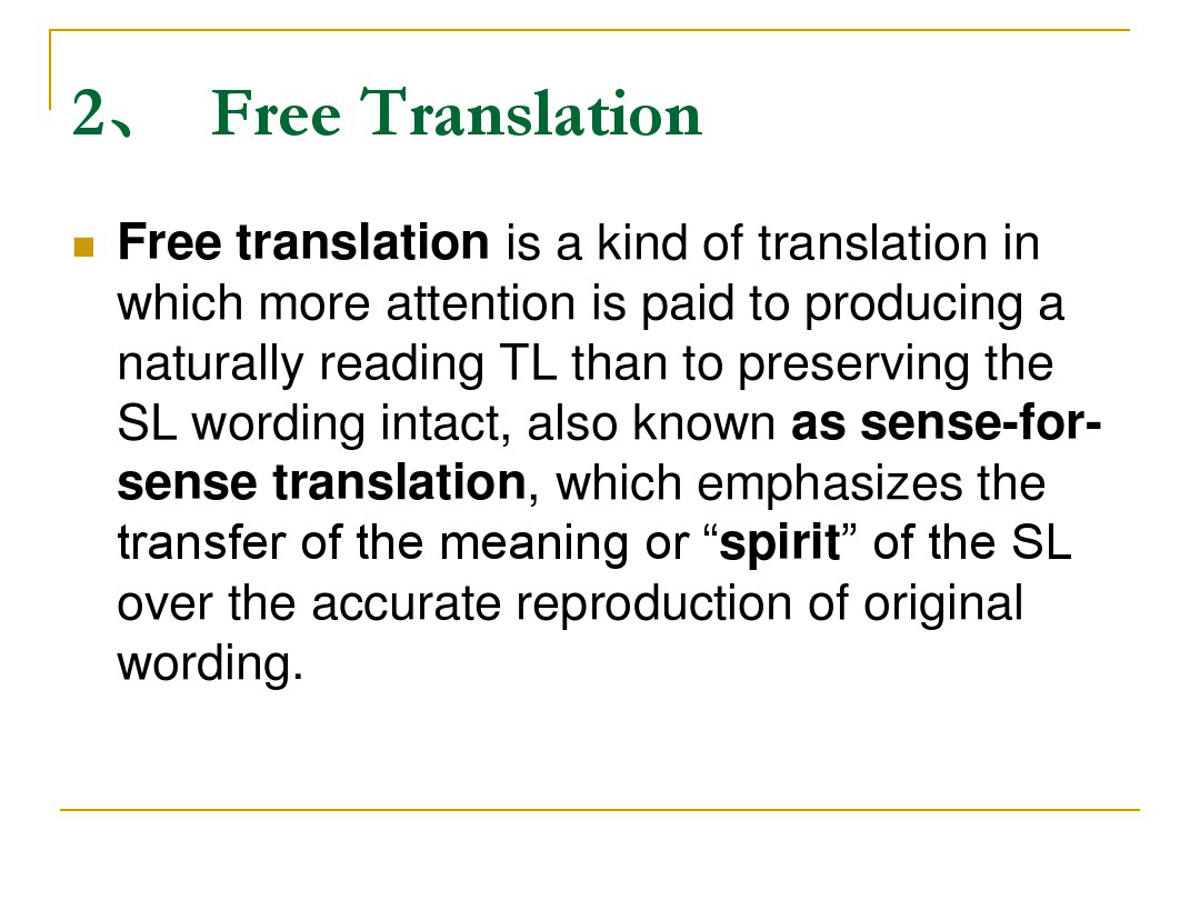
  1. 意译 是指根据原文的意思完整地表达,要求达意传神(sense-for sense translation)。意译主要在原语与译语体现巨大文化差异的情况下得以应用。从跨文化语言交际和文化交流的角度来看,意译强调的是译语文化体系和原语文化体系的相对独立性,更能够体现出本民族的语言特征。例如习语、诗词、成语等的翻译,常常通过意译来达到“信、达、雅”。

  2. It is worth noting that although many western scholars did not use the term free translation, they put forward other terms. 


  3. These new terms had a lot in common with free translation, such as 

  4. Nida's "dynamic equivalence" and "functional equivalence"

  5. Newmark's "communicative translation"

  6. Gideon Toury's “acceptability”

  7. Mildred L. Larson's “idiomatic translation”

例如:塞翁失马,焉知非福 。

  1. 如果直译的话,是这样的:

    When the old man on the frontier lost his mare, who could have guessed it was a blessing in disguise?   

    很明显直译是在讲个故事,但是却无法体现成语要表达的因祸得福的意思。所以我们需要意译:   

    A loss may turn out to be gain.

  2. The festures of free translation

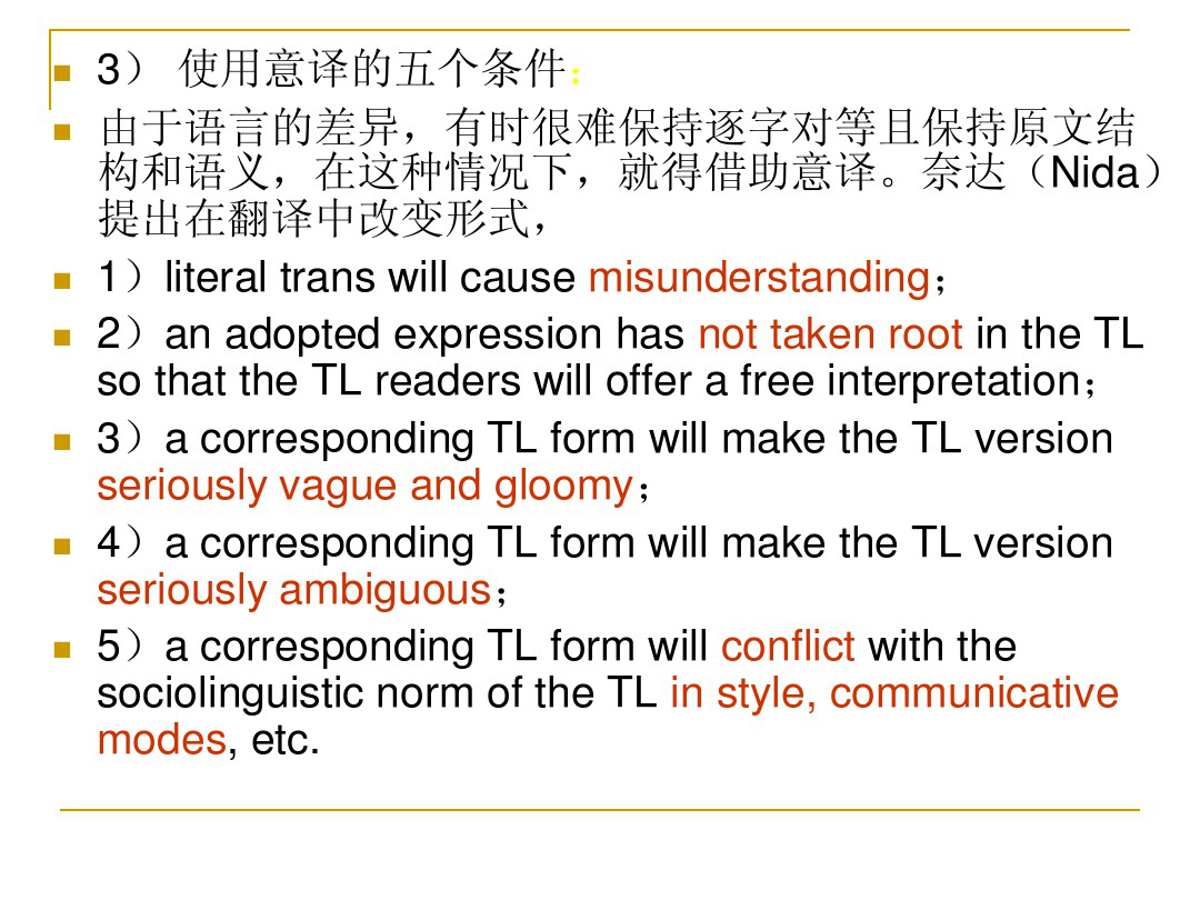
  3. 使用意译的5个条件

  4. When should we depend on free translation?