
目录

  • 1 Introduction: What is translation
    • 1.1 Translation VS translating
    • 1.2 Translation is a science & an art
  • 2 Chapter 1   Understanding of Translation from different perspectives:Translation & translators- The process of translation
    • 2.1 Descriptions of translation from the perspective of  the role of the translators
    • 2.2 Descriptions of translation from the perspective of  the process of translating
    • 2.3 Summary
    • 2.4 Assignment
  • 3 Chapter 2 The Principles of Translation
    • 3.1 Principles or Criteria of Translation
    • 3.2 Principles proposed by Chinese translators and scholars
    • 3.3 Principles proposed by foreign translators and scholars
    • 3.4 A systematic summary of principles of translation
    • 3.5 Summary
    • 3.6 Supplementary material: The schools of translation theories
    • 3.7 Assignment
  • 4 Chapter 3 Translation and Culture
    • 4.1 Review of the schools of translation theories: cultural translation
    • 4.2 Language & culture
      • 4.2.1 The relationship between language and culture
      • 4.2.2 Cultral infiltration in translation
    • 4.3 Culture differences and translation
      • 4.3.1 Differences between Chinese and western languages
      • 4.3.2 Cultural transmutation in translation
    • 4.4 Summary
    • 4.5 Assignment
  • 5 Chapter 4 The Professional quality of a translator
    • 5.1 Responsibilities of a translator
    • 5.2 Qualities of a translator
    • 5.3 Unique qualities of an interpreter
    • 5.4 Summary
    • 5.5 Assignment
  • 6 Chapter 5 The Creativity of translation
    • 6.1 Translation is an intelligence activity
    • 6.2 The challenges that translators face
    • 6.3 Sample analysis
    • 6.4 Summary: Creative ideas and being faithful
    • 6.5 Assignment
  • 7 Chapter 6 The purposes of translation
    • 7.1 Translation is a type of communication
    • 7.2 Translation purpose and translation strategy
    • 7.3 The influence of translation on language development
    • 7.4 The function of cultural transmission and integration in Translation
    • 7.5 Assignment
  • 8 Chapter 7 The Classification of translation
    • 8.1 Specific vs. Genera translation
    • 8.2 Literary vs. non-literary translation
    • 8.3 Translation vs. interpretation
    • 8.4 Variant translation
    • 8.5 Assignment
  • 9 Chapter 8 Machine Translation
    • 9.1 What is machine translation?
    • 9.2 Principle of machine translation
    • 9.3 History and Prospect
    • 9.4 Summary and discussion
    • 9.5 Assignment
  • 10 Chapter 9 The Process of Translation
    • 10.1 Introduction
    • 10.2 The process of translation
    • 10.3 Understanding is the premise of translation
    • 10.4 Understanding and expression
    • 10.5 Assignment
  • 11 Chapter 10 Literal translation and free translation
    • 11.1 Introduction to  Literal Translation &  Free Translation
    • 11.2 The differences between  literal translation and  word-for-word translation
    • 11.3 The definitions of free translation
    • 11.4 Different functions of  literal translation and  free translation
    • 11.5 Combination of  literal translation and free translation
    • 11.6 Assignment
  • 12 Chapter 11 Equivalence
    • 12.1 Equivalence in translation
    • 12.2 Different Levels of equivalence
    • 12.3 Similarity in translation
    • 12.4 Translatability and untranslatability
      • 12.4.1 Further reading
    • 12.5 Assignment
  • 13 Chapter 12 Domestication and Foreignization
    • 13.1 The concept and history of domestication and foreignization
    • 13.2 How to understand domestication and foreignization correctly
    • 13.3 The functional strategy for domestication and foreignization
    • 13.4 Assignment
  • 14 Chapter 13 Hypotaxis and Parataxis &
    • 14.1 Definition of parataxis and hypotaxis
    • 14.2 Features of parataxis and hypotaxis in English and Chinese
    • 14.3 parataxis and hypotaxis in C-E translation
    • 14.4 Summary
    • 14.5 Assignment
  • 15 Chapter 14 The Styles of Translation
    • 15.1 Style and translation
    • 15.2 What is style?
    • 15.3 Can style be translated?
    • 15.4 The expression means of style
    • 15.5 Style shift
    • 15.6 Assignment
  • 16 Chapter 15 The Effect of Translation
    • 16.1 Losses in translation
    • 16.2 Gains in translation
    • 16.3 Assignment
The differences between  literal translation and  word-for-word translation

1. Literal translation

1)Literal translation is an important translation method. It has many advantages, such as conveying the meaning of the original text and reflecting the style of the original text. It is estimated that about 70% of sentences need literal translation, so literal translation is widely used by translators.

Literal Translation is the rendering of text from one language to another one conveying the sense of the original whole. It is the way to maintain the contents and the form of the source language in accordance with the culture. It emphasizes the form similarity, and requires the accordance between the original passages and the target one in the choice of word, syntax and styles.

2)Word-for-word translation

This is often demonstrated as interlinear translation, with the TL immediately below the SL words. The SL word-order is preserved and the words translated singly by their most common meaning, out of context. Cultural words are translated literally. The main use of a word-for-word translation is either to understand the mechanics of the source language or to construe a difficult text as a pre-translation process.

        Eg. David Hawkes' translation of Du Fu's 《登高》
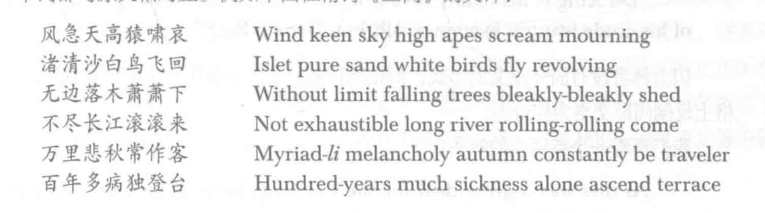

        Of course, Hawkes' translation method has a special purpose, that is, to let English readers know the meaning of single Chinese characters in Du Fu's poems, so as to understand the structure of ancient Chinese poetry to a certain extent. 

       Word-for-word translation is also used in foreign language teaching to clarify the syntactic features of a foreign language, or to compare the syntax of a foreign language with that of its mother tongue. 

       In general, such extreme situations as the above are rare. However, the phenomenon of using the original expression form and being too rigid in the literal meaning of the original text has always existed in all kinds of translation, and even some famous people can not help but make such mistakes. Look at the following examples.

Summary (literal trans vs. word-for-word trans)

The most important difference is that:

literal translation takes into account the grammatical norms of the target language and makes necessary adjustments to the form of the original text, so that the text is relatively smooth and the readers can understand it. 

However, word for word translation ignores the grammatical norms and expression habits of the target language, regards the original text as "sacred and inviolable", and blindly pursues formal equivalence. As a result, the translated text is obscure and hard, and even does not know what to say.

Looking at the actual translation from foreign language to Chinese, the style of word-for-word translation and dead translation is prevalent nowadays, and the purity of Chinese is facing an unprecedented threat. What's more, the Chinese people who have been accustomed to this "vicious Westernized" Chinese (恶性西化的中文) since childhood have adapted to various unnatural Chinese expressions and have no way to distinguish the original beauty of Chinese. We must pay enough attention to it.

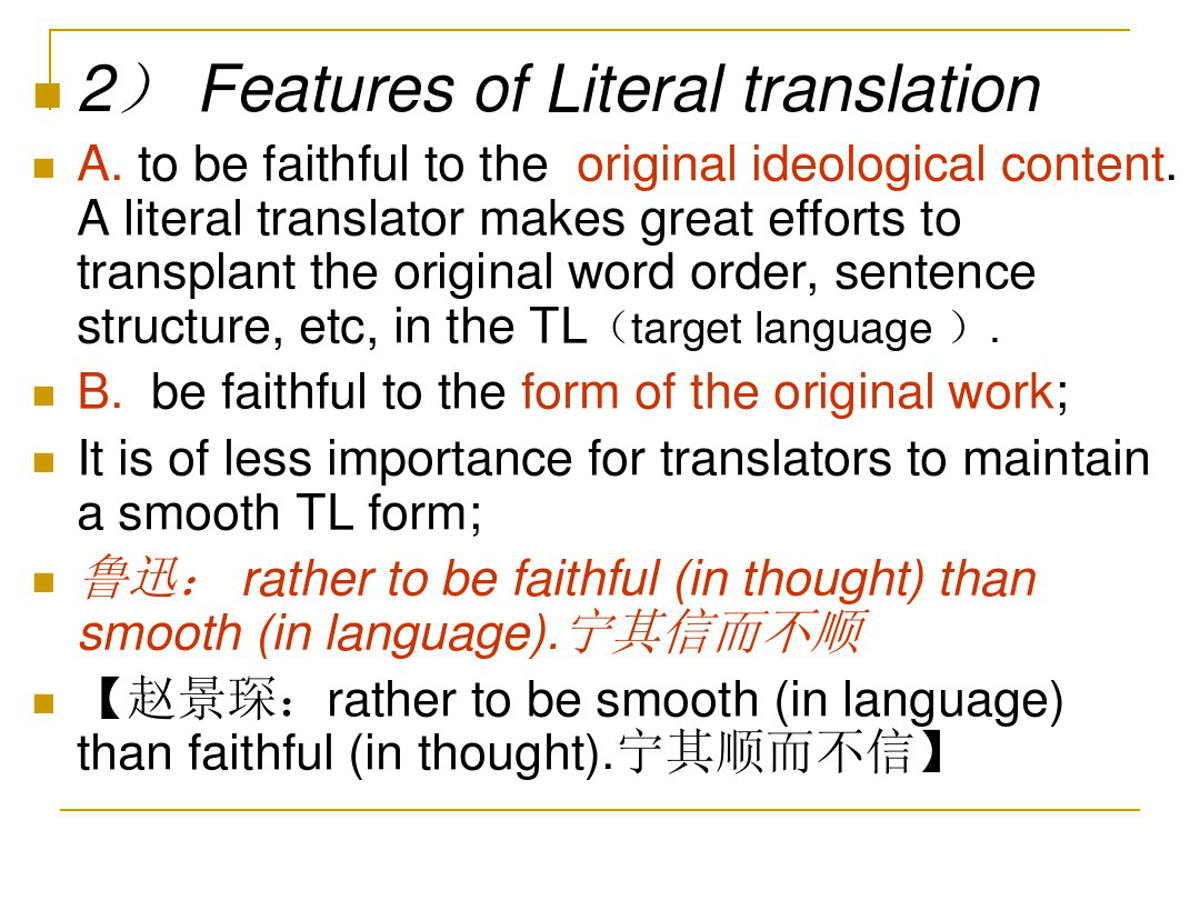
3. The features of literal translation

4. When should we depend on literal translartion?