
Understanding is the premise of translation
1. The importance of understanding in the whole translation process
译者不深刻的理解、体会与感受原作,绝不可能叫读者理解、体会与感受。
【傅雷,《傅雷谈翻译》,2005】
(My iron shroud contracted round me;persuasion advanced with slow,sure step. Shut my eyes as I would, these last words of his succeeded in making the way, which had seemed blocked up, comparatively clear. My work,which had appeared so vague,so hopelessly diffuse, condensed itself as he proceeded, and assumed a definite form under his shaping hand.) He waited for an answer. I demanded a quarter of an hour to think, before I again hazarded a reply. (Jane Eyre,Chapter 34)
请看下面的译文:
他等着回答。我要求在我冒险作一个回答之前,给我一刻钟思考。(上海译文出版社)
他等候着回答。我要求他给我一刻钟思考,才能再冒昧地答复他。(译林出版社)
他等着我答复。我要求在我再一次仓促作答之前,先让我考虑一刻钟再说。(人民文学出版社)
正确译法:
1. 他等着我答复。我要求先考虑一刻钟,而不是再次贸然回话。
【蒋华应,湖北广播电视大学学报,2010年1月,第30卷第1期】
反复阅读原作,读懂原作,考虑怎样较好的表达原意,通过几次阅读,使人物形象在头脑里逐渐清晰起来。
【草婴,许钧,“老老实实做人,认认真真翻译”,《译林》,1999年第5期】
翻译应该首先做到透彻,切忌望文生义。怎样才能做到透彻理解呢?首先译者必须抱严谨的科学态度,对原文至少要阅读三遍方能考虑动笔翻译:第一遍粗读原文,掌握全文大意,对一些疑难词句做上记号;第二遍细读原文,逐词、逐句、逐段地仔细研究,解决疑难问题;第三遍通读全文,以便“见树见林”,将全文精神“融会于心”。 【蒋华应,湖北广播电视大学学报,2010年1月,第30卷第1期】
Methods of Understanding
1. 阅读三遍:Reading Comprehension: Three Times
First reading: general reading for main idea, theme and background information;
Second reading: careful reading for details;
Final Reading: for stylistic features, spirit, etc..
2. “三分析”原则:Three Analyses
对原文进行语言分析:词汇含义、句法结构、惯用法、标点符号
对原文进行语境分析:上下文(文化内涵、文体)
对原文进行逻辑分析:翻译者的最后一张王牌(逻辑推理)
理解与表达是翻译的两个主要过程。理解是前提。翻译中的理解以阅读中的理解为基础,但阅读中理解程度是个人之事(可以一知半解);翻译则完全不同,要对原作者负责,也要对译文读者负责,所以必须透彻理解。
2. On the obstacles to understanding in Translation
(1) Vocabulary and context
a)字面意义(denotation)和引申意义(connotation)。
词的意义是和其他意义组合在一起而存在的,它只有通过语境才能确立;否则,会给正确的选词带来一定的难度,引起歧义的理解。
E.g : Were it left to me to decide whether we should have a government without newspapers or newspapers without a government, I should not hesitate a moment to prefer the latter (Thomas Jefferson, College English, Book 2)
译文:如果让我决定我们是要一个没有言论自由的政府,还是要只有自由而无政府的国家,我会毫不犹豫的选择后者。
b)多义词
如“bank”,我们常见的是Industrial and Commercial bank(工商银行)“Construction bank”(建设银行),那么“the blood bank”? 血液银行?
由此看来, 对原文的理解必须依靠字典, 找出正确的解释;联系上下文, 仔细推敲, 努力去体会原作的细微曲折之处, 确定一种理解。
英国现代语言学派创始人(Firth)曾说:
“Each word when used in a new context is a new word.”
【谭英,“理解——翻译的基础”,成都教育学院学报,第15卷第2期,2001年2月】
Textbook P153-154
Go over examples of touch, strait, train.
Summary
The above examples confirm an important translation principle, i.e. "There is no fixed translation of words" (词无定译).
However, it also shows that translators should be strict with themselves in terms of understanding. They should not only consult dictionaries and reference books when encountering unfamiliar words, but also pay more attention to familiar words and put them into context, Because it is these seemingly ordinary words that often become traps in translation.
In addition, translators should pay special attention to "false equivalents", which are words with the same literal meaning but different actual meanings in two languages. This kind of words is also called "false friends".
Lexicon is the fundamental element of a language. It is the pillar for the existence of language system. Therefore, “False Friends” at lexical level appears to be more prominent and widespread, including nouns, noun phrases and idioms.
Words
Busboy
误译:公共汽车售票员
正译:餐馆前杂工
Reason: busboy is a term used in United States of someone who works in the restaurant or catering industry clearing dirty dishes to the dishwasher, setting tables, and otherwise assisting the waiting staff.
Textbook P154
love child
busybody
baby shower
Idioms
Expressions
All his friends did not turn up. 他的朋友没全到。(不是“他的朋友全没到”)
People will be long forgetting her. 人们在很长时间内会记住她的。(不是“人们会永远忘记她”)
Textbook P155
Catch me doing it!
You are telling me.
I should worry.
They never meet but they quarrel.
Money dignifies what is frivolous if unpaid for. (Virginia Woolf, A Room ofOne's Own)
假如无需付出代价,金钱其实可以使琐屑的事情变得高贵起来。
Oliver was not altogether as comfortable as the hungry pig was, whenhe was shut up, by mistake, in the grain department of a brewery. (CharlesDickens, Oliver Twist)
当奥利弗被错关进啤酒厂谷仓时,他一点也不像一头饥肠辘辘的猪那样得其所哉。
以上三类(words, idioms, and expressions)“False Friends”可以看出, 有的字面意思与实际意义想去甚远,有的截然相反。译者绝不可不求其真伪就把它们当做“True Friends”拿来就译或望文生义。
著名翻译理论家Nida(1993)曾把“未能把源语的实质译出”(a failure to reflect the spirit of a source document) 看作是“不可饶恕的罪过”(mortal sin),
这就要求我们必须多读、多查、多记——积累,另一方面要避免想当然,应从上下文语境中细细品味其真实含义。这样才能剥“False friends”虚伪的面孔,而看到其真实的本质。
(2) Cultural background knowledge
翻译中不仅涉及到一种语言代表的民族风俗习惯、历史传统、宗教信仰、心理意识,还涉及人文地理等因素。中西方文化差异必然会带来翻译中的理解障碍。 如:由于地理位置不同,西风:在西方寓意“温暖”,在东方寓意“寒冷凛冽”。
【郑兰英,翻译中理解障碍问题分析,中国科技翻译,第16卷2期,2003年5月】
1. 自然条件的差异
汉语文化中,“东风”即“春天的风”,英国报告春天消息的却是西风。东风在中国文学作品中频繁出现,如“东风夜放花千树”、“等闲识得东风面,万紫千红总是春”,“万事俱备,只欠东风”等。那么东风在英国呢?
例:Biting east winds; a piercing east wind; How many winter days have I seen him, standing blue-nosed in the snow and east wind!
Ode to the West Wind——雪莱《西风颂》
可见,西风在英国为暖风,代表春天的来临。
例:刘姥姥说:“谋事在人,成事在天。”
——(《红楼梦》第六回)
参考译文:Man proposes,God disposes.
——大卫•霍克斯
Man proposes,Heaven disposes.
——杨宪益、戴乃迭
【郑兰英,翻译中理解障碍问题分析,中国科技翻译,第16卷2期,2003年5月】
宗教文化差异
儒教、道教、佛教是中国的三大宗教,它们对中国的传统文化产生了深远的影响,像道教中“玉帝”、佛教中“佛祖”“菩萨”、神话中的“老天爷”“龙王”等。在人们日常生活中所表现出来的喜、怒、哀、乐,也无处不在地受到本族宗教这方面的影响。如:“哦,天啦!老天爷呀!”、“老天作证” 、“阿弥陀佛” 、“谢天谢地”、“见鬼!”等。
习语:三教九流,鬼斧神工,鬼使神差,道高一尺、魔高一丈,借花献佛,临时抱佛脚,跑了和尚跑不了庙,做一天和尚撞一天钟等
西方人信仰基督教,希腊神话与《圣经》是西方文化的源泉,他们的心目中只有God(上帝)。
表示痛苦、悲哀或愤怒时,就说God!或My God。
祝福时会说God bless you.
表示祈祷时就说God bless me.
习语:God forbid!(苍天不容)、God forefend (绝无此事)、God helps those who help themselves (自助者天助) 、He that serves God for money will serve the devil for better wages.(为金钱侍奉上帝的人,为了更多的报酬也会给魔鬼卖力)等等。
TextbookP156-157
Roman Holiday
Brave new world
send sb. to Coventry
Queen Ann's dead
3. Characteristics of understanding stage
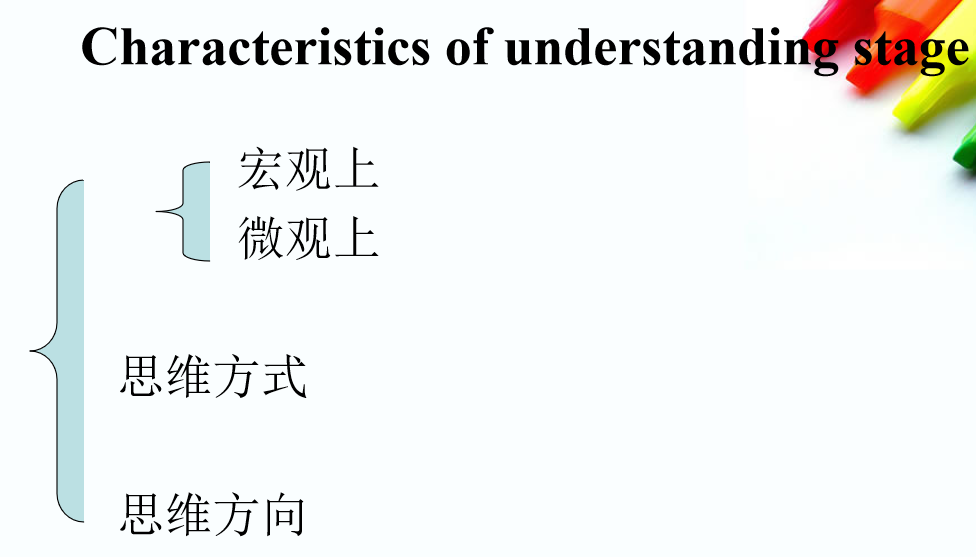
从宏观上,包括原作的主题、作者的思想观点、作品产生的社会、历史和文化背景等。
从微观上,包括词句的意义、语法和篇章的结构、修辞形式、上下文的逻辑关系,甚至细致到词语的色彩、语音、词形等方面。
一般性理解的思维方式大多是单语思维,阅读汉语作品就用汉语进行思维,阅读英语作品就用英语进行思维。翻译中的理解则采用的是双语思维方式,既用原语进行思维,也用译入语进行思维,两种语言在译者的大脑里交替出现。
一般的抽象思维的方向是从概念系统到语言系统,而阅读理解中的思维则是从语言系统到概念系统是逆向的。一般的阅读理解捕捉到语言概念系统后任务便完成了,翻译则要从这个概念系统出发,建构出另一种语言系统,也就是要经历“先逆向思维,再顺向思维”这样一个过程。

