
目录

  • 1 Introduction: What is translation
    • 1.1 Translation VS translating
    • 1.2 Translation is a science & an art
  • 2 Chapter 1   Understanding of Translation from different perspectives:Translation & translators- The process of translation
    • 2.1 Descriptions of translation from the perspective of  the role of the translators
    • 2.2 Descriptions of translation from the perspective of  the process of translating
    • 2.3 Summary
    • 2.4 Assignment
  • 3 Chapter 2 The Principles of Translation
    • 3.1 Principles or Criteria of Translation
    • 3.2 Principles proposed by Chinese translators and scholars
    • 3.3 Principles proposed by foreign translators and scholars
    • 3.4 A systematic summary of principles of translation
    • 3.5 Summary
    • 3.6 Supplementary material: The schools of translation theories
    • 3.7 Assignment
  • 4 Chapter 3 Translation and Culture
    • 4.1 Review of the schools of translation theories: cultural translation
    • 4.2 Language & culture
      • 4.2.1 The relationship between language and culture
      • 4.2.2 Cultral infiltration in translation
    • 4.3 Culture differences and translation
      • 4.3.1 Differences between Chinese and western languages
      • 4.3.2 Cultural transmutation in translation
    • 4.4 Summary
    • 4.5 Assignment
  • 5 Chapter 4 The Professional quality of a translator
    • 5.1 Responsibilities of a translator
    • 5.2 Qualities of a translator
    • 5.3 Unique qualities of an interpreter
    • 5.4 Summary
    • 5.5 Assignment
  • 6 Chapter 5 The Creativity of translation
    • 6.1 Translation is an intelligence activity
    • 6.2 The challenges that translators face
    • 6.3 Sample analysis
    • 6.4 Summary: Creative ideas and being faithful
    • 6.5 Assignment
  • 7 Chapter 6 The purposes of translation
    • 7.1 Translation is a type of communication
    • 7.2 Translation purpose and translation strategy
    • 7.3 The influence of translation on language development
    • 7.4 The function of cultural transmission and integration in Translation
    • 7.5 Assignment
  • 8 Chapter 7 The Classification of translation
    • 8.1 Specific vs. Genera translation
    • 8.2 Literary vs. non-literary translation
    • 8.3 Translation vs. interpretation
    • 8.4 Variant translation
    • 8.5 Assignment
  • 9 Chapter 8 Machine Translation
    • 9.1 What is machine translation?
    • 9.2 Principle of machine translation
    • 9.3 History and Prospect
    • 9.4 Summary and discussion
    • 9.5 Assignment
  • 10 Chapter 9 The Process of Translation
    • 10.1 Introduction
    • 10.2 The process of translation
    • 10.3 Understanding is the premise of translation
    • 10.4 Understanding and expression
    • 10.5 Assignment
  • 11 Chapter 10 Literal translation and free translation
    • 11.1 Introduction to  Literal Translation &  Free Translation
    • 11.2 The differences between  literal translation and  word-for-word translation
    • 11.3 The definitions of free translation
    • 11.4 Different functions of  literal translation and  free translation
    • 11.5 Combination of  literal translation and free translation
    • 11.6 Assignment
  • 12 Chapter 11 Equivalence
    • 12.1 Equivalence in translation
    • 12.2 Different Levels of equivalence
    • 12.3 Similarity in translation
    • 12.4 Translatability and untranslatability
      • 12.4.1 Further reading
    • 12.5 Assignment
  • 13 Chapter 12 Domestication and Foreignization
    • 13.1 The concept and history of domestication and foreignization
    • 13.2 How to understand domestication and foreignization correctly
    • 13.3 The functional strategy for domestication and foreignization
    • 13.4 Assignment
  • 14 Chapter 13 Hypotaxis and Parataxis &
    • 14.1 Definition of parataxis and hypotaxis
    • 14.2 Features of parataxis and hypotaxis in English and Chinese
    • 14.3 parataxis and hypotaxis in C-E translation
    • 14.4 Summary
    • 14.5 Assignment
  • 15 Chapter 14 The Styles of Translation
    • 15.1 Style and translation
    • 15.2 What is style?
    • 15.3 Can style be translated?
    • 15.4 The expression means of style
    • 15.5 Style shift
    • 15.6 Assignment
  • 16 Chapter 15 The Effect of Translation
    • 16.1 Losses in translation
    • 16.2 Gains in translation
    • 16.3 Assignment
The process of translation

The basic process of translation

What is the process of translation?

What are the stages of translation?

翻译的过程是什么?

          一般来说,翻译的过程指的就是翻译活动所经过的步骤或程序,也就是翻译行为的实施过程。(姜倩、何刚强 《翻译概论》上海:上海外语教育出版社,2015年,第150页。)
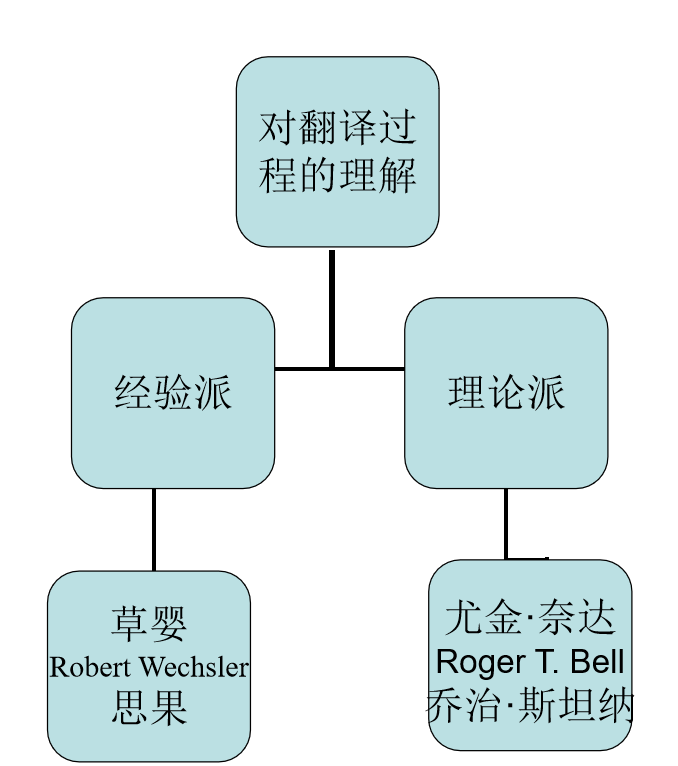

1.Translation process from the perspective of empiricism

草婴的观点

★熟悉原作,也就是反复阅读原作,读懂原作,考虑怎样较好的表达原意,通过几次阅读,使人物形象在头脑里逐渐清晰起来。

★动笔翻译,也就是忠实地逐字逐句把原著翻译成中文。

★*先仔细阅读译文,看有没有脱漏、误解的地方,逐一加以更正;

    *然后再从中文角度来审阅译稿,务使中文流畅易读,有时候也请演员朋友帮我朗读译稿,改正拗口的地方;

    *在交编辑审读后,再根据编辑所提的意见,认真考虑,作必要的修改。(草婴、许均,“老老实实做人,认认真真翻译”,《译林》,1999年第5期。)

思果的观点

       先把原文看懂,照原文译出来,看看念不念的下去,试删掉几个不一定用得着的字,看看是否有损文义和文气。如果有损,再补回来。试把不可少的字加进去,看看是否超出原文范围,增减以后再跟原文校对一次。有些地方是否有译错。语气的轻重是否恰如其分,原文的弦外之音译文里找不找得到?原文的意思要消化,译文的文字要推敲。(思果,《翻译研究》,北京:中国对外翻译出版公司,2001年,第16页。)

Robert Wechsler's view

翻译的过程从头至尾正如一场法庭审判(trial):

▲发现和确立证据(包括对作者相关作品的熟悉、对作品的文化艺术背景的了解、对作者生平的了解);

▲解读证据(找出原文的含义是什么,最重要的内容是什么,等等);

▲做出判断和决定。

(Wechsler, Robert  (1998). Performing without a Stage: The Art of Literary Translation. North Haven: Catbird Press, p15.)

Summary:

Chinese and foreign translators' understanding of the narrow translation process from their own experience is of great significance for us to understand the translation process, and also lays the foundation for us to understand the translation process from the theoretical level.

2、Translation process from the perspective of theory

     Different from the general empirical summary, this part aims to further understand the contradictions among various elements involved in the process of translation through the multi-angle investigation of the translation process, so as to provide a theoretical basis for dealing with these contradictions; at the same time, it makes a scientific analysis of the steps of the whole translation process and explores a feasible translation path theoretically.

(1) Eugene Nida's View

The four basic processes in translating consist of 

        (1)analysis of the source text,(最为复杂、最为关键)

        (2)transfer from source to target language,

        (3)restructuring in the target language,

        (4)testing of the translated text with persons who represent the intended audience.

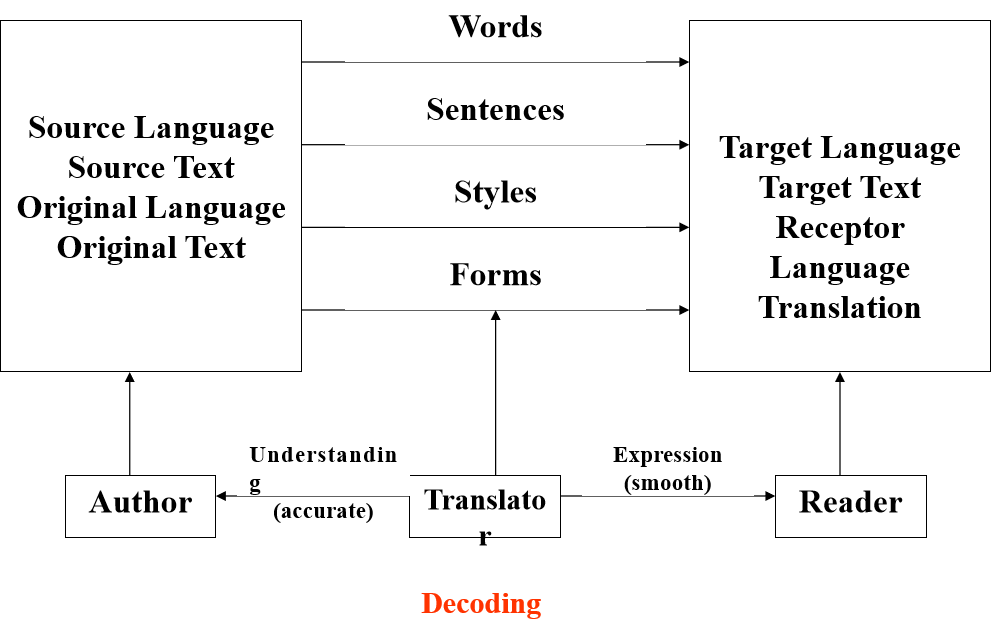
       The first three steps are the core of the translation process. They are the process of decoding the source language information and then recoding in the target language.

      Translation is a process of decoding.

The original text is like a telegraph/code (密码).

The translator is like a decoder (解码员).

His translation (the target text) is like a decoded telegraph, which must be understood by its reader.

(2)对翻译过程的全面考察,并借助某种理论,对其进行模式化探索

       Roger T. Bell在Translation and Translating: Theory and Practice一书中以与语言学为指导,借助于心理学和认知科学的研究成果,试图用一个系统的语言模式来描述翻译过程。这一过程可分为分析和综合两大阶段,每个阶段又包含了三个不同的操作领域,即句法、语义及语用三方面。

(参见廖七一等,《当代英国翻译理论》,湖北教育出版社,2001:207-265)

■把某一语言文本(即原文文本)分析成普遍的(不依赖任何特定语言)的语义表征(semantic representation);

■然后将该语义表征合成,构建另一种语言文体(即译入语文本)。(Bell, Roger T.(2001). Translation and Translating: Theory and Practice. Beijing: foreign Language Teaching and Research Press, p20.)

       换言之,翻译的过程就是分析(analysis)加合成(synthesis)的过程,其中分析就是阅读原语语篇的阶段,而合成则是表达或重构译入语语篇的过程。( Bell, Roger T.(2001). Translation and Translating: Theory and Practice. Beijing: foreign Language Teaching and Research Press, p45.)

       国内学者借助功能语言学理论也对翻译过程进行了研究,不再局限于静态的语言转化,而是将原作者和译者都置身于一定的语境之中,分析外部因素对原作者和译者的作用,以及这种作用对翻译过程的影响。这样,翻译过程就可概括为:

        原文语篇

        语言分析+语域/体裁分析+语篇分析

        所理解的原文意图

        译文语篇重构+译文语言/文化环境

        译文语篇

(司显柱,《功能语言学与翻译研究:翻译质量评估模式建构》,2007:117)

(3)对翻译过程的理论概括与理性剖析

     George Steiner是这方面的重要代表。他提出了“理解即翻译”(understanding as translation)的著名论断,认为理解或阐释过程包括四步:

    “信任”(Trust):相信待译材料言之有物

    “侵入”(Aggression):理解具有侵略性

    “吸收”(Incorporation):异化与同化

    “补偿”(Restitution): 重建平衡

(参见廖七一,2001:109-112;许钧,2009:53-54)

George Steiner’s View

◆信任(initiative trust),一切翻译和活动都要从信任开始,也就是相信所要翻译的作品是言之有物的,值得去翻译的。

◆进攻(aggression or penetration),即对原文的侵占与发掘,即我们通常意义上的理解,但是斯坦纳强调的是进攻性,用形象的说法就是:译者将意义俘虏过来,满载而归。

◆吸收(incorporation),即将文本从原语转换成译入语,然而,无论是内容还是形式,都不要把它吸收到一个真空地带:译入语早已存在,而且语义丰富,接纳新的东西会打乱或重组译入语的整个结构。

◆补偿(compensation),斯坦纳认为缺少了这一步,整个翻译过程就是不完整的。因为真正的翻译必须有来有往,必须恢复平衡,也就是说,翻译时要提供补偿的。(庄译传编译,乔治·斯坦纳著,《通天塔——文学翻译理论研究》,北京:中国对外翻译出版公司,1987年,第69—71页。)

Summary:

         The basic process of Translation consists of understanding and expression. Understanding the original text is the first step in translation, which is the basis or premise of expression. Correct understanding is helpful to correct expression; expression is the result of understanding, which is the stage in which the translator accurately conveys or expresses what he understands through the target language.

    方梦之指出,理解与表达的过程就是认识与实践、分析与综合的过程,它们即是彼此衔接,又是互有交叉、互臻完善的两个阶段,是同一问题不可分割的两个侧面。(方梦之主编,《译学词典》,上海:上海外语教育出版社,2003年,第15页。)