目录

  • 1 Introduction: What is translation
    • 1.1 Translation VS translating
    • 1.2 Translation is a science & an art
  • 2 Chapter 1   Understanding of Translation from different perspectives:Translation & translators- The process of translation
    • 2.1 Descriptions of translation from the perspective of  the role of the translators
    • 2.2 Descriptions of translation from the perspective of  the process of translating
    • 2.3 Summary
    • 2.4 Assignment
  • 3 Chapter 2 The Principles of Translation
    • 3.1 Principles or Criteria of Translation
    • 3.2 Principles proposed by Chinese translators and scholars
    • 3.3 Principles proposed by foreign translators and scholars
    • 3.4 A systematic summary of principles of translation
    • 3.5 Summary
    • 3.6 Supplementary material: The schools of translation theories
    • 3.7 Assignment
  • 4 Chapter 3 Translation and Culture
    • 4.1 Review of the schools of translation theories: cultural translation
    • 4.2 Language & culture
      • 4.2.1 The relationship between language and culture
      • 4.2.2 Cultral infiltration in translation
    • 4.3 Culture differences and translation
      • 4.3.1 Differences between Chinese and western languages
      • 4.3.2 Cultural transmutation in translation
    • 4.4 Summary
    • 4.5 Assignment
  • 5 Chapter 4 The Professional quality of a translator
    • 5.1 Responsibilities of a translator
    • 5.2 Qualities of a translator
    • 5.3 Unique qualities of an interpreter
    • 5.4 Summary
    • 5.5 Assignment
  • 6 Chapter 5 The Creativity of translation
    • 6.1 Translation is an intelligence activity
    • 6.2 The challenges that translators face
    • 6.3 Sample analysis
    • 6.4 Summary: Creative ideas and being faithful
    • 6.5 Assignment
  • 7 Chapter 6 The purposes of translation
    • 7.1 Translation is a type of communication
    • 7.2 Translation purpose and translation strategy
    • 7.3 The influence of translation on language development
    • 7.4 The function of cultural transmission and integration in Translation
    • 7.5 Assignment
  • 8 Chapter 7 The Classification of translation
    • 8.1 Specific vs. Genera translation
    • 8.2 Literary vs. non-literary translation
    • 8.3 Translation vs. interpretation
    • 8.4 Variant translation
    • 8.5 Assignment
  • 9 Chapter 8 Machine Translation
    • 9.1 What is machine translation?
    • 9.2 Principle of machine translation
    • 9.3 History and Prospect
    • 9.4 Summary and discussion
    • 9.5 Assignment
  • 10 Chapter 9 The Process of Translation
    • 10.1 Introduction
    • 10.2 The process of translation
    • 10.3 Understanding is the premise of translation
    • 10.4 Understanding and expression
    • 10.5 Assignment
  • 11 Chapter 10 Literal translation and free translation
    • 11.1 Introduction to  Literal Translation &  Free Translation
    • 11.2 The differences between  literal translation and  word-for-word translation
    • 11.3 The definitions of free translation
    • 11.4 Different functions of  literal translation and  free translation
    • 11.5 Combination of  literal translation and free translation
    • 11.6 Assignment
  • 12 Chapter 11 Equivalence
    • 12.1 Equivalence in translation
    • 12.2 Different Levels of equivalence
    • 12.3 Similarity in translation
    • 12.4 Translatability and untranslatability
      • 12.4.1 Further reading
    • 12.5 Assignment
  • 13 Chapter 12 Domestication and Foreignization
    • 13.1 The concept and history of domestication and foreignization
    • 13.2 How to understand domestication and foreignization correctly
    • 13.3 The functional strategy for domestication and foreignization
    • 13.4 Assignment
  • 14 Chapter 13 Hypotaxis and Parataxis &
    • 14.1 Definition of parataxis and hypotaxis
    • 14.2 Features of parataxis and hypotaxis in English and Chinese
    • 14.3 parataxis and hypotaxis in C-E translation
    • 14.4 Summary
    • 14.5 Assignment
  • 15 Chapter 14 The Styles of Translation
    • 15.1 Style and translation
    • 15.2 What is style?
    • 15.3 Can style be translated?
    • 15.4 The expression means of style
    • 15.5 Style shift
    • 15.6 Assignment
  • 16 Chapter 15 The Effect of Translation
    • 16.1 Losses in translation
    • 16.2 Gains in translation
    • 16.3 Assignment
History and Prospect

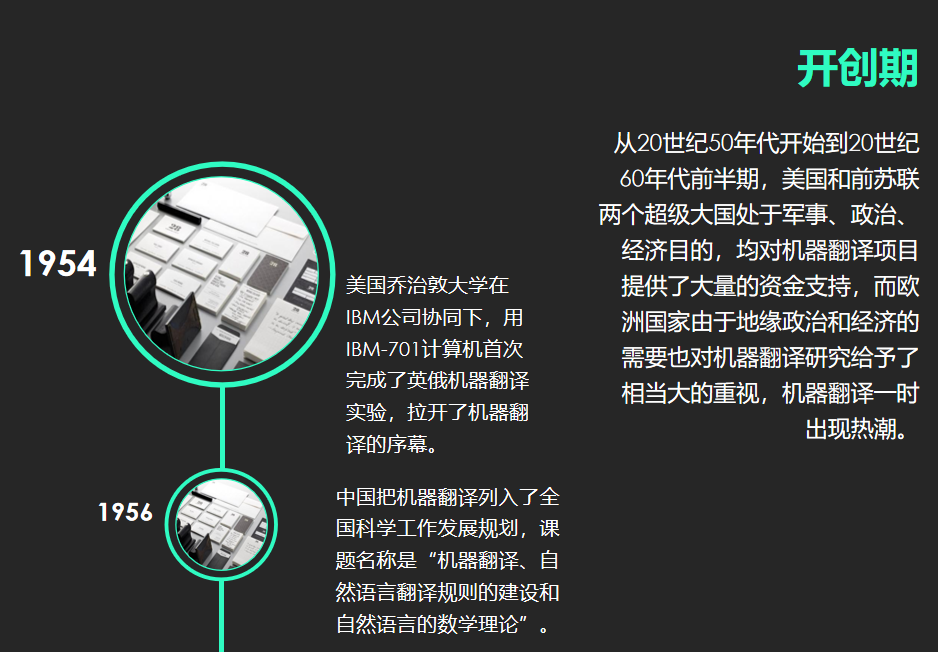
1、机器翻译的思想最早可以追溯到17世纪,而具体提出“机器翻译”主张并获得技术专利是在1933年;真正打开这扇大门的是美国人Warren Weaver,是他将人类带进机器翻译时代,他也因此获誉“机器翻译之父”。

2、二战以后,随着电子计算机的广泛应用,人们开始关注计算机在非数据上的应用,这其中就包括翻译,先驱者是Alan Turing (计算机科学之父,人工智能之父)。Weaver就是循着他的思想一路前行。Weaver所提出的机器翻译思想点燃了人们对机器翻译的热忱。

3、这之后的20世纪50年代和60年代是机器翻译的早期,当时,机器翻译的最大特点就是“眼高手低”,即目标定位太高,翻译工具落后。而且,由于没有语言学家和翻译家的参与,机器翻译中的诸多语言问题和翻译问题都未能给予足够的考虑。

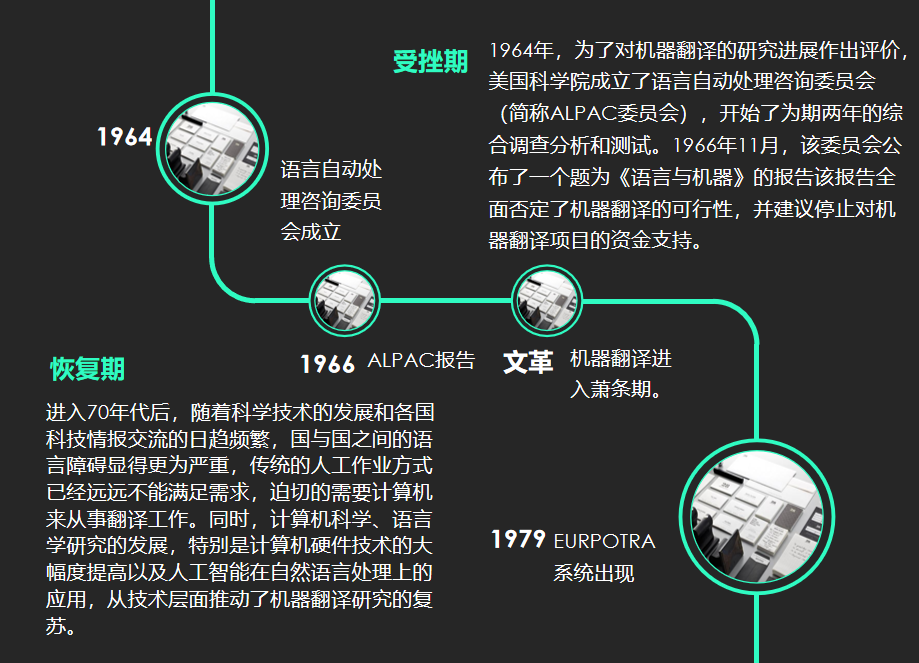
4、十多年的机器翻译实践之后,进入六十年代。1966年,美国国家科学学会的语言自动处理咨询委员会(ALPAC)就机器翻译发表了评测报告。这份报告使机器翻译一绝不振,但计算机语言学的基础研究却从未停止。

5、经过长达20年之久的沉寂,到20世纪80年代中期。机器翻译(MT)携机助翻译(machine-aided translation, MAT)雄风再起。但由于资本的逐利性,破坏了人们对机器翻译的总体印象。

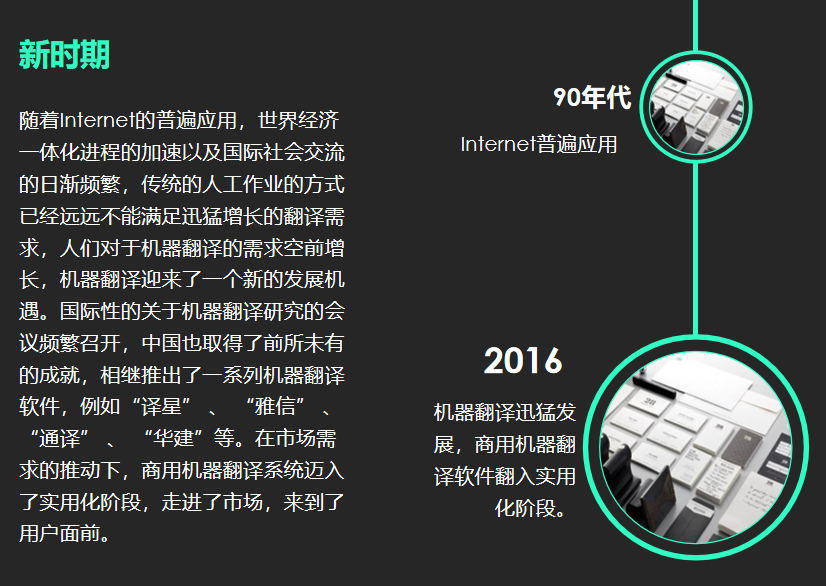
6、九十年代以后,机器翻译的发展出现了前所未有的势头。但不管是什么样的机器翻译,都未能获得令人满意的翻译效果。人们学会了整合优势的方法,即采用各种翻译方法的混合式机器翻译,是机器翻译的质量有了显著提高。

7、现在,机器翻译的对象,目的,应用环境和设施都改善了很多。现在的机器翻译才真正做到了“眼不高,手不低”。