
目录

  • 1 Introduction: What is translation
    • 1.1 Translation VS translating
    • 1.2 Translation is a science & an art
  • 2 Chapter 1   Understanding of Translation from different perspectives:Translation & translators- The process of translation
    • 2.1 Descriptions of translation from the perspective of  the role of the translators
    • 2.2 Descriptions of translation from the perspective of  the process of translating
    • 2.3 Summary
    • 2.4 Assignment
  • 3 Chapter 2 The Principles of Translation
    • 3.1 Principles or Criteria of Translation
    • 3.2 Principles proposed by Chinese translators and scholars
    • 3.3 Principles proposed by foreign translators and scholars
    • 3.4 A systematic summary of principles of translation
    • 3.5 Summary
    • 3.6 Supplementary material: The schools of translation theories
    • 3.7 Assignment
  • 4 Chapter 3 Translation and Culture
    • 4.1 Review of the schools of translation theories: cultural translation
    • 4.2 Language & culture
      • 4.2.1 The relationship between language and culture
      • 4.2.2 Cultral infiltration in translation
    • 4.3 Culture differences and translation
      • 4.3.1 Differences between Chinese and western languages
      • 4.3.2 Cultural transmutation in translation
    • 4.4 Summary
    • 4.5 Assignment
  • 5 Chapter 4 The Professional quality of a translator
    • 5.1 Responsibilities of a translator
    • 5.2 Qualities of a translator
    • 5.3 Unique qualities of an interpreter
    • 5.4 Summary
    • 5.5 Assignment
  • 6 Chapter 5 The Creativity of translation
    • 6.1 Translation is an intelligence activity
    • 6.2 The challenges that translators face
    • 6.3 Sample analysis
    • 6.4 Summary: Creative ideas and being faithful
    • 6.5 Assignment
  • 7 Chapter 6 The purposes of translation
    • 7.1 Translation is a type of communication
    • 7.2 Translation purpose and translation strategy
    • 7.3 The influence of translation on language development
    • 7.4 The function of cultural transmission and integration in Translation
    • 7.5 Assignment
  • 8 Chapter 7 The Classification of translation
    • 8.1 Specific vs. Genera translation
    • 8.2 Literary vs. non-literary translation
    • 8.3 Translation vs. interpretation
    • 8.4 Variant translation
    • 8.5 Assignment
  • 9 Chapter 8 Machine Translation
    • 9.1 What is machine translation?
    • 9.2 Principle of machine translation
    • 9.3 History and Prospect
    • 9.4 Summary and discussion
    • 9.5 Assignment
  • 10 Chapter 9 The Process of Translation
    • 10.1 Introduction
    • 10.2 The process of translation
    • 10.3 Understanding is the premise of translation
    • 10.4 Understanding and expression
    • 10.5 Assignment
  • 11 Chapter 10 Literal translation and free translation
    • 11.1 Introduction to  Literal Translation &  Free Translation
    • 11.2 The differences between  literal translation and  word-for-word translation
    • 11.3 The definitions of free translation
    • 11.4 Different functions of  literal translation and  free translation
    • 11.5 Combination of  literal translation and free translation
    • 11.6 Assignment
  • 12 Chapter 11 Equivalence
    • 12.1 Equivalence in translation
    • 12.2 Different Levels of equivalence
    • 12.3 Similarity in translation
    • 12.4 Translatability and untranslatability
      • 12.4.1 Further reading
    • 12.5 Assignment
  • 13 Chapter 12 Domestication and Foreignization
    • 13.1 The concept and history of domestication and foreignization
    • 13.2 How to understand domestication and foreignization correctly
    • 13.3 The functional strategy for domestication and foreignization
    • 13.4 Assignment
  • 14 Chapter 13 Hypotaxis and Parataxis &
    • 14.1 Definition of parataxis and hypotaxis
    • 14.2 Features of parataxis and hypotaxis in English and Chinese
    • 14.3 parataxis and hypotaxis in C-E translation
    • 14.4 Summary
    • 14.5 Assignment
  • 15 Chapter 14 The Styles of Translation
    • 15.1 Style and translation
    • 15.2 What is style?
    • 15.3 Can style be translated?
    • 15.4 The expression means of style
    • 15.5 Style shift
    • 15.6 Assignment
  • 16 Chapter 15 The Effect of Translation
    • 16.1 Losses in translation
    • 16.2 Gains in translation
    • 16.3 Assignment
Translation vs. interpretation

Interpreting

  The interpreter’s objective is to convey every semantic element as well as tone and register and every intention and feeling of the message that the source-language speaker is directing to target-language recipients (except in summary interpretation, used sometimes in conferences)

Modes of interpretation:

Simultaneous interpreting

Consecutive interpreting

Liaison interpreting

Whisper interpreting

Sight interpreting

Simultaneous interpreting: 

Simultaneous interpretation (SI) suffers the disadvantage that the interpreter must do the best he or she can within the time permitted by the pace of source speech and the advantages of time-saving and not disturbing the natural flow of the speaker. The most common form is extempore SI, where the interpreter does not know the message until he or she hears it. (extempore[ɪkˈstempəri] 即席的)

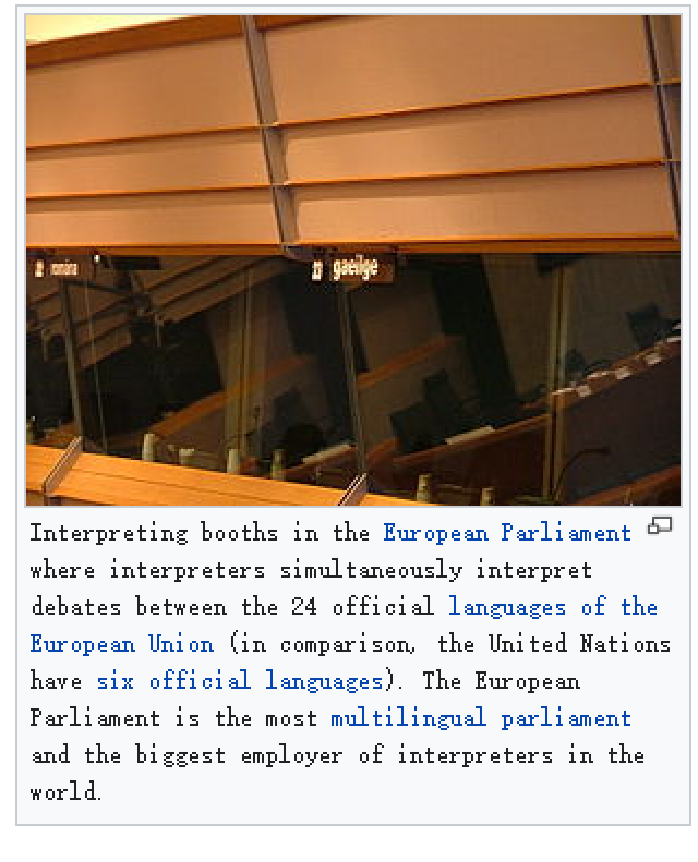
In the ideal setting for oral language, the interpreter sits in a sound-proof booth and speaks into a microphone, while clearly seeing and hearing the source-language speaker via earphones. The simultaneous interpretation is rendered to the target-language listeners via their earphones.

In consecutive interpreting (CI), the speaker is required to pause to allow interpretation — accuracy is greatly enhanced but the time needed is much greater (possibly double the time needed). Traditionally, the interpreter will sit or stand near the speaker

Types of interpretation

Conference 会议传译

Judicial 法庭传译

Escort 陪同传译

Public sector 公共部门传译

Medical 医疗传译

Sign language 手语传译

Media 媒体传译

Modalities

On-site

Telephone

Video