
Translation in a narrow sense and in a strict sense refers to the translation between two different languages, that is, to interpret the signs of one language with the symbols of another language, such as translating English into French, or translating Chinese into Spanish, etc. In this kind of interlingual conversion, generally speaking, the translator always hopes that the target text and the source text have a relatively high degree of correspondence in all aspects, although the objective effect is often not so.
On the other hand, with the deepening of the understanding of translation, scholars have a new definition of translation, which has already exceeded the traditional narrow scope.
According to Roman Jakobson (a Russian-American linguist and literary theorist), translation falls into 3 types: 语内翻译( intralingual translation)、语际翻译(interlingual translation)和符际翻译(intersemiotic translation).
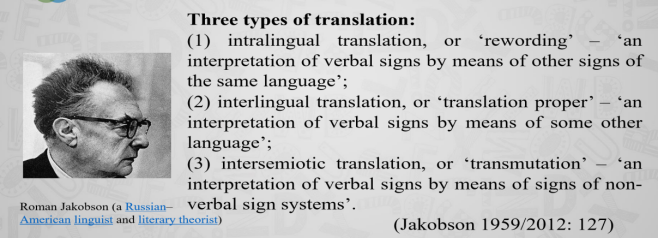
Here,Interlingual translation is what we call narrow translation. Intralingual translation refers to the use of some linguistic symbols to interpret other linguistic symbols in the same language, which is commonly known as "rewording". Such as translating ancient Chinese into modern Chinese, translating Cantonese into Putonghua, or translating English poetry into English prose. Interlingual translation is to interpret linguistic symbols through non-verbal semiotics, or to interpret non-verbal symbols with linguistic symbols. That is,for example, to express the meaning of written words in body language or to express the meaning of pictures and music in words.
Gideon Toury’s descriptive translation studies.
Among these Contemporary Western Translation Theories, Gideon Toury holds that translation refers to "any kind of target discourse that is regarded as translation in the target culture, regardless of its reasons".
Gideon Toury (June 1942 –October 2016) was an Israeli translation scholar and professor of Poetics, Comparative Literature and Translation Studies at Tel Aviv University, where he held the M. Bernstein Chair of Translation Theory. Gideon Toury was a pioneer of Descriptive Translation Studies.
Target-text oriented theory
Actually, Toury’s theory focus on target text, so it is a Target-text oriented theory. Here are two poles during the translation process, that is adequacy and acceptability between source-text and target-text.
No translation is ever entirely “ adequate”充分翻译 to the original version because the cultural norms cause shifts from the source text structures. No translaiton is ever entirely “acceptable” 可接受的翻译to the target culture because some new information and forms will be introduced to the system.
Here the adequate translation of source text can not be achieved in real translation, and foreignization 异化will be involved more or less. Also acceptability of the target text cannot be achieved either and domestication 归化 would be used more or less in order to be accepted and recognized by the target readers.
From this perspective, we can see the differences between Traditional model and Toury’s model on this slide. The traditional translation theory focus on the source text, that is to do the translating study on the original text, like Functional-dynamic equivalence, Directive and Normative, and Metatext. Metatext means that early translation studies regard translated as metatext, measured and evaluated in comparison with source text or some idealized interpretation of that initial version.
And the criteria or principle of translation is correctness and faithfulness (信和达) 。Different from the traditional modal of translation, Toury’s model focus on the target text. Because of the differences between languages, the actual text can never meet the ideal standards linguistically or literarily.
His theory can be divided into two periods. The first period is the theory of translational norms, which did the Sociological study of the cultural conditions affecting foreign-Hebrew language translation. The theory of translational norms contributes a lot to the “cultural turn” of translation studies. This theory constructs a multi-dimensional framework, which includes the historical, social and cultural factors influencing the translation activity. The second period is about Descriptive Translation Studies, aiming to develop a more comprehensive theory of translation based on his previous findings. His theoretical hypotheses distinguished him from his predecessor. Let’s look at the two periods one by one.
1. The first period is the theory of translational norms.
Toury came up with the term "translation norms", as hidden rules followed by the majority discovered by descriptive observation of actual translation. They are not understood as prescriptive rules but as norms specific to a context. Therefore, norms change with time and culture, so translation re-visits the same problem over and over again.
What is “Norm”?
A given society always has multiple and conflicting norms, all interconnected with other functioning systems, but if situations recur regularly, certain behavioral patterns can be established.
The translation of general values or ideas shared by a community---as to what is right or wrong, adequate or inadequate ---into performance instruction appropriate for and applicable to particular situation.
Norms are options that translators in a given socio—historical context select on a regular basis.
这里的所谓“规范”,就是在特定文化或文本系统中,被优先而且反复采用的翻译策略。(谭载喜)
“翻译规范”是指在目的语文化里制约译者取舍的标准或约束力。
Toury sees different kinds of norms operating at different stages of the translation process. Norms can be divided into initial norms(初始规范),preliminary norms (预备规范)and operational norms (操作规范).
图里认为,初始规范指译者首先必须在原语文本规范与目的语文化规范之间做出的基本选择:译者要么受制于前者,要么服从于后者,使译文在目的语文化中得到认可。
初始规范反映出译者是尽量忠实的保留原文中的各种参数,还是寻求最大限度的使用目标文本适应目标语中盛行的语言和文字规范(即在充分性和可接受性之间做出选择)。
Translation policy refers to factors determining the selection of texts for translation in a specific language , culture or time .
Directness of translation relates to whether translation occurs through an intermediate language.
2. The second period is about Descriptive Translation Studies
In the second period, Toury devoted himself to the exploration and construction of descriptive translation studies, the most famous monograph Descriptive Translation Studies and Beyond was published in 1995.
According to Toury, there are prescriptive and descriptive studies. Prescriptive approaches aim to formulate rules that should be followed by anyone who produces a text of a given type. They are focused on finding the most optimal or correct solutions. Descriptive approaches are about looking into existing texts and describing the rules they seem to follow.
Descriptive translation studies believe that a translation will be any target language text which is presented or regarded as such in a target system, on whatever grounds.
“翻译就是在目的系统当中,表现为翻译或者被认为是翻译的任何一段目的语文本,不管所根据的理由是什么”
As Gideon Toury points out, “what constitutes the subject matter of a proper discipline of translation studies are observable or reconstructable facts of real life rather than merely speculative entities resulting from preconceived hypotheses and theoretical models” (Toury 1995:1)
Summary
Toury is the most prominent representative of contemporary Israeli translation theory. His contribution to translation theory is embodied in his attempt to construct descriptive translation theory. He focuses on finding methodology for descriptive translation studies. His target-text oriented theoretical framework combines the linguistic comparison between the source text and the target text and the cultural framework of the translation. The purpose is to discover the behavior patterns in the translation process and "Reconstruct" the norms in the translation process.
图里是当代以色列翻译理论界最突出的代表人物,他对于翻译理论的而贡献,集中体现在他所试图构建的描写翻译研究理论上。他注重为描写性翻译研究寻找方法论,他所提出的译文导向的理论框架,结合了对原文与译文的语言比较和对译文文化框架的思考,目的是发现翻译过程中的行为模式,从而“重构”翻译过程中的规范。
The eventual goal of descriptive translation studies is to describe the actual translation phenomena, and through the description and analysis of specific translation cases, we can conclude the translation norms which have the function of demonstration or enlightenment for translation practice, and these norms may provide help for future translators and researchers.
描述性翻译研究的最终目的就是要对实际发生的翻译现象进行描写,并通过对具体翻译个案的描写和分析,归纳出对翻译实践具有示范或启示作用的翻译法则来,而这些法则或许能为将来的译者和研究人员提供帮助。
In terms of disposal, translation includes not only full-text translation全译, but also abridged translation节译, excerpt translation摘译, adapted translation 编译 and interpretation译述. These different approaches are also known as "variant translation" . Many scholars believe that strictly speaking, they are not translation in the strict sense, but some scholars put them into the category of translation.
In a word, translation is a very general and broad concept, which can be observed or discussed from many different angles. Therefore, when we discuss translation, it is necessary to clarify the specific meaning of translation, so as to avoid misunderstanding caused by different understanding.

