Translation purpose and translation strategy
1. What is Skopostheorie?
Skopos is a Greek word for‘purpose’.
According to Skopostheorie (the theory that applies the notion of Skopos to translation) , the prime principle determining any translation process is the purpose (skopos) of the overall translational action.
Skopos was introduced into translation theory in the 1970s by Hans J. Vermeer as a technical term for the purpose of a translation and of the action of translating.
The functionalist approaches focus on“functions of the texts and translations”.
The three representatives of the translation theory are:
Katharina Reiss’s functional category of translation criticism
Hans J. Vermeer’s Skopos theory
Justa Holz-Manttari’s theory of translational action.
Skopos Theory is the most important theory of this school. Reiss and Vermeer play key roles in the building of the theory and Christiane Nord’s role is crucial for a further development of the Skopos Theory.
Skopos Theory holds that translation is an intentional cross-cultural communication, which should take the expected functions to be achieved in the target culture as the primary reference.
A translator should choose translation strategies purposefully, the translation strategies should be determined by the intended function of the target text.
Therefore, it has broken the limitation of “equivalence translation” and made more translation possible.
2. Translational action
Justa Holz-Mänttäri's theory of translational action takes into account practical issues while, at the same time, places the emphasis firmly on the reader of the TT. This means, for example, that things like the source text type may be altered,if it is deemed to be inappropriate for the target culture.
Translational action views translation as purpose-driven, outcome-oriented human interaction and focuses on the process of translation as message-transmitter compounds(信息翻译综合体)involving intercultural transfer.
A communicative process involves:
The initiator (翻译的发起者)
The commissioner (委托人)
The ST producer (原文生产者)
The TT producer (译文生产者)
The TT user (译文使用者)
The TT receiver (译文接受者)
Translatorial action focuses very much on producing a TT that is functionally communicative for the receiver, the ST is analyzed solely for its construction and function profile.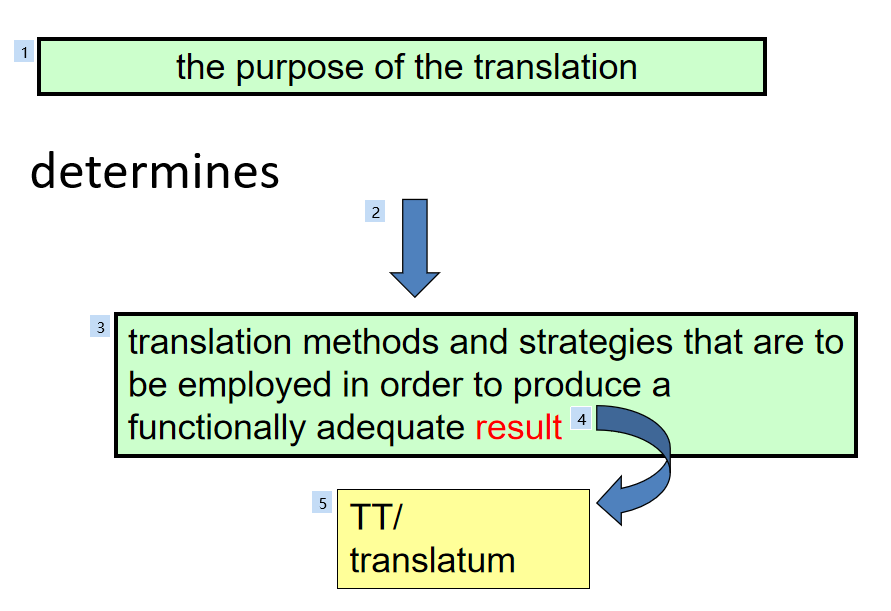
3. The influence of translation purpose on Translation Strategies
1)Literal translation VS free translation 直译和意译
自孙吴皇室开始信佛,皇帝宣旨,翻译经文。应皇帝所令,各家经院( commissioner)遂忙于招纳译士,大举翻译。此时译经不再是经士( TT user)内部之间的交流,而是要拿去给当权者( TT receiver)阅读。为了让皇帝能读懂,经文翻译开始关注“文”,转向摆脱原文结构约束的翻译,即意译。此外,早期的译经人员( TT producer),如竺法兰、安世高、支娄迦谶、康直等多是外国人,他们对中国语言文字的了解毕竟有限,翻译中弃“文”从“质”,非是必然,实是无奈。
翻译过程中,所有参与者各自的目的都会或大或小地影响翻译的目的,左右翻译的策略和方向。基于上述不同的翻译目的, 对经文的翻译采取了不同的翻译策略:从孙吴时期以前的“质” (直译)到孙吴时期以后的“文” (意译)。
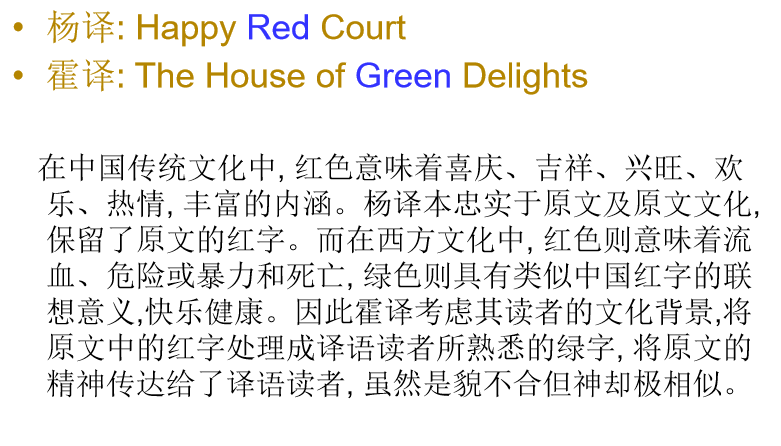
2)红楼梦 两个英译本翻译对比
The Story of the stone by David Hawkes VS
The Dream of a Red Mansion by Yang Xianyi couple
例1 原文: 平儿忙笑道: 那是他们瞅着大奶奶是个菩萨, 姑娘又是个腼腆小姐, 固然是托懒来混。 (第五十五回)
杨译: Pinger replied: They’re trying to take advantage , because Madam Zhu’s a real Bodhisattva and you’re such a gentle young lady.
霍译: Patience said: They think that because Mrs. Zhu is such a kind , saintly person and you are such a quiet , shy young lady they can get away with any thing.