
Text Appreciation
I Text Analysis
1. Theme
To prepare ourselves for this new world, we must all be re-educated so that we will be able to understand that there are more similarities than differences among peoples. The differences are superficial and insignificant whereas the similarities are essential and fundamental. These similarities enable all of us to be equal members in this global village and to live happily with mutual respect.
The author’s basic arguments are: first, life is a rare occurrence, and human existence even more so. Therefore we should have the greatest respect for all humanity; second, however different peoples may be in little details, they are united in their humanness, in their basic human faculties and gifts; third, they are also united in their needs, because today none of the most important problems we are faced with can be resolved with global cooperation. These views of course are not original. Many people have been thinking along the same line. Today more and more people agree that in the long run, nobody can be completely happy unless everybody else is happy, and nobody will be completely free unless everybody else is free.
In this article, in order to emphasize the importance of understanding the similarities among peoples, the author deliberately played down the importance of understanding their differences. This really was not necessary. In fact mutual understanding of these differences is absolutely vital for mutual respect. Only by a clear understanding of such differences can we learn to put them in proper context and benefit from each others’ accomplishments.
Differences do not divide us. It’s the wrong attitude toward the differences that divide us. The author’s condemnation of tribalism in all its forms as the cause of our misconception is very eloquent. The danger of doing terrible wrongs in the name of nationalism or patriotism can not be underestimated. But there is also the danger of using globalization as an excuse to encroach upon other countries’ sovereign rights. The existence of modern nations is a historical fact. It has to be redefined, yes. But in a world where many nations are still fighting for their basic rights, and indeed, where many peoples still don’t have their own nations, to talk about limiting national sovereignty is risky.
2. Structure
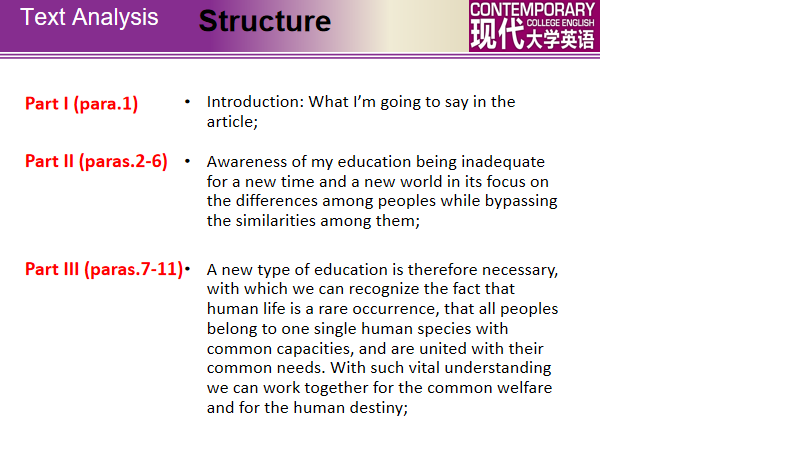
Part 1 (Paras.1-7) The old education focusing on nations’ differences should give way to the new one emphasizing the similarities.
Part2 (para 8) We should respect all human beings because human life is such a rare occurrence.
Part 3 (para. 9 ) However different peoples may be, they are united in their humanness, in their basic human faculties and gifts.
Part 4 (paras 10-11) They are also united in their needs.
3. Further Discussion
Question: According to the author, tribalism “had taken refined forms”(in para. 7). How do you understand its “refined forms”?
Tribalism originally refers to behavior and attitudes that are based on strong loyalty to a tribe. Here, its refined forms are modern regionalism, racism, and nationalism.
Only a few years ago an education in differences of references fulfilled a specific if limited need.(in para.6)
Question: What is the “specific” need?
The author is referring to the need of tourists.
Question: List out some aspects of the old education that emphasized the differences among nations.
its geography
comparative culture
anthropology
…
Then overnight came the great compression.
Question: How do you understand “the great compression”?
The so-called “global village”.
… that something in them enables them to respond deeply to forms and colors and ordered sounds. (in para.9)
Question: What does “forms and colors and ordered sounds” refer to?
Literature, architecture, art and music.
However friendly the universe may be, it has left the conditions of human existence precariously balanced.(in para.10)
Question: Why does the author say that the conditions of human existence are dangerously balanced?
The author is referring to the fact that human conditions are very delicate. We must have water and oxygen for survival. Too much or too little of these things would cause a disaster. These things should be well balanced.
 What do geography, anthropology and many other courses usually tell us about the differences between races and nations?
Are they important according to the author?
How should we be re-educated to adapt to the new world according to the author?
In which aspects does the author base his arguments? Elaborate each point.
Do you agree that tribalism is standing in our way to progress today?
II. Writing Device
Repetition
Geography had instructed me in differences of terrain, resources, and productivity. Comparative culture had instructed me in the differences of background and group interests. Anthropology had instructed me in the differences of facial bone structure, skin color and general physical aspect. (3)
And the simplest reality of all was that the human community was one—greater than any of its parts, greater than the separateness imposed by the nations, greater than the different faiths and loyalties or the depth and color of varying cultures. (Para. 4)
What effect do you think it has here?
Repetition:
a major rhetorical strategy for producing emphasis, clarity, amplification, or emotional effect
more examples:
With this faith we will be able to hew out of the mountain of despair a stone of hope. With this faith we will be able to transform the jangling discords of our nation into a beautiful symphony of brotherhood. With this faith we will be able to work together, to pray together, to struggle together, to go to jail together, to stand up for freedom together, knowing that we will be free one day.
from I have a dream
by Martin Luther King, Jr.
III. Detailed study and Sentence Paraphrase
1. These notes are in the nature of a confession. It is the confession of a miseducated man.(1)
These notes: these lines I have written down here; these short statements of views and comments
In the nature of a confession: a kind of confession; statements of my past wrongs
Miseducated: see note 2, notes to the text of the textbook
More words with the prefix”mis-”: misjudge, misleading, misguide, mistake, misinform, misspell, mispronounce, misprint, misinterpret
2. Not the world as it was in 1850 or 1900, for which my education might have been adequate,…(2)
Adequate: good enough in quality for a particular purpose or activity
adequate :adjective, satisfactory or acceptable in quality or quantity
足够的,能满足需要的
this office is perfectly adequate for my needs.
这间办公室完全能满足我的需要了。
足够的;恰当的, 可以胜任的;让人满意的, 尚可的
I hope you will prove adequate to the job.
我希望你证明能胜位这项工作。
CF. She was not adequate as the head of the school.
he was not tall enough to carry a rifle.
We lacked sufficient funds. ( enough充足的)
3. Geography had instructed me in differences of terrain, resources, and productivity. (3)
Geography had taught me about differences of terrain…etc.
Instruct: to teach; to educate
Instruct, in the sense of “educate” is used in the pattern: to instruct sb. in sth
The teacher instructed us in a new technique.
那位教师把新技术教给我们。
instruct a class in history给一个班学生上历史课
instruct a class in history给一个班学生上历史课
instruct sb. in English教某人英语
instruct sb. to do sth.命令某人做某事
instruct: direct or command someone to do something, especially as an official order
指示;命令,吩咐
differences of terrain, resources, and productivity: differences in the type of land they have (whether plains, hills, deserts, etc.); the kind of resources they own(such as land resources, mineral resources, fish resources, timber resources, etc.); and in the level of economic development (whether they are developed or underdeveloped; industrialized or agricultural).
4. Comparative culture had instructed me in the differences of background and group interests. (3)
Comparative culture: an academic discipline (学科); a study that involves comparing cultures of different countries.
Other comparative studies include: comparative literature, comparative linguistics, comparative government, comparative religion, etc.
Group interests: interests of ethnic, social, political groups
5. I was not surprised at the fact that…; or that some used wood for fuel and other dung; or that some enjoyed music with a five-note scale and others with twelve; or that some people were vegetarian by religion and others by preference. (3)
Be surprised at sth.: be surprised at the high price, be surprised at thedramatic change, etc.
Compare other words that are often used in this pattern: be astonished at, , be amazed at, be alarmed at, to be shocked at, be disappointed at,etc.
astonish 指“由于出乎意料而又不能理解而感到吃惊”, 语意较强, 如:
I was astonished to see he got up so early.
见他起得这么早我感到惊讶。
amaze 指“由于认为似乎不可能或极少可能发生的事出现而感到大为诧异、迷惑不解”, 语意较强, 如:
I was amazed at his impudence.
他竟然无耻到这种地步使我感到惊愕。
astound 指“使震惊”, 语意比amaze强, 如:
I was astounded at the news.
我听到这个消息大吃一惊。
Notice that in order to avoid repetition, some words are often omitted as in:
…some used wood for fuel and others (used) dung (for fuel)…
…some people were vegetarian by religion and others (were vegetarian) by preference.
A five-note scale: “note” here means a particular sound音or pitch and “scale” a series of musical notes moving upwards or downwards in pitch. 【音】音阶, 音列
by religion, by preference: by here means “according to”
in those respects (para. 4)
in those details; at those points
Examples:
In those respects, I don’t agree with you.
This room is fine except in one respect— what can I sit on?
In many respects the new version is worse than the old one.
Respect: a particular aspect, point, or detail
方面,着眼点
The government's record in this respect is a mixed one.
政府在这方面的记录好坏参半。
in all respects (=in every respect) 无论在哪方面[哪一点]来看, 在各方面
in many respects在许多方面
in no respect无论在哪方面[哪一点]都不是...; 完全不是...
in one respect在一个方面, 在一点上
in some respects在某些方面
in that [this] respect在那一[这一]方面
The marriage was a disaster in every respect.
这场婚姻从任何角度来说都是彻底的失败。
6…. The principal significance of such differences was that they were largely without significance. (4)
Principal: main, chief, major, the most important
Do not mix it up with its homonym(a different word that happens to have the same pronunciation) “principle”. 同音异义词(如fair集市和fair美的等); 同形异义词; 同音同形异义词(如pool水潭和 pool 一种弹子戏)
More examples of homonyms: meet and meat/ beat and beet甜菜,糖萝卜/ boy and buoy浮标,航标/ horse and hoarse/ right and write/ bear and bare
Notice how the author played with the word “significance”.
More examples: what we have to fear is fear itself. (Franklin D. Roosevelt)
The business of government is to keep the government out of business---that is, unless business needs government aid. (Will Rogers)
7. The differences were all but wiped out by the similarities. (Para. 4)
almost; nearly
to destroy or remove completely
The differences became so insignificant compared with the similarities, they were almost completely pushed aside and forgotten.
All but
almost; nearly
Examples:
It’s all but impossible.
an all but impossible task
All but the morning star have disappeared.
All but one were present.
Wipe out
to get rid of; destroy all of
Examples:
The entire population(城镇、地区或国家的)全体居民,人口was wiped out by the terrible disease.
The earthquake wiped out the whole town. 那次地震毁掉了整个城镇。
The cost of the new building will wipe out all the company’s profits this year.
wipe out a stain擦去污点
wipe out illiteracy扫除文盲
wipe out deficits消灭赤字
wipe out a disgrace 雪耻
wipe out
(把器皿里面用抹布)擦净
Wipe out the bath before you use it.
使用浴盆前先把里面擦洗干净。
These cups have been thoroughly wiped out.
这些杯子已经擦干净了。
擦掉(符号)
These stains won't easily wipe out.
这些斑点不易去掉。
She got angry and wiped out her name on the blackboard.
她生气了, 于是就把黑板上她的名字擦掉了。
了结
This last payment will wipe out your debt to me.
这最后一笔付款将了结你欠我的债务。
彻底摧毁, 消灭
The plague once could wipe out a village.
鼠疫曾一度可以夺走整个村庄村民的生命。
We are always ready to wipe out any enemy who dares to attack.
我们时刻准备着消灭一切胆敢来犯之敌。
The wicked must be wiped out.
恶人必须除掉。
8. …that beyond the differences are realities scarcely comprehended because of their very simplicity. (4)
… that if you go beyond the differences you find realities or true facts that people hardly understand precisely because they are so simple and obvious.
9. And the simplest reality of all was that the human community was one—greater than any of its parts, greater than the separateness imposed by nations, greater than the different faiths and loyalties or the depth and color of varying cultures. (Para. 4)
And the simplest fact was that the human community was one organic whole, and the whole is always bigger and more important than the parts. Today the world is divided into nations which force the world to become separate parts. But no single nation is more important than the whole humanity, and differences in their religious faiths, political or national loyalties, or their cultures should not be allowed to blind us to the basic things they all share.
10. This larger unity was the most important central fact of our time—something on which
people could build at a time when hope seemed misty, almost unreal. (Para. 4)
the human community as a whole something people could use as a basis for further development
at a time when hope seemed misty, almost unreal: at a time when hope seemed to be unclear, not very bright, and almost non-existent.
What time was the author talking about here?
11. It turned out that my ability to get along with other peoples depended not so much upon my comprehension of the uniqueness of their way of life as my comprehension of the things we had in common. (Para. 5)
races or nations not one thing but rather sth. else
not so much… as:
与其说....不如说e.g.
I like teaching not so much for the pay as for the chance to be among young people.
He lost his job not so much for his incompetence as for his age. At 45, he was considered too old.
The fact that, I could adjust myself well to other nations was not because of my understanding of the differences between us but because of my understanding of the similarities we shared.
12. But to stop there was like clearing the ground without any idea of what was to be built on it. (Para. 5)
to get the land ready for construction by removing irrelevant things from it
If we only respect differences but pay no attention to similarities, it will be aimless/unconstructive.
13. When you got through comparing notes, you discovered that you were both tailking about the same nerighbourhood, i.e. this planet, and the conditions that made it pleasant or hostile to human life. (5)
Get through doing: complete; finish doing
get through
To arrive at the end of; finish or complete. 结束:到达终点;结束或完成
I got through the novel in one evening.
我一个晚上就看完了这本小说。
用完, 花光
He has got through all the money I lent him. 我借给他的钱他已花光了。
To succeed in making contact; reach. 到达:成功地和…联络;到达
(用电话)接通某人
I rang you several times but wasn't able to get through.
我几次打电话给你, 都没有打通。
To make oneself understood. 使自己被理解
get through with完成, 干完
compare notes: to exchange views or information about sth. both have done or are interested in to see if they agree
i.e. (Latin) that is
conditions hostile to human life: conditions which make it difficult for people to live
hostile : adjective, unfriendly; antagonistic
The local people are hostile to outsiders.
当地人敌视外地人。
to反对…:
■(predicate) opposed:
hostile to reform反对改革
Many people were openly hostile to the idea.
很多人公开反对这一想法。
towards对…不友善:
He was extremely hostile towards her. 他偏要跟她过不去。
不友善的;敌对的
14. That was at a time when we thought of other places and peoples largely out of curiosity or in terms of unusual vacations. (6)
That was at a time when we were interested in other places and peoples because they were exotic and therefore would make our vacation exciting.
In terms of/in…terms就…而言, 从…方面说来
with regard to; from the point of view of
Examples:
The book has been well reviewed, but in terms of actual sales it hasn’t been very successful.
In business terms the project is not really viable, but it would add to the prestige of the company.
He referred to your work in terms of high praise. 他对你的工作大加赞扬。
He thought of everything in terms of money. 他是从钱的角度来看每一件事。
in the long term从长远观点来看
in the short term就眼前来说
15. It was the mark of a rounded man to be well traveled… (6)
the mark of a rounded man:
the sign or indication of a man who has received a well-rounded education, not one-sided. But complete and varied
well traveled: been to many countries
A rounded man: someone who has received a well-rounded education (通才教育), not one-sided, but complete and varied
16. The old emphasis upon superficial differences had to give way to education for mutuality and for citizenship in the human community. (7)
Give way to: give its place to sth. better, to be replaced by, e.g.
The traditional extended family has now given way to the nuclear family.
Coal is dirty and will have to give way to gas or other cleaner energy.
Mutuality: mutual respect, mutual understanding; equality; interdependence
Give way (to)
a. to admit defeat in an argument or fight
b. to break under pressure; collapse
c. to have its place taken by
d. to allow oneself to show
Examples:
My new evidence forced him to give way.
The floor gave way under the heavy weight.
Steam trains gave way to electric trains.
He gave way to tears.
17. … the universe itself does not hold life cheaply. Life is a rare occurrence… (Para. 8)
to think that sth. is important event; happening
not hold sth cheaply: to hold sth dear; to think that sth is important
The earth is the only place where life can be found, so the universe seems to favor life more/ take life seriously. And the respect of life is the very basis on which we must build the future world community.
Examples:
1. Snow is of frequent occurrence in that country.
2. His arrival was an unexpected occurrence.
3. Conflicts were of daily occurrence.
18. Of all these countless forms of life, only one, the human species, possesses certain faculties in combination that give it supreme advantages over all the others. (Para. 8)
has certain abilities and powers
when put together something that may help one to be successful or to gain a favorable result
advantage: a condition or circumstance that puts one in a favourable or superior position
有利条件,优势
give sb. an advantage使某人处于更有利的地位
give sb. an advantage over使某人处于更有利的地位
A better education gave us the advantage. 良好的教育使我们处于有利地位
Another qualification would give me a big advantage at job interviews.
再有一项资历会使我在求职面试时极占优势。
Her Olympic experience gave her a big advantage over the other contestants for the final victory.
她的奥运会参赛经历使她比起其他竞技对手在争取最后获胜上具有很大的优势。
Have/get/gain an the advantage over胜过, 优于, 比…占优势:
The company has an unfair advantage over its competitors.
这家公司与竞争者相比有不公平的优势。
East coast resorts have the advantage over west coast ones.
东海岸的旅游胜地比西海岸占优势。
1. I bought the jacket at an advantage.
2. He negotiated for my advantage.
3. It is of great advantage to them.
4. We must use to the best advantage what ability we may possess.
5. Employ your time to the best advantage.
6. Our volleyball girls had the advantage of being taller than their Japanese opponents.
7. The advantage we have over them is that they are weak and sentimental.
8. You have an advantage over me.
It is important to emphasize “in combination” because in isolation certain human faculties may not compare favorably with other species. For example, eagles have better sight; dogs have better sense of smell; tigers are more powerful; birds can fly, and fish can swim.
19. Among those faculties or gifts is a creative intelligence that enables man to reflect and foresee, to take in past experience, and also to visualize future needs. (8)
Of all the faculties they have, the most important is their creative intelligence. Human beings have a brain.
Gifts: natural abilities or talents, so-called because they are considered gifts from God
Gifted: adj., talented and intelligent
Reflect and foresee: to think and plan and predict
Take in past experience: absorb or understand or learn from past experience
Take in
a. to provide lodgings for (a person) 接待; 收留
b. to include包括
c. to understand fully; grasp领会; 理解
d. to deceive欺骗; 使上当
Examples:
He had nowhere to sleep so we offered to take him in.
This is the total cost of the holiday, taking everything in.
The study of physics takes in many difficult subjects.
物理的学习包括许多困难的方面。
It took me a long time to take in what you were saying.
The lecturer had the feeling that a good deal of what he said had not been taken in by the students.
演讲人觉得他说的许多话学生都没有领会。
Don’t be taken in by his promise.
The salesman finds it easy to take in old ladies.
这个推销员发现老太太们容易上当受骗
Visualize future needs: foresee future needs and take action to meet these needs
visualize
form a mental image of; imagine:
It is not easy to visualize the future.
make (something) visible to the eye:
The cells were better visualized by staining.
20. there are endless other wonderful faculties, the workings of which are not yet within our understanding… (8)
Notice that in this sentence the relative pronoun “which” is not the object of a verb phrase but the object of a noun phrase. More examples:
At about 10 p.m. he went to see a movie, the name of which he said he had forgotten.
He likes to use big pompous words, the meanings of which are never clear.
Not yet within our understanding: still beyond our comprehension
21. Viewed in global perspective, what counts is not that… but that… (Para. 9)
past participle,When we look at it from the global point of view
what is important parallelism
1. It is not how much you read but what you read that counts.
2. In business, a strong personality often counts for more than formal training.
3. These empty promises don’t count. We need action.
In a certain perspective
from a certain point of view
Examples:
The company’s results need to be looked at in their proper perspective; our profits
have fallen but it’s been a difficult year for our competitors, too.
You must get the story in its right perspective.
搭配
不同的角度;新视角
更广阔的视角
适当的角度;实际的角度:
我们现在可以从实际的角度观察事物。
文化视角、历史角度、政治视角、社会角度、理论视角等
in the right perspective正确地、客观地、全面地(观察事物)
in its right perspective正确地、客观地、全面地(观察事物)
in the wrong perspective片面地、错误地(观察事物)
in its wrong perspective片面地、错误地(观察事物)
22. However friendly the universe may be, it has left the conditions of human existence precariously balanced. (10)
See note 10, notes to the text of the textbook.
Precariously balanced: likely to lose the balance any moment. The author is referring to the fact that human conditions are very delicate. We must have water and oxygen for survival. Too much or too little of these things would cause a disaster. These things should be well balanced.
23. Remove any one of these and the unity of human needs will be destroyed and the human race would also perish.
The unity of human needs: the delicate balance or independence of human needs
24. … how to control the engines we have created that threaten to alter the precarious balance on which life depends. (10)
Here the word “engines” is used figuratively to stand for all the technological developments human beings have achieved. Human beings have invented a great many things to give us more power and to make our life easier. But these human creations are now threatening to change the balance of our environmental conditions.
25. ..some nation or people may come forward not only with the vital inspiration that people need no less than food. (11)
The author is hoping that some nation or people may come forward to take up the responsibility to lead us in solving the present problems, a country which understands the vital human needs and can give the rest of the world important inspiration. It is clear that the author is hoping that his own country, the United States, will be able to play that role. He did not say it, but he implied it, believing as many of his countrymen did that such is their “manifest destiny”.
Come forward
to offer oneself to fill a position; give help to the police, etc.
volunteer oneself for a task or post or to give evidence about a crime
自告奋勇;主动争取;自愿作证
Examples:
Only two people have come forward for election to the committee.
No one has come forward with any information about the murder.
26. Leadership on this higher level does not require mountains of gold or thundering propaganda. (Para. 11)
spiritual or moral level very loud or noisy propaganda
Leadership on the spiritual/moral level is not based on money or propaganda.
The author here is not talking about economic, political or military leadership. He is talking about moral or spiritual leadership, thus “leadership of a higher level”
Thundering: adjective
[attrib.]making a resounding, loud, deep noise打雷的;雷鸣似的
a thundering voice雷鸣般的嗓音
thundering waterfalls. 发出雷鸣般巨响的瀑布。
■(informal)extremely great, severe, or impressive(非正式)极大的;非常的,异乎寻常的
a thundering error极大的错误
Propaganda:
[mass noun](chiefly derogatory)information, especially of a biased or misleading nature, used to promote or publicize a particular political cause or point of view
(主贬)(尤指偏狭误导的)宣传;谣言
He was charged with distributing enemy propaganda.
他被指控散布敌方言论。
■the dissemination of such information as a political strategy
(作为政治策略的)宣传;传播;散布
The party's leaders believed that a long period of education and propaganda would be necessary.
该党领袖认为长期的教育和宣传是很有必要的。

