

Part two Background Information
I. Author
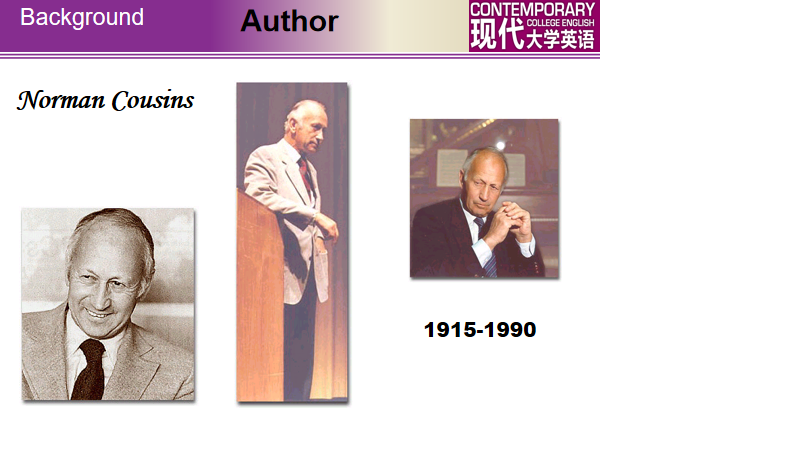
Norman Cousins (1915—1990)
Careers:
ª writer
ª editor
ª citizen diplomat
ª promoter of holistic healing
ª unflagging optimist
Lifelong Concerns:
ª war and peace
ª world governance
ª justice
ª human freedom
ª the human impact on the environment
ª health and wholeness
Belief in world governance:
ª He believed that enduring world peace could only be
achieved through effective world governance.
Belief in world federalism:
ª He argued for a world no longer based on the supremacy
of nationalism and other superficial differences.
Contribution to peace and human well-being:
ª He arranged for medical treatment in USA for 24 young
Japanese women who came to be known as the
“Hiroshima Maidens”;
ª helped support the medical care of 400 Japanese children
orphaned by the atomic bomb;
ª with his wife, legally adopted one of the "Maidens";
ª helped create a program for the “35 Polish women who had
been victims of Nazi medical experiments during the war”.
Summary of his life:
ª In June 1983 Cousins told the graduating class of Harvard Medical School that the "conquest of war and the pursuit of social justice... must become our grand preoccupation and magnificent obsession." These certainly were the concerns that obsessed him throughout his life, and over the years he battled through his writings and actions to make them matters of more general concern. Driven by the shock and portent of Hiroshima, he worked to combat unchecked nationalism, promote federalism, and build a sense of world citizenship, in the belief that people as a whole might yet construct a new world order of peace and justice. His optimism, intellectual curiosity, and commitment to the preservation of human life were equally unquenchable.
Quotations:
ª Inevitably, an individual is measured by his or her largest concerns.
ª Life is an adventure in forgiveness.
ª A library, to modify the famous metaphor of Socrates, should be the delivery room for the birth of ideas—a place where history comes to life.
ª If something comes to life in others because of you, then you have made an approach to immortality.
ª Just as there is no loss of basic energy in the universe, so no thought or action is without its effects, present or ultimate, seen or unseen, felt or unfelt.
ª Wisdom consists of the anticipation of consequences.
Part One
Introduction to the text
Today everybody agrees that the world is getting smaller and smaller. International community, world village, global integration, globalization, world market, etc. have become some of the most frequently used words in the English language. What kind of impact will all this have on us? What must we do to adapt ourselves to these changed conditions? This essay attempts to address this issue.
I. Listen to the short passage. Note down every word in it. Then have a group discussion about the issue involved in it.
Will Globalization Lead the Way to…?
Technology has now created the possibility and even the likelihood of a global culture. The Internet, fax machines, satellites, and cable TV are sweeping away cultural boundaries. Global entertainment companies shape the perceptions and dreams of ordinary citizens, wherever they live. This spread of values, norms, and culture tends to promote Western ideals of capitalism.
Will local cultures inevitably fall victim to this global “consumer” culture? Will English eradicate all other languages? Will consumer values overwhelm people’s sense of community and social solidarity? Or, on the contrary, will a common culture lead the way to greater shared values and political unity?
II. Take the Globalization Quiz —
Directions: Decide true or false about each statement about globalization.
1. Global wealth doubled from $14 trillion to $28 trillion in one decade. _____
2. According to the World Bank, this wealth has reduced global poverty. _____
3. Almost one fourth of the world’s population (1.2 billion people) lives on less than $1 per day, the measure for extreme poverty. _____
4. Almost 50% of the world’s population lives on less than $2 a day, the measure for poverty. _____
TFTT
5. About forty countries today are poorer than they were twenty years ago. _____
6. The top seven developed countries in the world (called the G-7) have 10% of the world’s population and 63% of the wealth. _____
7. Seventy-five percent of the world’s population lives in the 133 nations which are still developing (called the G-77), but these 133 nations combined have only 20% of the wealth. _____
FTF
8. Women suffer harsher consequences in the global economy. Women and their children make up more than 70% of the poorest people on earth. _____
9. Two-thirds of the 125 million children in the world who do not go to school are girls. _____
10. Workers have, for the most part, benefited from globalization._____
TTF
III. Do You Know?
When did globalization start? (Hint: There were three waves.)
The most recent wave of globalization, which started in 1980, was spurred by a combination of advances in transport and communications technologies and by large developing countries who sought foreign investment by opening up to international trade.
The first wave lasted from 1870 to the start of World War I.
Following World War II, a second wave of globalization emerged, lasting from about 1950 to 1980.
What is globalization?
The growing integration of economies and societies around the world.
It is an inevitable phenomenon in human history that’s been bringing the world closer through the exchange of goods and products, information, knowledge and culture. But over the last few decades, the pace of this global integration has become much faster and dramatic because of unprecedented advancements in technology, communications, science, transport and industry.

