
Introduction
1 Background
This is an essay on the problem of lifestyle in our post-industrial modern society.
The big differences between traditional agricultural society and industrial society canbe said to have started from the invention of the clock and watch as well as machines.Machines are time-saving apparatus. Time-saving means they can do things morequickly. It increases efficiency. In modern society, time is money. And we go fasterand faster. We are always in a hurry. We are always afraid of lagging behind. We takefor granted that faster is better. We can’t wait. We must satisfy our needs immediately.People use instant food, instant noodles.
In a way, human beings seem to have succeeded. Momentous changes have takenplace. The world market is flooded with all kinds of products; GDP has been quicklydoubled and redoubled. The world and people living in this world have changedbeyond recognition.
But now the author raises the question: Is it wise to keep speeding? Shouldn’t we slowdown before we speed out of control? Isn’t it more important to send time than to savetime? Is this quick fix society an ideal society?
Clearly the author is not alone in feeling that way in modern times; people seem tohave more and more, but they are often enjoying less and less. She reminds us of thefamous Chaplin movie Modern Times, in which workers appear as extensions ofmachines rather than machines appear as extensions of human beings.
There is perhaps also a philosophical aspect about speed. It is not necessarily ablessing. In fact, more haste may mean less speed, as the proverb goes.
2 Structure
I The introduction (paras. 1–3)
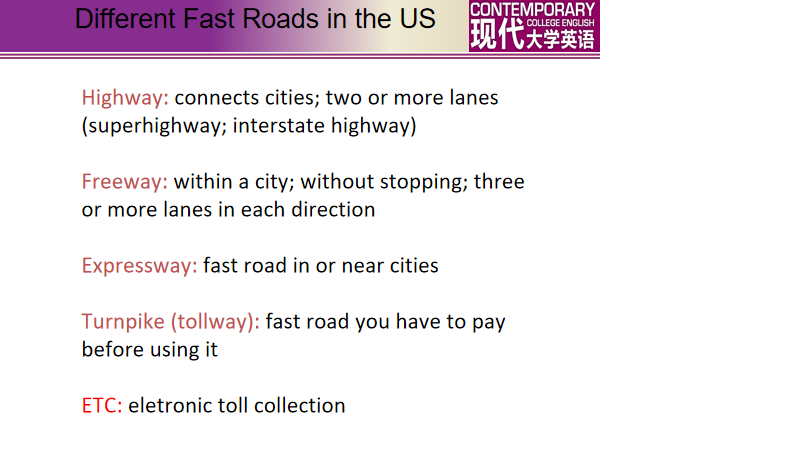
The author compares her ride on fast roads/turnpikes and interstates to West Virginiaand her return trip on a different route.
II The body (paras. 4–6)
The three ways Americans seek quick fixes
III The conclusion (paras. 7–8)
The author states the thesis of her essay and appeals to her fellow countrymen torediscover life/return to life in the slow lane.
3 Writing Skills
On the face of it, this is an expository essay which explains what a quick fix society is.However, the purpose of the essay is neither to define nor to classify. Its purpose is topersuade Americans to return to life in the slow lane. The patterns of exposition areused to argue and persuade. The writer chiefly uses five patterns to develop the centralidea of her essay.
1. Comparison–contrast
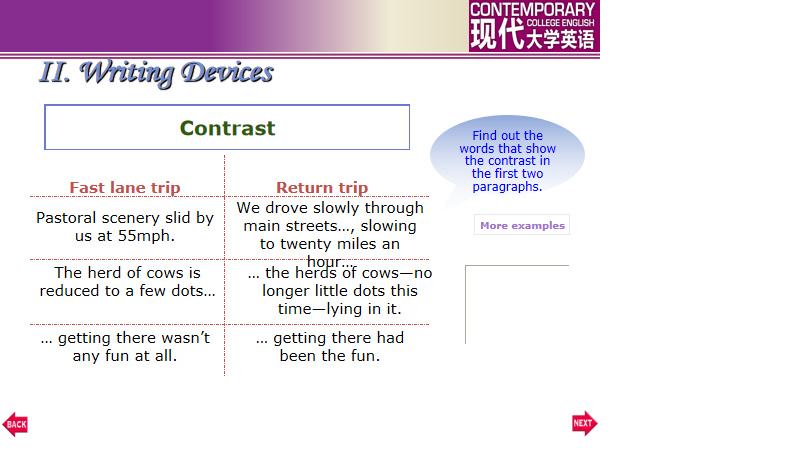
Comparison–contrast is a way of developing an essay. It means explaining thesimilarities and/or differences between events, people, ideas, etc. In this essay, thewriter concentrates on differences rather than similarities. In the first two paragraphs,she contrasts her featureless driving on fast roads and the pleasure of the return trip ona different route. In Paragraph 4, she points out how Americans’ lifestyle has changedfrom “saving for a rainy day” to “relax now, pay later”, and what they did in the pastwhen they wanted to lose weight, and how they try to get quick results today.
2. Definition
The central paragraphs (4–6) define “a quick fix society” by describing three features of such a society.
3. Exemplification
Using an example or examples is one of the simplest ways of explaining anything. InParagraph 5, several examples are given to illustrate how the “I-hate-to-wait” attitudeis reflected in various aspects of American life. In the next paragraph, the writer listsfacts to show how the iceberg principle applies to the way many Americans live theirlives.
4. Rhetorical questions
Rhetorical questions in the essay are chiefly used in Paragraphs 3, 5 and 7. We couldask the students to think about what purposes such questions serve.
5. Repetition
1) Of structure: In Paragraph 4, four if-clauses are used to contrast the way Americans did things in the past (the first three) and the way they seek a quick fix today (the last one).
2) Of words: The writer repeats the word “fast” throughout Paragraph 5 with negative
implications.
4 Language and Style
Unlike some essays such as “The Man in the Water”, this is an informal essay. Wedon’t find long and complicated sentences and the vocabulary mainly consists of plainwords, everyday expressions and phrasal verbs. Another feature we notice is the use ofa number of contemporary expressions and abbreviations such as “faxed”, “qualitytime”, CD, VCR, etc., which are facets of contemporary life connected with the quickfix way of life in the US.

