
I Introduction
1 Background
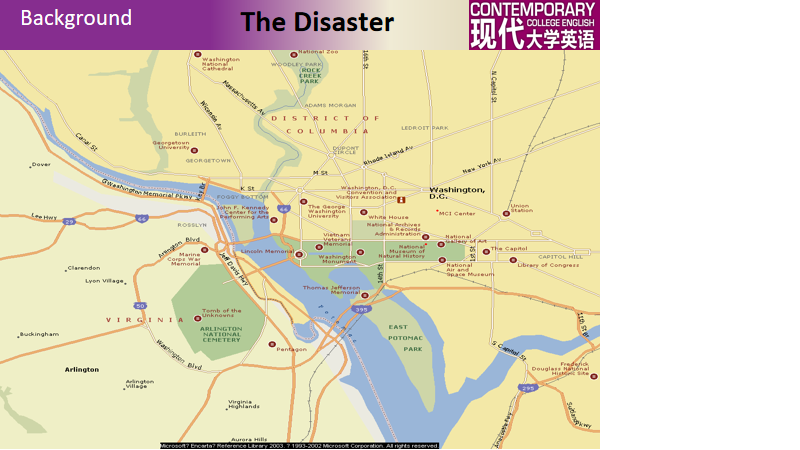
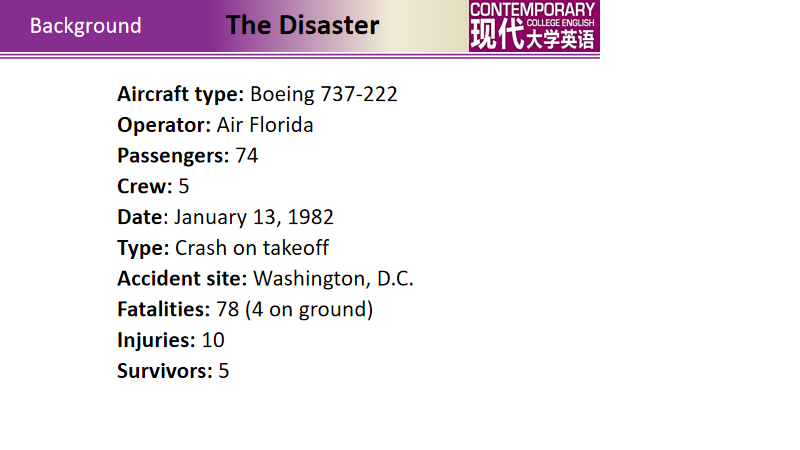
This is a short essay about an air crash that took place in the capital of the UnitedStates in the year 1982. A plane took off from the Washington National Airport anddid not clear the bridge over the Potomac River because of the thick ice on the wings.It hit the bridge and fell right into the river, bringing all the passengers to instant deathexcept six from the tail section who found themselves gasping and struggling in theicy water. Only five people survived, and they were able to survive because of fourheroes. The author wrote this essay in praise of these heroes, three of whom had riskedtheir lives to rescue the survivors and were able to live to tell the story, but the manthat really held the whole nation’s attention was the fourth man who had kept pushinghis lifeline and floatation rings to others until he went under.
Heroism has always been admired in human history. Many household names arenames of those unforgettable heroes and heroines. World literature is full of legendarystories of these people’s courage and heroic deeds. Alexander the Great, Achilles,Hercules, to name just a few. These people all have extraordinary qualities. Theycould have been revolutionary martyrs, great statesmen, staunch true believers whodied for their faith; people who laid down their lives in performing their duty, whodisplayed courage in their attempts to save the lives of others. Ironically there has alsobeen an over-emphasis on war heroes whose main feat is their ability to kill manyenemies, as well as on those politicians who have shown unusual talent in seizingpower, influence and money. But this man in the water does not fit in any of thesedescriptions. He did not have to give his rings to others; he did not even know thesepeople; and he died anonymous, unidentified. He was extraordinary precisely becausehe was not extraordinary. He showed what every one of us could do. The display ofhis heroism is a song to the human character. In our world today, we do not have to bereminded that there are a lot of displays of human weaknesses. But it is this kind oftrue story that reminds us that we have no reason to be pessimistic or cynical.
The fact that this hero happened to be an American should remind us that heroism isnot a national trait. No nation has a monopoly of this human spirit. Over the years,however, there has always been prejudice against different races and ethnic groups.When some people talk about the American character for example, they sometimes goto extremes. But blind hatred is just as wrong as blind worship. The United States hastheir share of human trash of course, but they also have numerous decent, honest,brave people like the one in the water, who have made their country a great countryand their people a great people. And it is this side of their national character that weshould learn from.
2 Structure
Again we can divide this essay into the conventional three parts: the introduction, thebody, and the conclusion. In the introduction (paras. 1–2), the writer begins with abrief account of the air disaster and then states the thesis of the essay. In the next sixparagraphs, the writer goes on to support the thesis by describing and analyzing thedeeds of four heroes with emphasis on one of them known as “the man in the water”.In the conclusion (para. 9), the writer restates the thesis in a more emphatic way bypointing out that in the struggle between man and nature the man in the waterrepresents human nature at its best.
I. A brief account of the air crash that leads to the thesis of the essay—in the aircrash, human nature rose to the occasion (paras. 1–2)
II. The development of the thesis: how human nature rose to the occasion (paras. 3–8)
1. The heroic deeds of three of the four heroes in the disaster. (para. 3)
2. A brief description of what the man in the water did. (para. 4)
3. The imagined thoughts and feelings of the man on the plane and in the water. (paras.5–6)
4. The writer’s reflections on the man’s role in the battle between man and nature: Hetriumphs over nature. (paras. 7–8)
III. The reason why the man could have done what he did—the human spirit enables him to defy death (para. 9)

