
I Introduction
1 Background
Our first impression of this text may be that this is a story about the relationshipbetween husband and wife. If we look deeper, however, we find that it can also betaken as a discussion of subtle expressions of racist feelings that are found in manyordinary people.
Racism is one of the most irrational and dangerous sentiments in our world. Historyhas recorded countless stories of human cruelty and suffering caused by racism. Wecan never forget how 6 million innocent people were slaughtered in Germanconcentration camps simply because they were Jews; we cannot forget what theJapanese did to the Chinese during the Second World War because they were made tobelieve that they were the superior race; we cannot forget how hundreds of thousandsof people were brutally murdered in a matter of a few months in Rwanda, a country ofonly 3 million people. Indeed, even as mankind enters the 21st century, racism is stillfar from being a thing of the past. If we look around we can find many countries andregions where people are being tormented by the worst kind of racism.
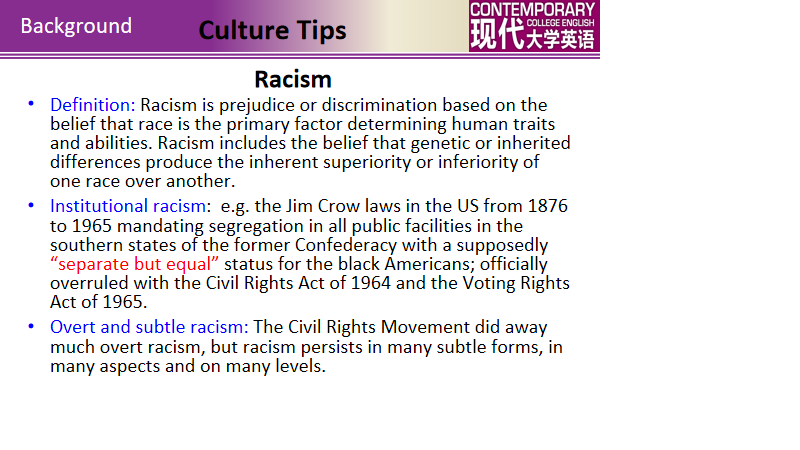
Racism has been called the national curse of the United States ever since the blackslaves were first brought into this continent. We all know the sufferings of the blacksas described in Uncle Tom’s Cabin; we also know about the Ku Klux Klan and the JimCrow laws. But since the Civil Right movement of the 1960s, a lot of changes havetaken place, and the racial relationship has dramatically improved so much that thecountry even has a black president in the White House. However, cultural heritagetends to linger on. It is not uncommon for people to enter the 21st century but stillthink and act like they were still in the Middle Ages. So racism is stillvery much alive,even in the United States. The only thing is that it now may take more subtle forms.The present article deals precisely with this subtle manifestation of racial prejudice.The little argument between this white couple reveals a very disturbing truth, that is,racism is by no means only the problem of a few terrible monsters; in a certain sense,we are also often guilty of the crime, and unless all of us ordinary people open oureyes to this fact and determine to say no, it is bound to continue to plague the world.
This story can also be regarded as a discussion of husband-wife relationship. It’s interesting that the debate takes place between a white couple. And the fact that theyargue over the racist problem and not about problems that husband and wife usuallyquarrel about may reflect the general social background at the time when racism was aproblem of public concern in the United States. What is the writer trying to tell ushere? Maybe, he is telling us that women are usually more sensitive and observant, ormore serious on matters of moral principles. Maybe he is telling us husband and wifecan be married for many years without really knowing each other’s innermostthoughts; they may remain strangers.
2 Structure
I. The issue that started the family quarrel (paras. 1–5)
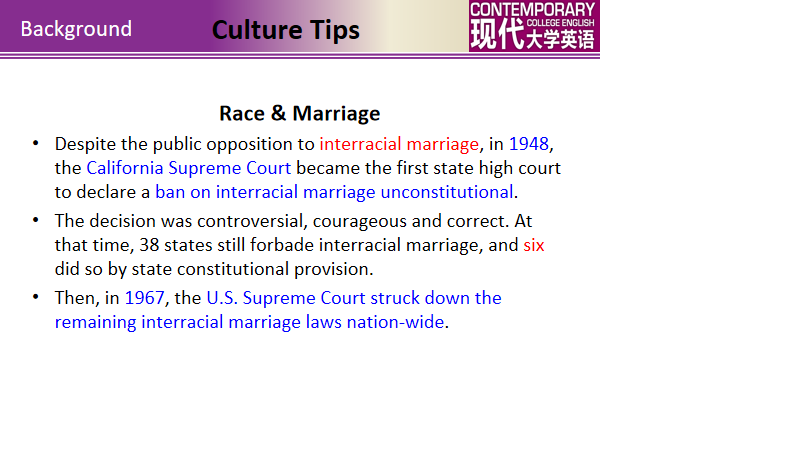
1. The couple were chatting while washing dishes when the husband said something about interracial marriages, which he thought on the whole were a bad idea.
2. The wife considered his point of view ridiculous, which made the husband feel hurt because his wife was clearly implying that he was a racist.
II. The arguments of the husband in his self-defense (paras. 6–18)
1. He likes blacks and their language and gets along well with them.
2. Different races have different cultures, which makes marriage difficult, but it has nothing to do with racism.
3. Statistics show many interracial marriages finally break up.
III. The husband’s failure to please his wife and divert her attention from thisunpleasant argument (paras. 19–24)
The wife cut her finger; the husband rushed to help stop her bleeding and hoped shewould show appreciation and reward him by ending this unpleasant discussion.
IV. The answer (paras. 25–44)
1. The wife insisted on her husband’s immediate answer as to whether he would
marry her if she were black, single and they fell in love.
2. The husband was forced to give his honest answer that he wouldn’t, which confirmed his wife’s opinion that he was a racist, and made her furious.
V. The anger (paras. 45–48)
1. The husband thought that his wife was not behaving in a reasonable and logical
way.
2. He felt deeply hurt at first by his wife’s attitude. 3. In the end he was sorry for what had happened.
VI. The stranger (paras. 49–57)
1. The husband decided to forgive her and make up with her by his changing answer to her question, but this did not improve the situation.
2. His wife did not return to bed, making him feel she was a stranger once again like she had been the night they were married.

