
目录

  • 1 General information
    • 1.1 Syllabus
    • 1.2 Overview
      • 1.2.1 Learning objectives
      • 1.2.2 Learning contents
      • 1.2.3 Learning activities
      • 1.2.4 Schedule
        • 1.2.4.1 Online schedule
        • 1.2.4.2 Offline schedule
      • 1.2.5 Grading policy
      • 1.2.6 Office hour
    • 1.3 Ap knowledge
    • 1.4 Platform usage guideline and technical support
  • 2 Nomenclature
    • 2.1 Nomenclature
    • 2.2 Inorganic compounds
    • 2.3 Organic compounds
  • 3 Atom
    • 3.1 Basic Atomic Theory
    • 3.2 Evolution of Atomic Theory
    • 3.3 Atomic Structure and Symbolism
    • 3.4 Isotopes
    • 3.5 Early development of the periodic table of elements
    • 3.6 Organization of the elements
  • 4 Atoms: the quantum world
    • 4.1 Wave Nature of Light
    • 4.2 Quantized Energy and Photons
    • 4.3 the Bohr Model
    • 4.4 Wave Character of Matter
    • 4.5 Atomic Orbitals
    • 4.6 3D Representation of Orbitals
    • 4.7 Many-Electron Atoms
    • 4.8 Electron Configurations
  • 5 Chemical Bonds
    • 5.1 Prelude to Chemical Bonds
    • 5.2 Lewis Electron Dot Diagrams
    • 5.3 Ionic Bonds
    • 5.4 Covalent Bonds
    • 5.5 Other Aspects of Covalent Bonds
    • 5.6 Violations of the Octet Rule
  • 6 Molecular Shape and Structure
    • 6.1 VSEPR theory
    • 6.2 Hybridization
      • 6.2.1 sp3 hybridization
      • 6.2.2 sp2 hybridization
      • 6.2.3 sp hybridization
      • 6.2.4 Other hybridization
    • 6.3 Multiple Bonds
    • 6.4 Molecular Orbitals
    • 6.5 Second-Row Diatomic Molecules
  • 7 Properties of Gases
    • 7.1 Property of Gases
    • 7.2 新建课程目录
  • 8 Fundamentals of Thermochemistry
    • 8.1 Systems, States and Processes
    • 8.2 Heat as a Mechanism to Transfer Energy
    • 8.3 Work as a Mechanism to Transfer Energy
    • 8.4 Heat Capacity and Calorimetry
    • 8.5 The First Law of Thermodynamics
    • 8.6 Heats of Reactions - ΔU and ΔH
    • 8.7 Indirect Determination of ΔH - Hess's Law
    • 8.8 Standard Enthalpies of Formation
  • 9 Principles of Thermodynamics
    • 9.1 The Nature of Spontaneous Processes
    • 9.2 Entropy and Spontaneity - A Molecular Statistical Interpretation
    • 9.3 Entropy Changes and Spontaneity
    • 9.4 Entropy Changes in Reversible Processes
    • 9.5 Quantum States, Microstates, and Energy Spreading
    • 9.6 The Third Law of Thermodynamics
    • 9.7 Gibbs Energy
  • 10 Chemical equilibrium
    • 10.1 Equilibrium
    • 10.2 Reversible and irreversible reaction
    • 10.3 Chemical equilirbium
    • 10.4 Chemical equilibrium constant, Kc
    • 10.5 Le Chatelier's principle
      • 10.5.1 Haber process
    • 10.6 RICE table
      • 10.6.1 Calculating Equilibrium Constant Values
  • 11 Acid–Base Equilibria
    • 11.1 Classifications of Acids and Bases
    • 11.2 Properties of Acids and Bases in Aqueous Solutions
    • 11.3 Acid and Base Strength
    • 11.4 Buffer Solutions
    • 11.5 Acid-Base Titration Curves
    • 11.6 Polyprotic Acids
    • 11.7 Exact Treatment of Acid-Base Equilibria
    • 11.8 Organic Acids and Bases
  • 12 Kinetics
    • 12.1 Prelude to Kinetics
    • 12.2 Chemical Reaction Rates
    • 12.3 Factors Affecting Reaction Rates
    • 12.4 Rate Laws
    • 12.5 Integrated Rate Laws
    • 12.6 Collision Theory
    • 12.7 Reaction Mechanisms
    • 12.8 Catalysis
Violations of the Octet Rule

Violations of the Octet Rule

Learning Objectives


  • Recognize the three major types of violations of the octet rule.


As important and useful as the octet rule is in chemical bonding, there are some well-known violations. This does not mean that the octet rule is useless—quite the contrary. As with many rules, there are exceptions, or violations.

There are three violations to the octet rule. Odd-electron molecules are the first violation to the octet rule. Although they are few, some stable compounds have an odd number of electrons in their valence shells. With an odd number of electrons, at least one atom in the molecule will have to violate the octet rule. Examples of stable odd-electron molecules are , and . The Lewis electron dot diagram for  is as follows:

Nitrogen and oxygen share four electrons between them. Oxygen has two lone pairs while nitrogen has one full lone pair and one additional electron.

Although the  atom has an octet of electrons, the N atom has only seven electrons in its valence shell. Although  is a stable compound, it is very chemically reactive, as are most other odd-electron compounds.

Electron-deficient molecules are the second violation to the octet rule. These stable compounds have less than eight electrons around an atom in the molecule. The most common examples are the covalent compounds of beryllium and boron. For example, beryllium can form two covalent bonds, resulting in only four electrons in its valence shell:
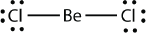
Beryllium has only four electrons when bound in BeCl2.

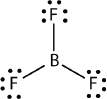
Boron commonly makes only three covalent bonds, resulting in only six valence electrons around the  atom. A well-known example is :
The third violation to the octet rule is found in those compounds with more than eight electrons assigned to their valence shell. These are called expanded valence shell molecules. Such compounds are formed only by central atoms in the third row of the periodic table or beyond that have empty d orbitals in their valence shells that can participate in covalent bonding. One such compound is . The only reasonable Lewis electron dot diagram for this compound has the P atom making five covalent bonds:

Formally, the  atom has 10 electrons in its valence shell.


Summary

There are three violations to the octet rule: odd-electron molecules, electron-deficient molecules, and expanded valence shell molecules.

Relative radio