
Other Aspects of Covalent Bonds
Learning Objectives:
Describe a nonpolar bond and a polar bond.
Use electronegativity to determine whether a bond between two elements will be nonpolar covalent, polar covalent, or ionic.
Describe the bond energy of a covalent bond.
Consider the H2 molecule:
H:H
Because the nuclei of each H atom contain protons, the electrons in the bond are attracted to the nuclei (opposite charges attract). But because the two atoms involved in the covalent bond are both H atoms, each nucleus attracts the electrons by the same amount. Thus the electron pair is equally shared by the two atoms. The equal sharing of electrons in a covalent bond is called a nonpolar covalent bond.
Now consider the molecule:

There are two different atoms involved in the covalent bond. The H atom has one proton in its nucleus that is attracting the bonding pair of electrons. However, the F atom has nine protons in its nucleus, with nine times the attraction of the H atom. The F atom attracts the electrons so much more strongly that the electrons remain closer to the F atom than to the H atom; the electrons are no longer equally balanced between the two nuclei. Instead of representing the HF molecule as

it may be more appropriate to draw the covalent bond as

with the electrons in the bond being nearer to the F atom than the H atom. Because the electrons in the bond are nearer to the F atom, this side of the molecule takes on a partial negative charge, which is represented by δ− (δ is the lowercase Greek letter delta). The other side of the molecule, the H atom, adopts a partial positive charge, which is represented by δ+:

A covalent bond between different atoms that attract the shared electrons by different amounts, and cause an imbalance of electron distribution is called a polar covalent bond.
Technically, any covalent bond between two different elements is polar. However, the degree of polarity is important. A covalent bond between two different elements may be so slightly unbalanced that the bond is, essentially, nonpolar. A bond may be so polar that an electron actually transfers from one atom to another, forming a true ionic bond. How do we judge the degree of polarity? Scientists have devised a scale called electronegativity, a scale for judging how strongly atoms of any element attract electrons. Electronegativity is a unitless number; the higher the number, the more an atom attracts electrons. A common scale for electronegativity is shown in Figure .
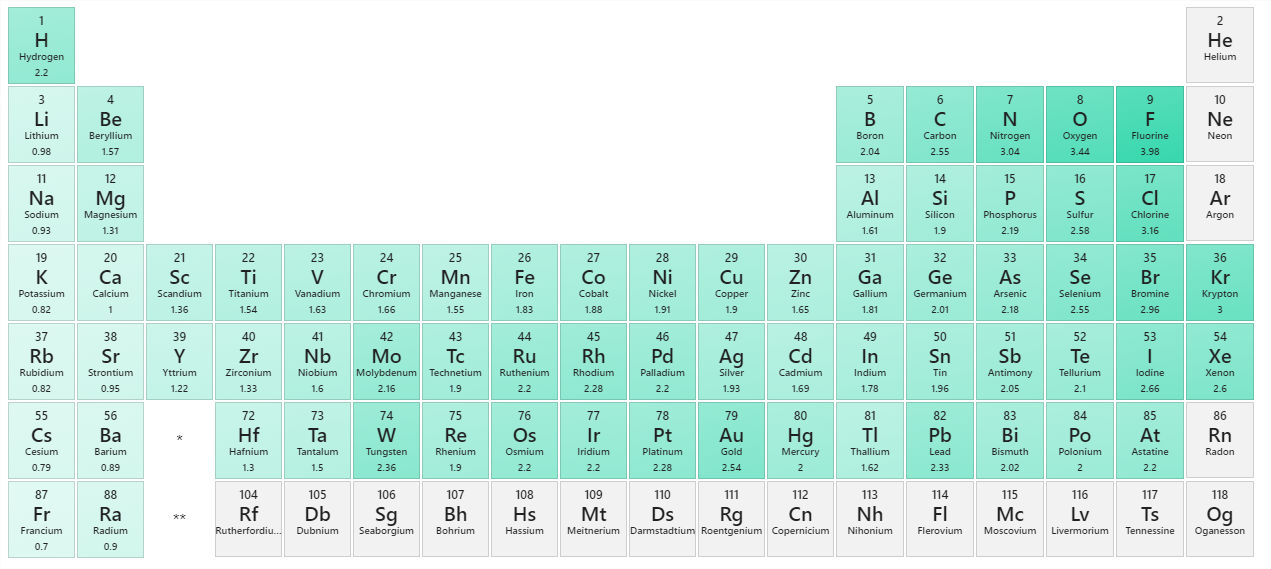
The polarity of a covalent bond can be judged by determining the difference of the electronegativities of the two atoms involved in the covalent bond, as summarized in the following table:
| Electronegativity Difference | Bond Type |
|---|---|
| 0 | nonpolar covalent |
| 0–0.4 | slightly polar covalent |
| 0.4–1.9 | definitely polar covalent |
| >1.9 | likely ionic |
The polarity of a covalent bond can have significant influence on the properties of the substance. If the overall molecule is polar, the substance may have a higher melting point and boiling point than expected; also, it may or may not be soluble in various other substances, such as water or hexane.
It should be obvious that covalent bonds are stable because molecules exist. However, they can be broken if enough energy is supplied to a molecule. For most covalent bonds between any two given atoms, a certain amount of energy must be supplied. Although the exact amount of energy depends on the molecule, the approximate amount of energy to be supplied is similar if the atoms in the bond are the same. The approximate amount of energy needed to break a covalent bond is called the bond energy of the covalent bond. Table , lists the bond energies of some covalent bonds.
| Bond | Energy (kJ/mol) | Bond | Energy (kJ/mol) | |
|---|---|---|---|---|
| C–C | 348 | N–N | 163 | |
| C=C | 611 | N=N | 418 | |
| C≡C | 837 | N≡N | 946 | |
| C–O | 351 | N–H | 389 | |
| C=O | 799 | O–O | 146 | |
| C–Cl | 328 | O=O | 498 | |
| C–H | 414 | O–H | 463 | |
| F–F | 159 | S–H | 339 | |
| H–Cl | 431 | S=O | 523 | |
| H–F | 569 | Si–H | 293 | |
| H–H | 436 | Si–O | 368 |
A few trends are obvious from Table . For bonds that involve the same two elements, a double bond is stronger than a single bond, and a triple bond is stronger than a double bond. The energies of multiple bonds are not exact multiples of the single bond energy; for carbon-carbon bonds, the energy increases somewhat less than double or triple the C–C bond energy, while for nitrogen-nitrogen bonds the bond energy increases at a rate greater than the multiple of the N–N single bond energy. The bond energies in Table are average values; the exact value of the covalent bond energy will vary slightly among molecules with these bonds, but should be close to these values.
To be broken, covalent bonds always require energy; that is, covalent bond breaking is always an endothermic process. Thus the ΔH for this process is positive:
Molecule–O–H → Molecule–O + H
with ΔH ≈ +463 kJ/mol
However, when making a covalent bond, energy is always given off; covalent bond making is always an exothermic process. Thus ΔH for this process is negative:
Molecule–S + H → Molecule–S–H
with ΔH ≈ −339 kJ/mol
Bond energies can be used to estimate the energy change of a chemical reaction. When bonds are broken in the reactants, the energy change for this process is endothermic. When bonds are formed in the products, the energy change for this process is exothermic. We combine the positive energy change with the negative energy change to estimate the overall energy change of the reaction. For example, in
2H2 + O2 → 2H2O
we can draw Lewis electron dot diagrams for each substance to see what bonds are broken and what bonds are formed:

(The lone electron pairs on the O atoms are omitted for clarity.) We are breaking two H–H bonds and one O–O double bond and forming four O–H single bonds. The energy required for breaking the bonds is as follows:
| 2 H–H bonds: | 2(+436 kJ/mol) |
| 1 O=O bond: | +498 kJ/mol |
| Total: | +1,370 kJ/mol |
The energy given off when the four O–H bonds are made is as follows:
| 4 O–H bonds: | 4(−463 kJ/mol) |
| Total: | −1,852 kJ/mol |
Combining these two numbers:
| +1,370 kJ/mol + (−1,852 kJ/mol) | |
| Net Change: | −482 kJ/mol ≈ ΔH |
The actual ΔH is −572 kJ/mol; we are off by about 16%. Although not ideal, a 16% difference is reasonable because we used estimated, not exact, bond energies.
Summary
Covalent bonds can be nonpolar or polar, depending on the electronegativities of the atoms involved.
Covalent bonds can be broken if energy is added to a molecule.
The formation of covalent bonds is accompanied by energy given off.
Covalent bond energies can be used to estimate the enthalpy changes of chemical reactions.

