目录

  • 1 General information
    • 1.1 Syllabus
    • 1.2 Overview
      • 1.2.1 Learning objectives
      • 1.2.2 Learning contents
      • 1.2.3 Learning activities
      • 1.2.4 Schedule
        • 1.2.4.1 Online schedule
        • 1.2.4.2 Offline schedule
      • 1.2.5 Grading policy
      • 1.2.6 Office hour
    • 1.3 Ap knowledge
    • 1.4 Platform usage guideline and technical support
  • 2 Nomenclature
    • 2.1 Nomenclature
    • 2.2 Inorganic compounds
    • 2.3 Organic compounds
  • 3 Atom
    • 3.1 Basic Atomic Theory
    • 3.2 Evolution of Atomic Theory
    • 3.3 Atomic Structure and Symbolism
    • 3.4 Isotopes
    • 3.5 Early development of the periodic table of elements
    • 3.6 Organization of the elements
  • 4 Atoms: the quantum world
    • 4.1 Wave Nature of Light
    • 4.2 Quantized Energy and Photons
    • 4.3 the Bohr Model
    • 4.4 Wave Character of Matter
    • 4.5 Atomic Orbitals
    • 4.6 3D Representation of Orbitals
    • 4.7 Many-Electron Atoms
    • 4.8 Electron Configurations
  • 5 Chemical Bonds
    • 5.1 Prelude to Chemical Bonds
    • 5.2 Lewis Electron Dot Diagrams
    • 5.3 Ionic Bonds
    • 5.4 Covalent Bonds
    • 5.5 Other Aspects of Covalent Bonds
    • 5.6 Violations of the Octet Rule
  • 6 Molecular Shape and Structure
    • 6.1 VSEPR theory
    • 6.2 Hybridization
      • 6.2.1 sp3 hybridization
      • 6.2.2 sp2 hybridization
      • 6.2.3 sp hybridization
      • 6.2.4 Other hybridization
    • 6.3 Multiple Bonds
    • 6.4 Molecular Orbitals
    • 6.5 Second-Row Diatomic Molecules
  • 7 Properties of Gases
    • 7.1 Property of Gases
    • 7.2 新建课程目录
  • 8 Fundamentals of Thermochemistry
    • 8.1 Systems, States and Processes
    • 8.2 Heat as a Mechanism to Transfer Energy
    • 8.3 Work as a Mechanism to Transfer Energy
    • 8.4 Heat Capacity and Calorimetry
    • 8.5 The First Law of Thermodynamics
    • 8.6 Heats of Reactions - ΔU and ΔH
    • 8.7 Indirect Determination of ΔH - Hess's Law
    • 8.8 Standard Enthalpies of Formation
  • 9 Principles of Thermodynamics
    • 9.1 The Nature of Spontaneous Processes
    • 9.2 Entropy and Spontaneity - A Molecular Statistical Interpretation
    • 9.3 Entropy Changes and Spontaneity
    • 9.4 Entropy Changes in Reversible Processes
    • 9.5 Quantum States, Microstates, and Energy Spreading
    • 9.6 The Third Law of Thermodynamics
    • 9.7 Gibbs Energy
  • 10 Chemical equilibrium
    • 10.1 Equilibrium
    • 10.2 Reversible and irreversible reaction
    • 10.3 Chemical equilirbium
    • 10.4 Chemical equilibrium constant, Kc
    • 10.5 Le Chatelier's principle
      • 10.5.1 Haber process
    • 10.6 RICE table
      • 10.6.1 Calculating Equilibrium Constant Values
  • 11 Acid–Base Equilibria
    • 11.1 Classifications of Acids and Bases
    • 11.2 Properties of Acids and Bases in Aqueous Solutions
    • 11.3 Acid and Base Strength
    • 11.4 Buffer Solutions
    • 11.5 Acid-Base Titration Curves
    • 11.6 Polyprotic Acids
    • 11.7 Exact Treatment of Acid-Base Equilibria
    • 11.8 Organic Acids and Bases
  • 12 Kinetics
    • 12.1 Prelude to Kinetics
    • 12.2 Chemical Reaction Rates
    • 12.3 Factors Affecting Reaction Rates
    • 12.4 Rate Laws
    • 12.5 Integrated Rate Laws
    • 12.6 Collision Theory
    • 12.7 Reaction Mechanisms
    • 12.8 Catalysis
Prelude to Chemical Bonds

Prelude to Chemical Bonds

Diamond is the hardest natural material known on Earth. Yet diamond is just pure carbon. What is special about this element that makes diamond so hard? Bonds. Chemical bonds.

In a perfect diamond crystal, each C atom makes four connections—bonds—to four other C atoms in a three-dimensional matrix. Four is the greatest number of bonds that is commonly made by atoms, so C atoms maximize their interactions with other atoms. This three-dimensional array of connections extends throughout the diamond crystal, making it essentially one large molecule. Breaking a diamond means breaking every bond at once. Also, the bonds are moderately strong. There are stronger interactions known, but the carbon-carbon connection is fairly strong itself. Not only does a person have to break many connections at once, but the bonds are also strong connections from the start.
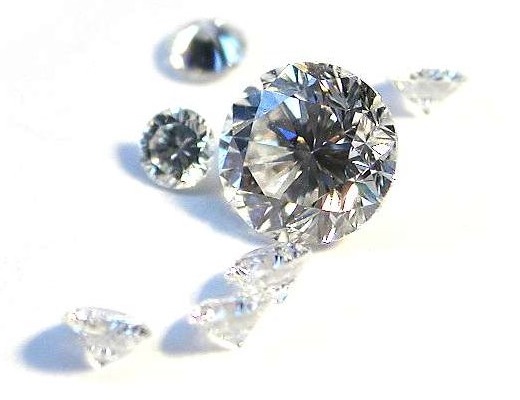
Diamond is the hardest known natural substance and is composed solely of the element carbon. (CC SA-BY 3.0; Mario Sarto).

There are other substances that have bonding arrangements similar to diamond. Silicon dioxide and boron nitride have some similarities, but neither of them comes close to the ultimate hardness of diamond.