
目录

  • 1 General information
    • 1.1 Syllabus
    • 1.2 Overview
      • 1.2.1 Learning objectives
      • 1.2.2 Learning contents
      • 1.2.3 Learning activities
      • 1.2.4 Schedule
        • 1.2.4.1 Online schedule
        • 1.2.4.2 Offline schedule
      • 1.2.5 Grading policy
      • 1.2.6 Office hour
    • 1.3 Ap knowledge
    • 1.4 Platform usage guideline and technical support
  • 2 Nomenclature
    • 2.1 Nomenclature
    • 2.2 Inorganic compounds
    • 2.3 Organic compounds
  • 3 Atom
    • 3.1 Basic Atomic Theory
    • 3.2 Evolution of Atomic Theory
    • 3.3 Atomic Structure and Symbolism
    • 3.4 Isotopes
    • 3.5 Early development of the periodic table of elements
    • 3.6 Organization of the elements
  • 4 Atoms: the quantum world
    • 4.1 Wave Nature of Light
    • 4.2 Quantized Energy and Photons
    • 4.3 the Bohr Model
    • 4.4 Wave Character of Matter
    • 4.5 Atomic Orbitals
    • 4.6 3D Representation of Orbitals
    • 4.7 Many-Electron Atoms
    • 4.8 Electron Configurations
  • 5 Chemical Bonds
    • 5.1 Prelude to Chemical Bonds
    • 5.2 Lewis Electron Dot Diagrams
    • 5.3 Ionic Bonds
    • 5.4 Covalent Bonds
    • 5.5 Other Aspects of Covalent Bonds
    • 5.6 Violations of the Octet Rule
  • 6 Molecular Shape and Structure
    • 6.1 VSEPR theory
    • 6.2 Hybridization
      • 6.2.1 sp3 hybridization
      • 6.2.2 sp2 hybridization
      • 6.2.3 sp hybridization
      • 6.2.4 Other hybridization
    • 6.3 Multiple Bonds
    • 6.4 Molecular Orbitals
    • 6.5 Second-Row Diatomic Molecules
  • 7 Properties of Gases
    • 7.1 Property of Gases
    • 7.2 新建课程目录
  • 8 Fundamentals of Thermochemistry
    • 8.1 Systems, States and Processes
    • 8.2 Heat as a Mechanism to Transfer Energy
    • 8.3 Work as a Mechanism to Transfer Energy
    • 8.4 Heat Capacity and Calorimetry
    • 8.5 The First Law of Thermodynamics
    • 8.6 Heats of Reactions - ΔU and ΔH
    • 8.7 Indirect Determination of ΔH - Hess's Law
    • 8.8 Standard Enthalpies of Formation
  • 9 Principles of Thermodynamics
    • 9.1 The Nature of Spontaneous Processes
    • 9.2 Entropy and Spontaneity - A Molecular Statistical Interpretation
    • 9.3 Entropy Changes and Spontaneity
    • 9.4 Entropy Changes in Reversible Processes
    • 9.5 Quantum States, Microstates, and Energy Spreading
    • 9.6 The Third Law of Thermodynamics
    • 9.7 Gibbs Energy
  • 10 Chemical equilibrium
    • 10.1 Equilibrium
    • 10.2 Reversible and irreversible reaction
    • 10.3 Chemical equilirbium
    • 10.4 Chemical equilibrium constant, Kc
    • 10.5 Le Chatelier's principle
      • 10.5.1 Haber process
    • 10.6 RICE table
      • 10.6.1 Calculating Equilibrium Constant Values
  • 11 Acid–Base Equilibria
    • 11.1 Classifications of Acids and Bases
    • 11.2 Properties of Acids and Bases in Aqueous Solutions
    • 11.3 Acid and Base Strength
    • 11.4 Buffer Solutions
    • 11.5 Acid-Base Titration Curves
    • 11.6 Polyprotic Acids
    • 11.7 Exact Treatment of Acid-Base Equilibria
    • 11.8 Organic Acids and Bases
  • 12 Kinetics
    • 12.1 Prelude to Kinetics
    • 12.2 Chemical Reaction Rates
    • 12.3 Factors Affecting Reaction Rates
    • 12.4 Rate Laws
    • 12.5 Integrated Rate Laws
    • 12.6 Collision Theory
    • 12.7 Reaction Mechanisms
    • 12.8 Catalysis
Chemical equilibrium constant, Kc

Chemical equilibrium constant, Kc

Learning Objectives


  • Explain the importance of the equilibrium constant.

  • Construct an equilibrium constant expression for a chemical reaction.


Equilibrium Constant

Consider the hypothetical reversible reaction in which reactants A and B react to form products C and D. This equilibrium can be shown below, where the lowercase letters represent the coefficients of each substance.
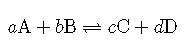

As we have established, the rates of the forward and reverse reactions are the same at equilibrium, and so the concentrations of all of the substances are constant. Since that is the case, it stands to reason that a ratio of the concentration for any given reaction at equilibrium maintains a constant value. The equilibrium constant (Keq) is the ratio of the mathematical product of the products of a reaction to the mathematical product of the concentrations of the reactants of the reaction. Each concentration is raised to the power of its coefficient in the balanced chemical equation. For the general reaction above, the equilibrium constant expression is written as follows:
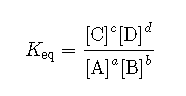

The concentrations of each substance, indicated by the square brackets around the formula, are measured in molarity units (mol/L).

The value of the equilibrium constant for any reaction is only determined by experiment. As detailed in the above section, the position of equilibrium for a given reaction does not depend on the starting concentrations and so the value of the equilibrium constant is truly constant. It does, however, depend on the temperature of the reaction. This is because equilibrium is defined as a condition resulting from the rates of forward and reverse reactions being equal. If the temperature changes, the corresponding change in those reaction rates will alter the equilibrium constant. For any reaction in which a Keq is given, the temperature should be specified.

When Keq is greater than 1, the numerator is larger than the denominator so the products are favored, meaning the concentration of its products are greater than that of the reactants.

If Keq is less than 1, then the reactants are favored because the denominator (reactants) is larger than the numerator (products).

When Keq is equal to 1, then the concentration of reactants and products are approximately equal.


Reaction Quotient

The reaction quotient, Q, is used when questioning if we are at equilibrium. The calculation for Q is exactly the same as for K but we can only use K when we know we are at equilibrium. Comparing Q and K allows the direction of the reaction to be predicted.

  •  =  equilibrium

  •  <  reaction proceeds to the right to form more products and decrease amount of reactants so value of  will increase

  •  >  reaction proceeds to the left to form more reactants and decrease amount of products so value of  will decrease


Relative radio