
-
1 Thought Patt...
-
2 Case Study
So far, we have already learned different aspects about verbal communication, such as addressing, compliments, taboos and culturally loaded words, which will help you to have better communications with people by recognizing the cultural differences with linguistic signs. While during intercultural communication, there will always be some differences that cannot be recognized or presented superficially, and these differences take roots inside our mind and play a more decisive role. They are different patterns of thought.
Sometimes, we will find people from different cultures inscrutable not because of the words or grammar they use, but the different ways of communication, or to be more exact, that’s because the different thinking patterns encouraged by that certain culture.
Thinking patterns are not born to be with us, but influenced by the cultures we live in, and people of the same race may act differently when they grow up in different cultures. This phenomenon is reflected in some movies involving intercultural communication. Now let’s firstly enjoy a video clip from the movie The Farewell, and in this video you will see different responses to the serious topic of life – death.
Ok, have you found out the different thinking patterns in this movie? Yes, they are the typical high-context thinking pattern being more indirect and euphemistic, and the typical low-context thinking pattern, likely to be more direct and facts-oriented.
Facing the fact that her grandma has cancer, Bill, who migrated to America when she was 6 years old, advocate that grandma deserves the truth. While her parents and relatives who live in China and Japan for long time would like to keep it a secret to grandma, thinking that truth will cause a more serious suffering than the disease itself. You see, what a striking contrast between a typical Oriental thinking pattern and a Western thinking pattern.
Robert Kaplan, the famous linguist, used different shapes to demonstrate different thinking patterns in different cultures.
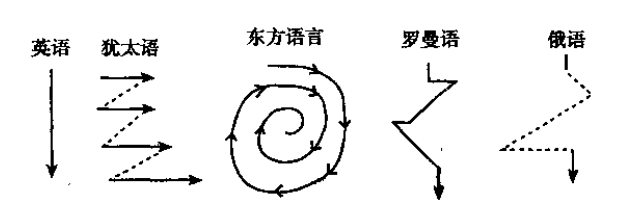
English Semitic Oriental Romance Russian
Figure 1 Sequencing Differences by Culture
As you can see in figure 1, English-speakers were likely to be more linear and direct than Semitic individuals who solve problems using a combination of tangential and semi-direct approaches. Asians employed a circular approach, Romance cultures used a more consistently circuitous approach, and Russians used a combination of direct and circuitous approach.
Learning one language is not only learning the grammar and vocabulary, but learning the logic and problem-solving approach embedded in its culture. Understanding and appreciation of differences among cultures in cognitive processing and problem solving will be a major step towards successful intercultural communication. And for the students, it will also help you make great progress in learning in terms of listening, speaking, reading, writing, and even translation.

