
-
1 Conversation ...
-
2 Video
-
3 Practice
After learning the ways of addressing and greeting in the previous lectures, let’s come to a more interesting and complicated part of communication, which is how to initiate a conversation with people of different cultures and how to make conversations go smoothly.
Firstly, let’s have a look at a conversation between people of different cultures. In this conversation, there are some common mistakes that usually take place in cross-cultural communication. Please try your best to figure them out.
Conversation1:
Li works in a foreign company in Dalian, and Robert is his boss. One day, they met in the elevator.
Robert: Morning, Li.
Li: Oh, Good morning, Robert. How’s everything going?
Robert: Not too bad.
Li: Wow, I like your new watch, it must be very expensive. How much is it?
Robert: Well... it’s a birthday gift from my wife, so, in fact, I have no idea how much it is.
Li: Oh, okay.
Robert: Li, we have a new colleague from America to join us. Would you please pick her up at the airport tomorrow?
Li: No problem.
Robert: Thank you!
Conversation2:
The next day. Li went to the airport to pick up Emily Prentiss, the new colleague.
Li: Hi, Ms. Emily, I’m Li. Nice to meet you.
Emily: Nice to meet you, Li. Thank you for picking me up.
Li: You’re welcome. It’s a long journey, and you must be very tired. Sleep for a while.
Emily: Thank you. I’m fine. We can go directly to the company, and I would like to meet my new colleagues first.
Li:Okay.
Li: Emily, how old are you? You look so young.
Emily: (a little bit embarrassed) Thank you.
Li: Is this the first time of your visiting China?
Emily: Yes.
Li: Do you like China?
Emily: Definitely.
Li: Do you think Dalian is a beautiful city?
Emily: Oh, yes.
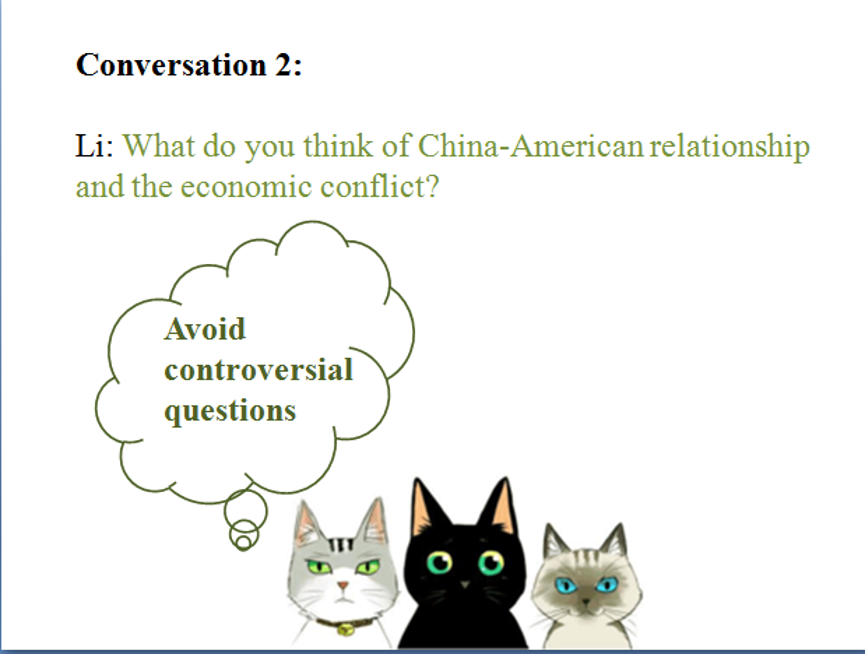
Li: What do you think of China-American relationship and the economic conflict?
Emily: Well, it’s quite a complicated question, maybe we can talk about it later when we have enough time. Do you mind my taking a nap? It’s really a long journey.
Li: Oh, of course not.
During the two conversations, Li had made 5 basic mistakes which are against the rules of cross-cultural communication.
Have you found out all the mistakes?


Have you ever made similar mistakes when having conversations with foreign friends? To become a conversationalist, let’s bear the dos and don’ts in mind when you start a conversation and keep it go smoothly without offending the other person of different cultures.
I. DON’Ts
1. Don’t stare at others or avoid eye-contact all the time.
Conversation between people should occur in a natural way, not contrived. So, pay attention to your behavior, and do not stare at the other person, nor should you try to avoid eye contact all the time.
2. Don’t ask predictable questions.
*Are you an American?
*Is this your first visit to China?
Both the two questions have predictable answers which will kill a good conversation. Avoid the questions which request only yes or no for an answer. Ask some open-ended questions.
3. Don’t choose topics that will intrude on others’ privacy.
Age, money and marriage condition are extremely private and personal questions in the west, so questions involving these topics should be avoided. If you really need to learn about this information, try to be polite by starting your question with “Would you please…?” “I don’t mean to…, but…”.
4. Don’t ask controversial questions.
Controversial topics, such as politics and religion, which may lead to unpleasant response, should also be avoided.
5. Don’t bomb questions without getting the other person’s feedbacks.
Donot fire questions at the person without giving your feedback, because nothing is worse than feeling being interviewed or interrogated. Asking too many questions will only make the other person feel uncomfortable and will leave him/her finding a way out of the conversation.
II. Dos
1. Start the conversation in a natural way, and show your concern.
Make the person you are talking with feel that you care about what he/she is saying and that his/her opinion matters to you. This will be a good start of a conversation.
2. Ask open-ended questions
Open-ended questions are questions that require more than a yes or no for an answer. Open-ended questions allow people to elaborate and create conversations.
For example:
*What do you think about the new season of the TV show?
*Why do people think Chinese is a difficult language to learn?
3. Choose general topics acceptable to both Westerners and Chinese.
Generally speaking, hobbies, weather, films or books are topics acceptable to both Westerners and Chinese.
4. Branch off yourtopics
Branch off your conversation into different topics so that your partner can always find a topic he/she is interested in. In this way, the conversation will notcome to a dead end easily.
For example, I like reading. Reading can create a peaceful atmosphere which can always make me feel satisfied. Suspense stories are my favorite.
This conversation is branched off into three parts: your hobby, your personality, and the type of books you like. It will give the other person some inspiration.
5. Tell stories instead of questioning.
Sharing your own experience will be better than questioning others all the time, and as we mentioned before, nobody likes the feeling of being interviewed. When telling your stories, try to use concise language.

