1.商务信函写作原则
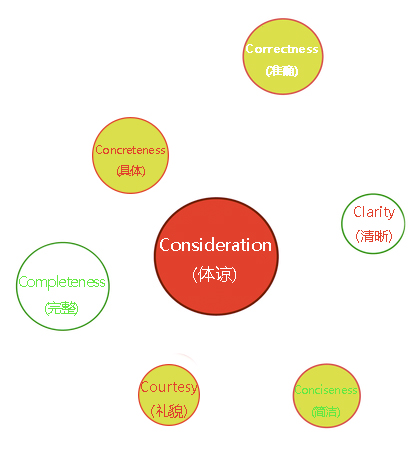
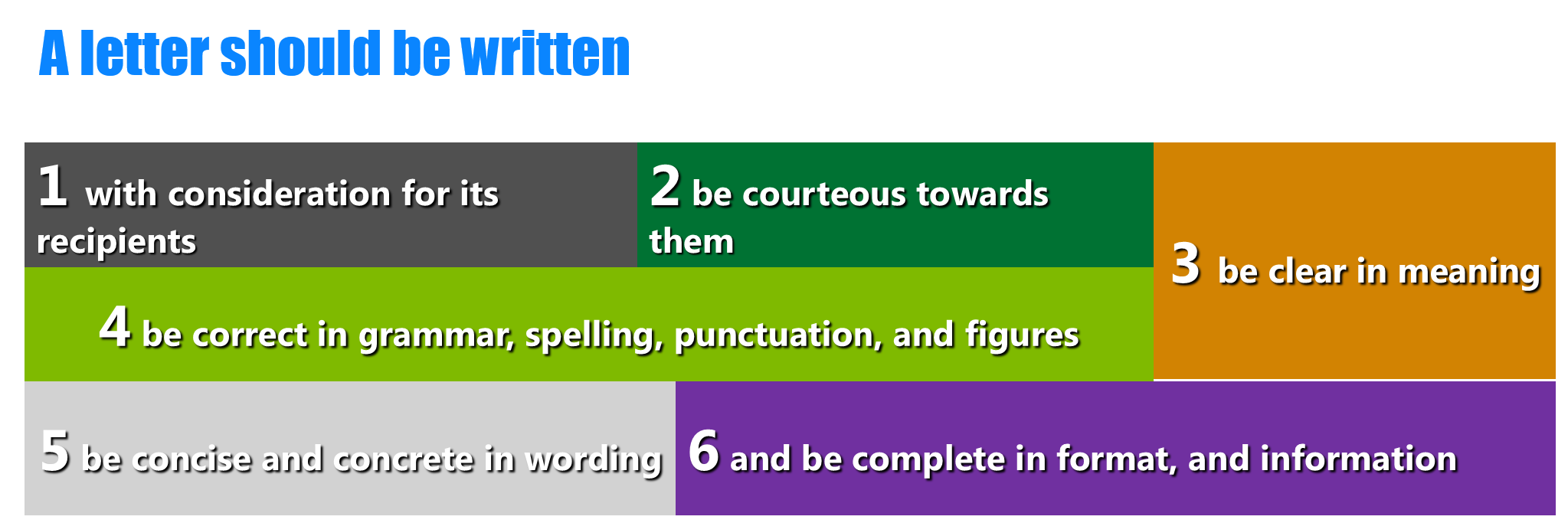
7Cprinciples

1.Courtesy
Courtesy is not mere politeness. It stems froma sincere You-attitude.
In order to make a business letter courteous,try to avoid irritating, offensive, or belittling statements. To answer letterspromptly is also a matter of courtesy.
2. Consideration
Consideration emphasizes You-attitude ratherthan We-attitude. When writing a letter, keep the reader’s request, needs,desires, as well as his feelings in mind. Plan the best way to present themessage for reader to receive.
The following points are necessary for writinga letter to embody consideration:
e.g.1 We allow 2% discount for each payment. (We-attitude)
You earn 2% discount when you paycash. (You-attitude)
e.g.2 We won’t be able to send you the brochurethis month. (We-attitude)
We will send you the brochure nextmonth. (You-attitude)
3.Completeness
A business letter should include all thenecessary information. It is essential to check the message carefully before itis sent out.
4.Clarity
The writer must try to express his meaningclearly so that the reader will understand it well. To achieve this, he shouldtry to:
1)Avoid using the words which have different understanding or unclearmeaning
e.g. As to the steamers fromHong Kong to San Francisco, we have bimonthly direct services.
The word “bimonthly” has two meanings: twice a month, or once twomonths. The reader will feel puzzled about the meaning.
(Rewriting):
We have twodirect sailings every month from Hong Kong to San Francisco.
We havesemimonthly direct sailing from Hong Kong to San Francisco.
We have a directsailing from Hong Kong to San Francisco every two months.
2)Pay attention to the position of the modifiers
e.g. We shall be able to supply 12 cases of the item only.
We shallbe able to supply 12 cases only of the item.
Themodifier “only” in the above sentences modifies two different words, so the twosentences have different meanings.
3)Pay attention to the sentence structures
e.g. We sent you 4 samples yesterday of the goods which you requested in yourletter of April 6th by air.
We sent you, by air, 4 samples ofthe goods which you requested in your letter of April 6th yesterday.
4)Paragraph carefully and properly
Commercial letters should be clear and tidy,easy to understand the content. So a writer should paragraph a letter carefullyand properly. One paragraph for each point is a good general rule.
5. Conciseness
To achieve conciseness is to use concisesentences and fewest words, without losing completeness and courtesy, toexplain the meaning of a letter clearly.
1)Avoid using wordy expressions
e.g. Enclosed herewith please find two copies of... (Wordy)
We enclose two copies of... (Concise)
2)Avoid unnecessary repetition
e.g. Will you ship us any time during the month of December, or even Novemberif you are rushed, for November would suit us just as well? (Wordy)
Pleaseship us by the end of November. (Concise)
3)Use short sentences, simple words and clearexplanations
4)Avoid padded expressions
5)Use subject line flexibly and properly
Using subject line flexibly and properly cancancel the same content in the opening sentence of a letter.
6.Concreteness
Make the message specific, definite and vivid.
e.g.1 ST675L8-BandRadio Cassette Recorder is of full functions.
ST675L8-Band Radio Cassette Recorder can deliver superbFM/MW/LW/SW1/SW2 Stereo band reception. Full auto-stop and automatic quickprogram search (AQPS system).
e.g.2 We have drawn on you as usual under your L/C.
We havedrawn on you our sight draft No.536 for the Invoice amount US$736.00, under your L/C No.132 of the bank ofChina.
7.Correctness
Correctness refers not only to correct usage ofgrammar, punctuation and spelling, but also to standard language, properstatement, and accurate figures as well as the correct understanding ofcommercial jargons.
1)Avoid using overstatements
e.g.1 It is the lowest price available to you. (No)
It is the lowest price that we canoffer you now. (Yes)
e.g.2 We are well-established exporters of allkinds of goods made in Sweden. (No)
We are well-established exporters ofSwedish sundry goods, such as Toys, Buttons and Stationary. (Yes)
2)Using accurate numbers

