
Tips:
Most hotels in China operate under management contract agreements, which are signed between property owners and management companies to recognize bilateral rights, duties and responsibilities. According to the contract, the management company is obliged to provide professional, skilled, qualified staffing and efficient management. For a basic management fee and an incentive fee paid by the hotel owner, the management company ensures their brand’s management style, service rules, quality standards and operational methods are in place.
Hotel owners gain revenue from real estate investments and hotel operations, while management companies profit from management services and brand value. While they share the same interest, their focus is different. For example, hotel owners pay more attention to the annual return of cash flow, appreciation of their real estate, growth of hotel competency, and the ripple effect of capital growth on other assets they own. On the other hand, hotel management companies are in pursuit of growing market presence and market share, guaranteed delivery of qualified services, and a larger group of potential customers for their brands.
As one-stop consumption becomes popular, hotel owners are likely to expand their operations in places near business centers and office buildings to meet growing consumer demands and to add value to the supporting assets. Moreover, a combination of commercial real estate and hotels will give hotel owners access to convenient transportation, thereby raising the net value of their properties.
Background:
Wancheng Center is one of the most popular commercial complexes in Shanghai. It is owned by Wancheng Corporation, along with other office buildings, commercial centers, complexes and high-end residential buildings.
Wancheng Center is a popular commercial complex in Chengdu. Wancheng group, the owner, has a number of businesses such as commercial office buildings, commercial centers, complexes, high-end residential real estate. Wancheng Center is located in IFS business district of Chengdu, which is the financial center of Chengdu and one of the core business districts of the city. It has the highest degree of internationalization and is one of the most famous business districts in China. It is also one of the most famous business areas in China, as it boasts the largest number of international brands.
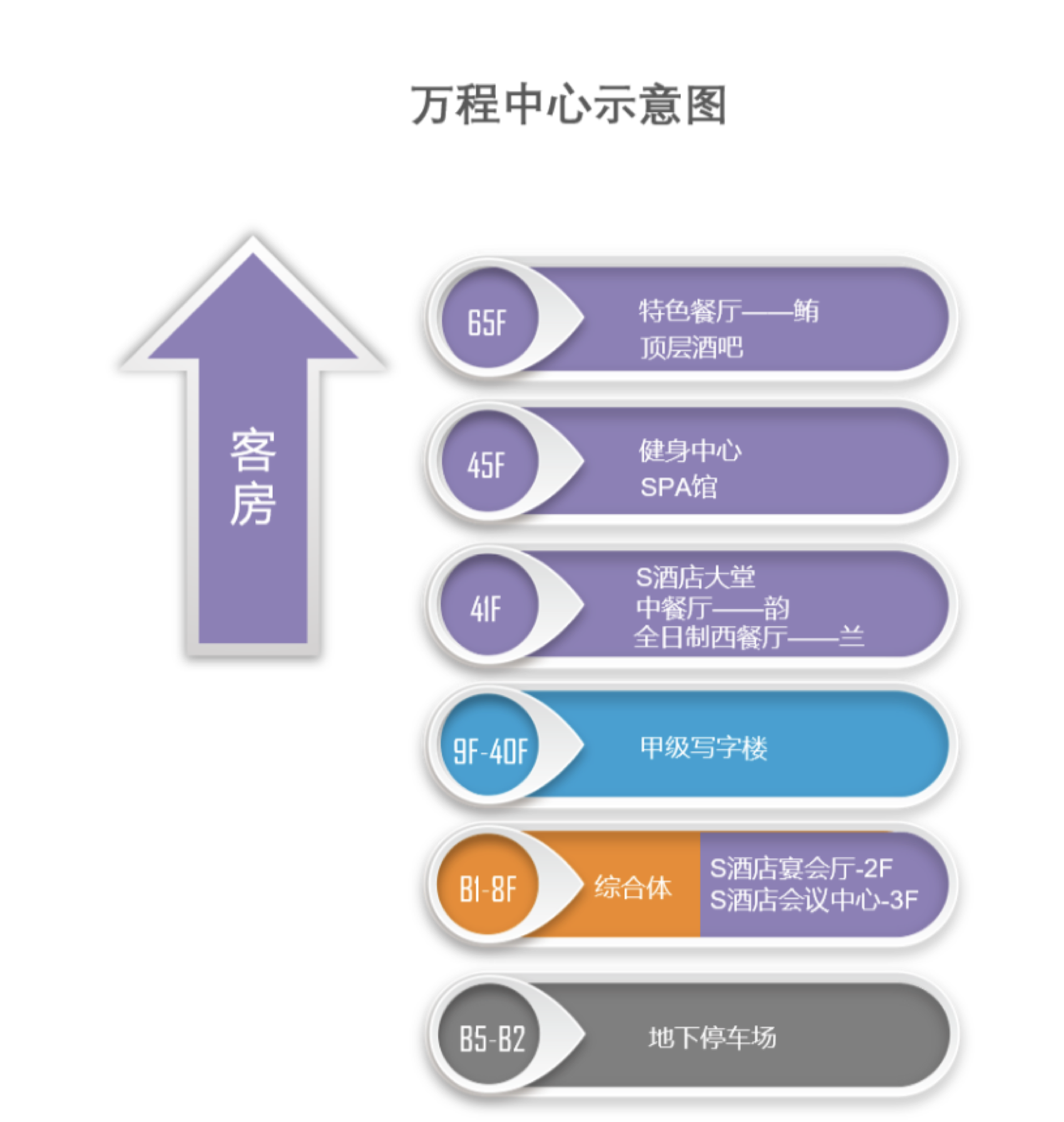
The Center is divided into four parts: Class A office spaces from the 9th to the 40th floor; parking lots from the 2nd to the 5th floor underground; a shopping mall from the 1st floor underground to the 8th floor above ground; and the S Hotel from the 41st floor and above. The shopping mall has components such as first-class boutiques (e.g., LV, Hermes and Tiffany), luxury watch stores (e.g., Omega), fashion retailers, department stores with imported products, high-end baby and children’s clothing stores, deluxe home appliance dealers, gourmet restaurants, IMAX theater, and art gallery. The mall also holds regular pop-up events and art exhibitions of Chinese and international artists. Moreover, the Center offers multiple dining options located on different floors at various price points. Current cuisine categories include Japanese, chain Thai, Sichuan, popular Hangzhou dishes, high-end Cantonese, steak, Chinese aristocrat. Several popular dessert stores recommended by online influencers are located on B1 floor. The fine Cantonese restaurant on the 5th floor is the highest grossing restaurant at the Center with average monthly sales of RMB 10 million.
The 41st floor and above of the Wancheng Center belongs to the S Hotel, which is operated by the world’s largest hotel management company, “J.” The hotel lobby is located on the 41st floor, guestrooms from the 46th to the 63rd floor, executive suites from the 59th to the 63rd floor, and swimming pool, fitness center and Spa on the 45th floor. The hotel offers 300 guestrooms (190 rooms with a king bed and 110 with twin beds), 3 ballrooms (300m2 each) and 6 multifunctional meeting rooms. The ballrooms and meeting rooms are located near the shopping mall on the 2nd and 3rd floors respectively.
The hotel runs three restaurants: Lan (western restaurant) and Yun (Chinese restaurant) on the 41st floor, and a featured restaurant, Wei, on the 65th floor. Yun is famous for its Huaiyang cuisine. It has a hall that can accommodate 40 people for a catered reception and 6 VIP dining rooms that offer views of the Huangpu River. Wei boasts delicate Japanese cuisine. It offers 50 seats, 10 of which face the Huangpu River. No other restaurants or bars can give customers such great views of the Hunagpu River and city landscape.
As a luxury brand, the revenue yielded by lodging and dining (including banquet) is almost the same, which shows the significance of the dining sector in hotel operations. According to the financial report of 2018 and the first half of 2019, contributions to total revenue were Lan 10- 14%, Yun 17%-20%, Wei 3-5%, and the rooftop bar 3-5% (based on the historical data averages).
Your team:
You are the director of the Food and Beverage department. You need to seek support from your team and other departments (e.g., Sales & Marketing, Housekeeping and Public Relations) to complete an adjustment plan for your department to address the recent financial challenges described below.
A decline in total retail sales in the first half of 2019 intensified the pressure on the Chinese consumer market. As a result, all tenants in the Wancheng Center experienced a year-over-year loss of revenue, to differing degrees, and are trying to boost sales by offering distinctive promotions. Competition is fierce, especially among restaurants. S Hotel, which owns several restaurants and bars has not been spared. The total revenue during the first half of 2019 from its three eateries is 5-10% less than budgeted, leading to a drastic decline of profit in its dining sector. For example, Yun has seen its contribution to the hotel’s total revenue reduced more than 15%. Wei has fared worse, with a daily profit below RMB30,000 during the busiest dinner time the past two weeks. Although it has steady customer traffic, the rooftop bar has experienced average check decreases by 10-15% compared with the first half of 2019. Based on this trend and these numbers, the hotel owners demanded an immediate meeting with managers to address the financial situation and prepare adjustments for the third quarter.
In response, the Food and Beverage department agreed to adjust its operational plan and submit a proposal that includes a business plan for Q2 2020 through Q1 2021 to the general manager before Jan 24, 2020. The general manager would first review the proposal and then present it to the hotel owners at the meeting in early March 2020. If passed, the proposal would be put into practice in the second quarter of 2020.
Date | Objective | Form | Chapter
|
According to the development status of hotel restaurant in Chengdu and the information given in the case, reasonable assumptions were put forward for the brand upgrading of each restaurant and bar in S Hotel. (Including design description and brand positioning)
| Upgrade Plan(Paper) | Chapter1(Main) Chapter2-4(secondary)
| |
1.Marketing research(You should identify target customers, and forecast demand according to the regional characteristics) 2. Make promotion and publicity plans(Marketing strategy, promotion channels and activities, budget and schedule, etc.) | Marketing plan | Chapter 4
| |
You need design a new menu, identify the brand beverage star products of the cafe, and make reasonable pricing.
| Make a menu | Chapter6 (Main) Chapter5,7,9 (secondary)
| |
Final paper and Presentation | Paper and Presentation | All Chapters
|
Performance indicators | Little/No Value | Below Expectations | Meets Expectations | Exceeds Expectations | Score
| |||||
1 | The upgrade plan is in line with the local market and case background. It is innovative and can solve the problems faced by the brand | 0-3 | 4-6 | 7-8 | 9-10 | |||||
2 | Can define target customers correctly | 0-3 | 4-6 | 7-8 | 9-10 | |||||
3 | Clearly describe the new brand promotion strategy and plan | 0-3 | 4-6 | 7-8 | 9-10 | |||||
4 | Menu design reasonable, clear planning, unique | 0-3 | 4-6 | 7-8 | 9-10 | |||||
5 | The business plan is comprehensive and detailed, with correct format and contains all the tasks and challenges | 0-3 | 4-6 | 7-8 | 9-10 | |||||
Key ability | ||||||||||
1 | Knowledge of food and beverage courses | 0-3 | 4-6 | 7-8 | 9-10 | |||||
2 | Strategic planning capability | 0-3 | 4-6 | 7-8 | 9-10 | |||||
3 | Creative ability | 0-3 | 4-6 | 7-8 | 9-10 | |||||
4 | Ability to communicate | 0-3 | 4-6 | 7-8 | 9-10 | |||||
5 | The overall impression | 0-3 | 4-6 | 7-8 | 9-10 | |||||
Total Score | ||||||||||
加分 | Presentation in English | 0-1 | 2 | 3 | 4-5 | |||||
>70
| 1 (70-75) | 2 (76-85)
| 3 (86-90)
| 4-5 (90-100) | ||||||
Final Score | ||||||||||

