Photolithography
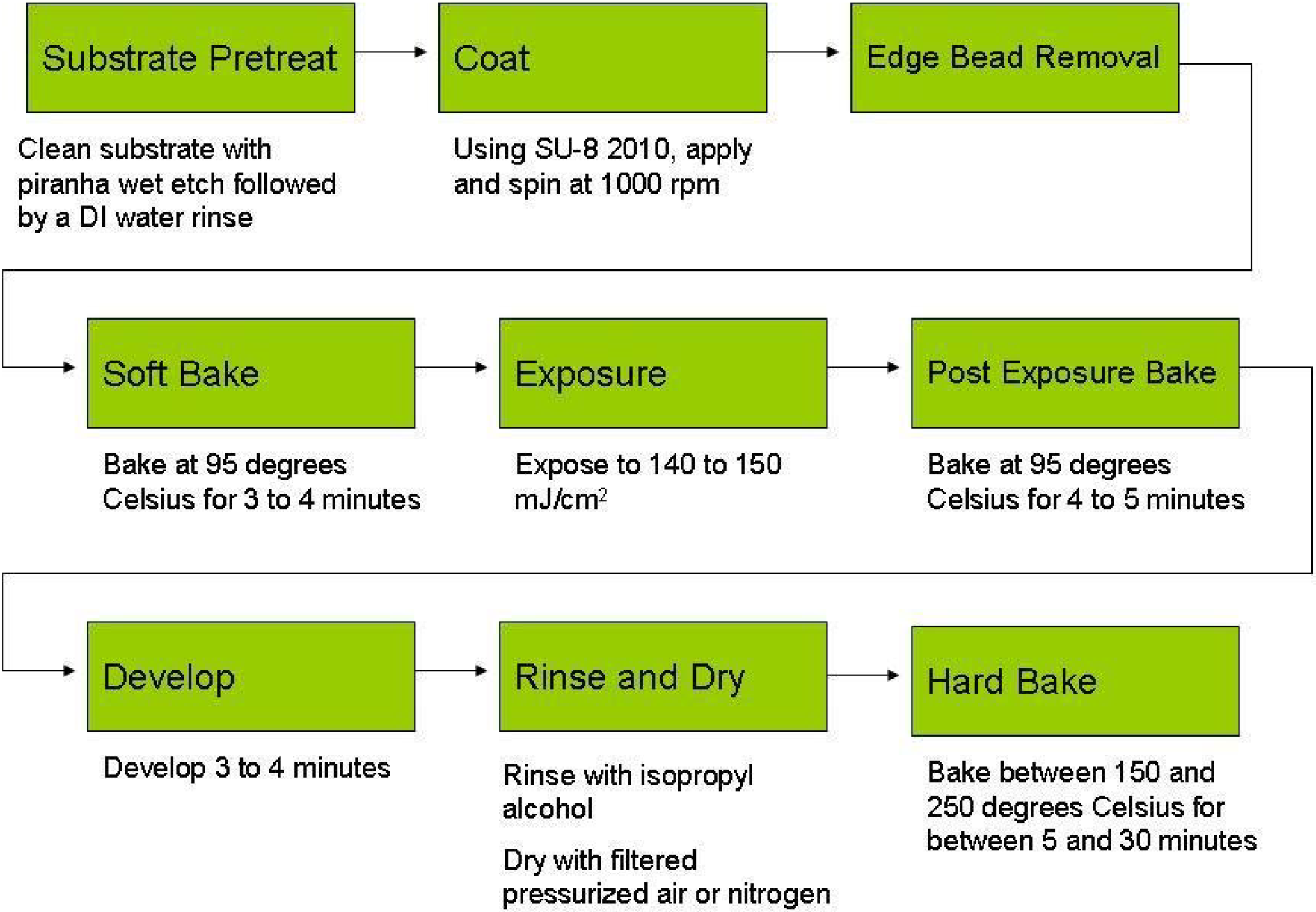
Pay attention to all the process parameters (how long is the piranha wet etch; what is the exposure time for a given UV exposure system). These parameters may not be given in the data sheet and depend on where you are going to perform the photolithography steps. You will need these parameters for “debugging” if the process goes wrong. The following are 2 protocols developed by your fellow classmates.
SU-8 Protocol Recipe #1
01 Substrate Preparation: Clean Substrate
Using piranha wet etch (H2SO4 and H2O2)
Using De-ionized water rinse
02 Coat SU-8
Using SU-8 2015 spin at 2000 rpm for 30 s with accelerationof 300 rpm/s
03 Edge Bead Removal (EBR)
Using small stream of solvent (MicroChem’s EBR PG) to remove thick bead
04 Soft Bake
Using a uniformity thermal hotplate to warm the soft bake
Soft bake for 3~4 min and control temperature at 95 °C
Remove wafer and Cool down wafer to room temperature
Return wafer to hotplate and repeat cool down and heat up to remove “wrinkle”
05 Exposure
Expose wafer under Ultraviolet at the wavelength of 350 nm
Exposure energy is 140~160 mJ/cm2
For silicon wafer, we choose 1X dose
06 Post Exposure Bake
Using hotplate to back wafer for 4~5 min at 95 °C
07 Development
Using MicroChem’s as SU-8 developer to develop SU-8 for 3~4 min
08 Rinse and Dry
Spray and wash the developed wafer with fresh solution for 10 s
Second spray and wash with Isopropyl Alcohol for 10 s
Using pressure air with filter (or N2) to dry wafer
09 Hard Bake (Optional)
Hard bake wafer 150 °C for 5~30 min to anneal any crack
10 Removal (Optional)
Using MicroChem’s Remover PG with OmniCoat to lift off SU-8
Control temperature at 50~80 °C and immerse wafer for 30~90 min in Remover.
Also can use Plasma removal (200 W, 80 sccm O2, 8 sccm CF4, 100 mtorr, 10 °C)
SU-8 Protocol Recipe #2