
生物传感器(英)

邓盛元、万莹、汪俊松、李大力

目录

  • 1 INTRODUCTION / 绪论
    • 1.1 Introduction of Biosensors / 生物传感器概论
      • 1.1.1 Presentation / 课程讲义
      • 1.1.2 Video / 课程视频
      • 1.1.3 Narratives / 视频文本
      • 1.1.4 Retrospect / 要点回顾
    • 1.2 Classification of Biosensors / 生物传感器的类型
      • 1.2.1 Presentation / 课程讲义
      • 1.2.2 Video / 课程视频
      • 1.2.3 Narratives / 视频文本
      • 1.2.4 Retrospect / 要点回顾
    • 1.3 Supplementary Materials / 补充学习
    • 1.4 Quiz and Homework / 作业测验
  • 2 SURFACE IN BIOSENSORS / 生物传感器的表界面科学
    • 2.1 Surface Chemistry / 表面化学
      • 2.1.1 Presentation / 课程讲义
      • 2.1.2 Video / 课程视频
      • 2.1.3 Narratives / 视频文本
      • 2.1.4 Retrospect / 要点回顾
    • 2.2 Biosensing Interfaces / 生物传感界面
      • 2.2.1 Presentation / 课程讲义
      • 2.2.2 Video / 课程视频
      • 2.2.3 Narratives / 视频文本
      • 2.2.4 Retrospect / 要点回顾
    • 2.3 Supplementary Materials / 补充学习
    • 2.4 Quiz and Homework / 作业测验
  • 3 PROTEIN SENSORS / 蛋白质传感器
    • 3.1 ELISA and Immunofluorescence / 酶联免疫吸附分析与免疫荧光法
      • 3.1.1 Presentation / 课程讲义
      • 3.1.2 Video / 课程视频
      • 3.1.3 Narratives / 视频文本
      • 3.1.4 Retrospect / 要点回顾
    • 3.2 Aptamer and Catalysis Based Biosensors / 基于适配体与催化的生物传感器
      • 3.2.1 Presentation / 课程讲义
      • 3.2.2 Video / 课程视频
      • 3.2.3 Narratives / 视频文本
      • 3.2.4 Retrospect / 要点回顾
    • 3.3 Supplementary Materials / 补充学习
    • 3.4 Quiz and Homework / 作业测验
  • 4 DNA SENSORS / DNA传感器
    • 4.1 Nucleic Acid Biomarkers and Sequencing / 核酸标志物及测序
      • 4.1.1 Presentation / 课程讲义
      • 4.1.2 Video / 课程视频
      • 4.1.3 Narratives / 视频文本
      • 4.1.4 Retrospect / 要点回顾
    • 4.2 DNA Detection and Amplification / DNA检测与信号放大
      • 4.2.1 Presentation / 课程讲义
      • 4.2.2 Video / 课程视频
      • 4.2.3 Narratives / 视频文本
      • 4.2.4 Retrospect / 要点回顾
    • 4.3 Supplementary Materials / 补充学习
    • 4.4 Quiz and Homework / 作业测验
  • 5 EXPERIMENTATION / 实验内容
    • 5.1 List of Experiments / 实验列表
    • 5.2 In-Class Demo 1 / 课内实验1
    • 5.3 In-Class Demo 2 / 课内实验2
    • 5.4 Out-of-Class Demo 1 / 课外实验1
    • 5.5 Out-of-Class Demo 2 / 课外实验2
    • 5.6 Out-of-Class Demo 3 / 课外实验3
    • 5.7 Out-of-Class Demo 4 / 课外实验4
    • 5.8 Out-of-Class Demo 5 / 课外实验5
    • 5.9 Out-of-Class Demo 6 / 课外实验6
  • 6 WRITING ASSIGNMENT / 课程报告
    • 6.1 Project I / 项目I
    • 6.2 Project II / 项目II
  • 7 SUPPORTING INFO / 支持信息
    • 7.1 Syllabus / 教学大纲
    • 7.2 Schedule / 教学实施计划
    • 7.3 Apps / 智能应用
    • 7.4 References / 参考文献
    • 7.5 Textbooks / 参考教材
    • 7.6 Network Resources / 网络资源
Out-of-Class Demo 5 / 课外实验5

Microfluidic Cell Assay


Photolithography (a, b, c) and Soft Lithography (d, e, f):
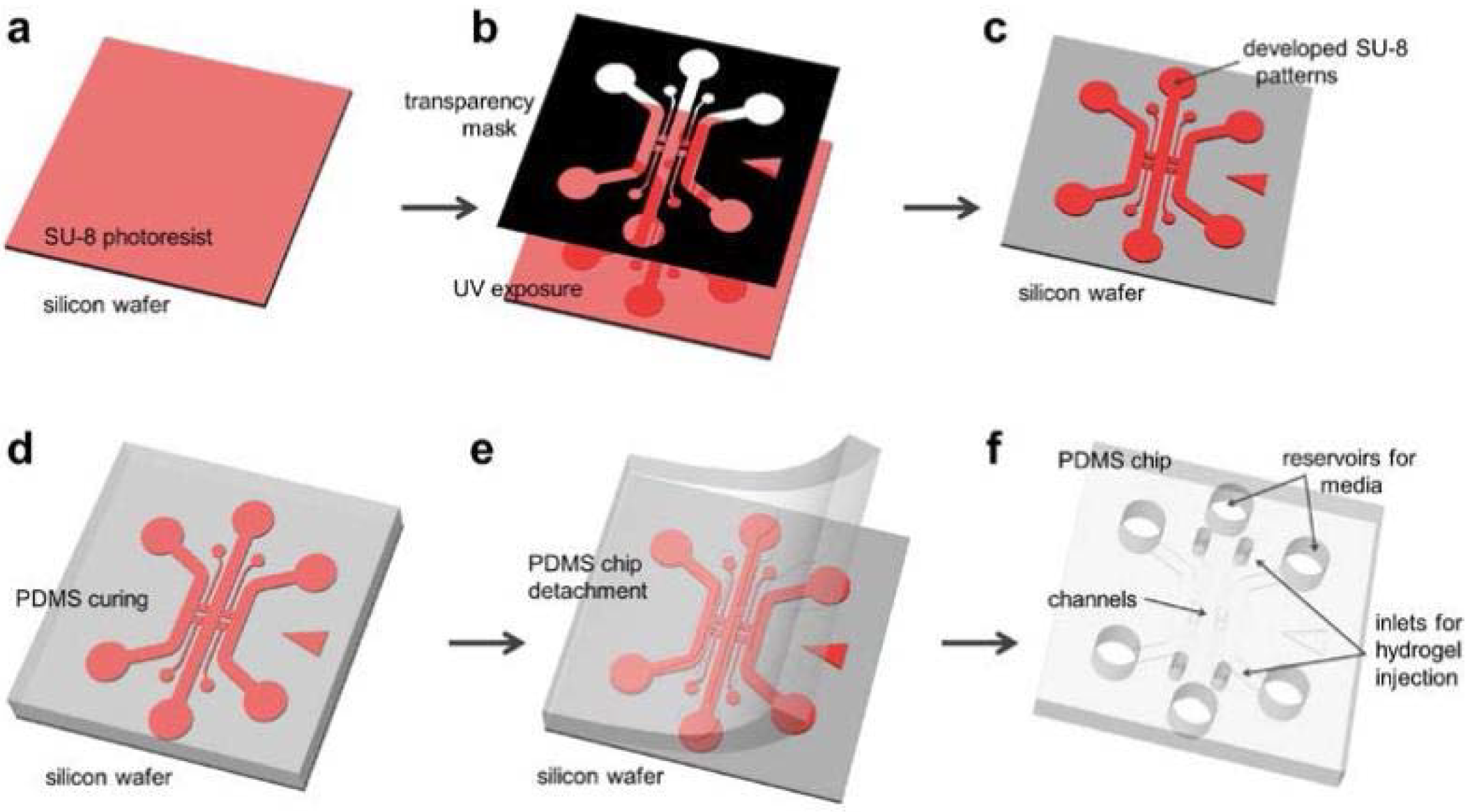


[1]   SU-8 is spin-coated and pre-baked on a bare wafer;

[2]   Use a transparency photo mask (black), ultraviolet (UV) light is exposed on the SU-8;

[3]   Exposed SU-8 is then post-exposure baked and developed to define channel patterns;

[4]   Polydimethylsiloxane (PDMS) mixed solution is poured on the wafer and cured;

[5]   Cured PDMS is then peeled from the wafer;

[6]   Device is trimmed, punched and autoclaved ready for assembly.


Hydrogel IncorporatingMicrofluidic Assay:
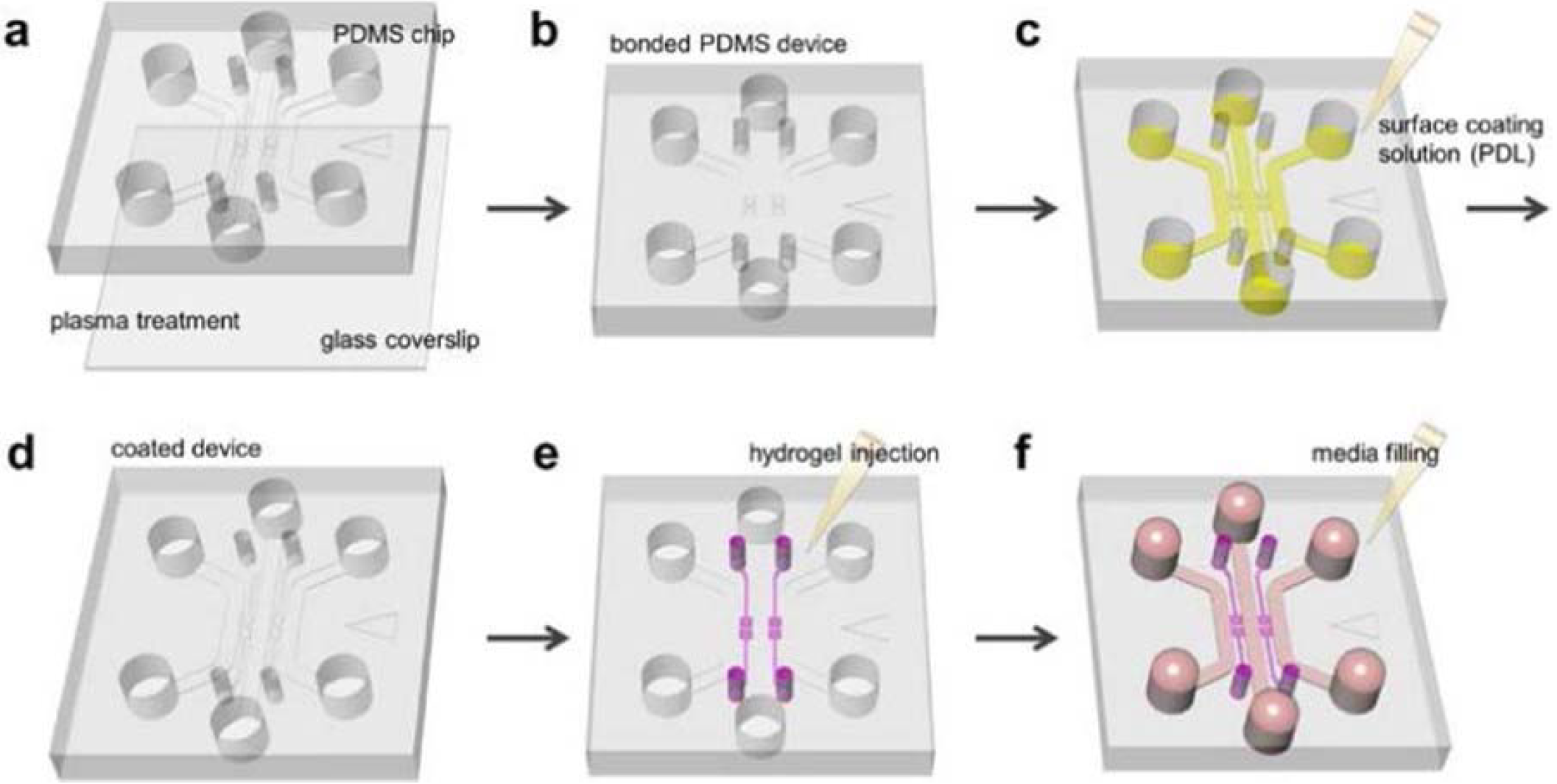


[1]   Autoclaved PDMS device and coverslip are assembled with plasma treatment;

[2]   To close the microfluidic channels;

[3]   Surface coating solution (PDL) solution is filled and device is placed in an incubator;

[4]   After washing and aspiration, coated device is stored in dry oven for 24 hours to render the microfluidic channel surface hydrophobic;

[5]   Hydrogel is filled into the hydrogel region;

[6]   Medium is added into the microfluidic channel.

Device is ready for cell seeding in incubator.


Cell Culturein Microfluidic Assay:
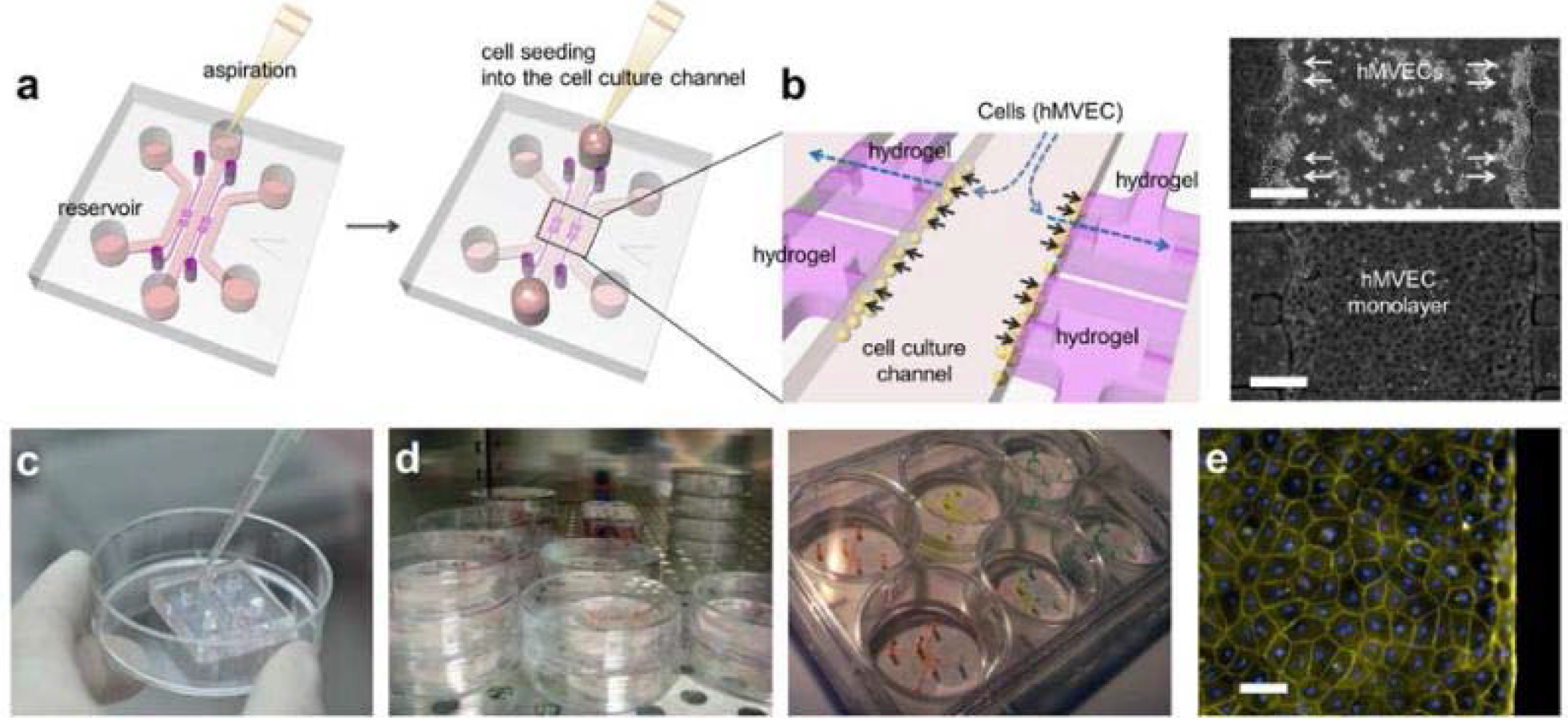


[1]  After aspiration of medium in the reservoir, 50~60 μL of the human microvascular endothelial cell (hMVEC) suspension is added into one reservoir connected to the center channel.

[2]   Hydrostatic pressure difference in the reservoirs pushes the suspended hMVECs onto the collagen gel to facilitate attachment. hMVECs right after seeding (right top) and tight monolayer at 1 day (right bottom). Scale bar indicates 250 microns.

[3]   To add cell suspension or media into the reservoir, use a pipette and gently inject medium into one reservoir after aspiration. The filled liquid automatically fills the channel and replaces the contained medium.

[4]   Cell seeded assays can be stored in incubator or 6-well plate with various experimental conditions.

[5]   In 4 days of culture, hMVECs form intact monolayer in channel and on Type-1 collagen wall. Actin filaments and nuclei were then stained withrhodamine-phalloidin (yellow, Sigma-Aldrich) and 4’,6-diamidino-2-phenylindole (DAPI, blue, Sigma-Aldrich), respectively. Scale bar indicates 50 microns. Endothelialcell monolayer was imaged by confocal microscopeand its diffusion coefficient was measured by fluorescent dextran diffusion.