
★Baselines (基线)
Preparing a project for construction means that the project must be broken down to a suitable level of detail so that it can be monitored and controlled. Creating a baseline (also called a target or project forecast (目标预测) is the first step in the control process. The baseline establishes the goals for the project and allows management to measure how well the project is proceeding and what the end result will be. The estimate serves as the cost baseline for a project, while the schedule serves as the time baseline.
▶Cost baseline(成本基线)
From the contractor's perspective, the accepted bid price, which becomes the contract price, is the cost baseline for the project and the target by which the success of the project will be measured.
From the designer's and the owner's perspective, the agreed-upon contract price is the culmination(顶点) of a series of pricing exercises that have been prepared since the first conceptual estimate(初步估算,概念性估算). If the scope of the project has been well managed and the estimates done well, then the bids received should be close to the prior estimates(初始的估算).
Throughout the design/build process, the application of Pareto's law(帕累托定律) plays an important part in the control of project costs.
———Pareto (1848-1923), an Italian economist, believed that 80% of the outcome of any project is determined by 20% of its included elements. Thus, any project control system needs to identify the major cost elements of the project early and develop a system of controls to monitor and manage them.
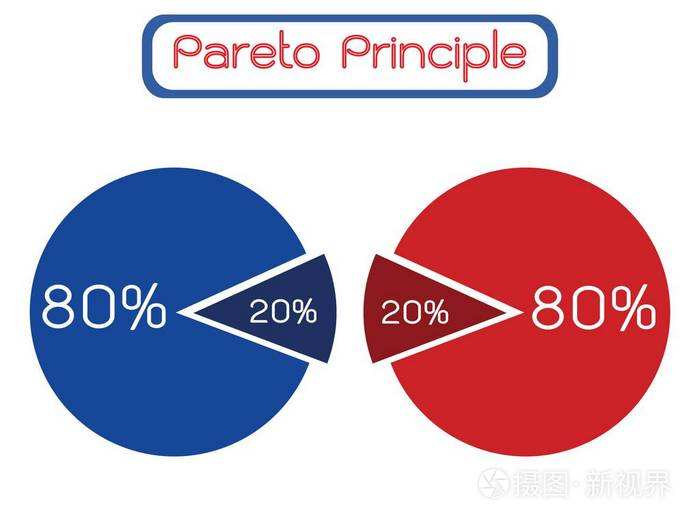
By using detailed and summary reports, project managers focus on the elements in need of tight control and only look at less critical elements at a summary level.
▶Time baseline(工期基线)
Through the schedule the project team manages the time and related resources to complete the project. When the schedule is combined with the estimate, the cash flow can be projected(突出,计划).
Most projects are developed in full detail using a network-based CPM schedule with summary reports generated as necessary for reporting purposes. For example, on large projects detailed network schedules are developed for each of the major system, which is necessary to coordinate and control the system work.
The baseline schedule identifies the key milestone dates of the projects as well as key material delivery dates. Subcontractor start and finish dates are also shown. These dates are all important control points . A delayed material delivery can have a domino effect (多米诺效应)on the following work of the project.——(多米诺效应,也称多米洛骨牌效应,指一件事的发生会引发一连串连锁反应,常用来比喻系统内的因果关系。因按一定间距排列的多米诺骨牌相继倒下而得名。)

▶Baseline summary(基线小结)
The estimate and the schedule are the two primary tools used to control the cost and time elements of a project. The level of detail should be dictated(命令、口述) by the degree of control necessary. As the control system is established, the project manager must determine the most time- and cost-sensitive parts of the project and design the system to focus on these areas.
As the project proceeds, the actual cost and schedule for the project will change for many reasons. The baseline, however, will not change. It will always serve as a measure of how the project was planned at the beginning of the project.
★Crashing(赶工)

▶What does crashing mean?(什么是赶工)
Crashing a project means the process of accelerating an activity or multiple activities to shorten the overall duration of a project. By adding additional people, equipment, or work hours, a project manager can shorten an activity's duration. If the activity affected is critical, the project will be shortened as well.
▶Why are project crashed?(为什么要赶工)
Activities are crashed for different reasons:
▷The project has slipped considerably behind schedule. An activity may need to be completed by a specific date for contractual reasons.
▷Some activities can be accomplished more economically during a certain time of the year, encouraging managers to accelerate preceding activities.
▷The contractual situation provides even more incentive(激励) to avoid schedule slippage(延误、拖延).
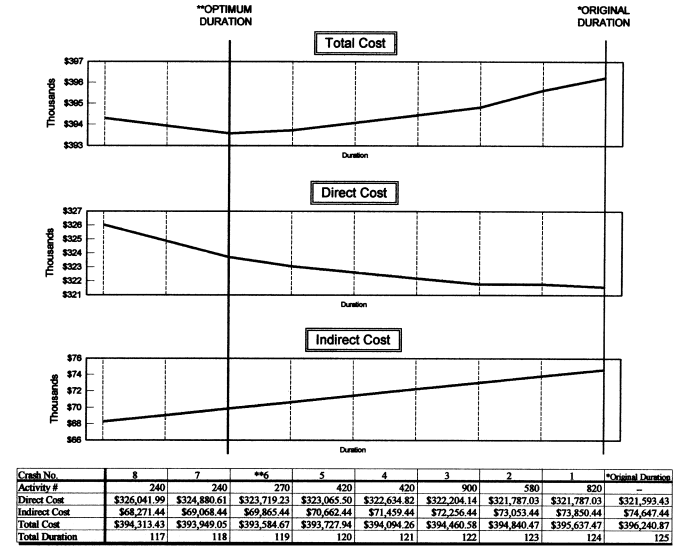
▷The cost to accelerate an activity, which shortens the project's duration, may be less expensive than the cost of running the project for the same period. When an activity is cashed, its direct costs increase. (As we have discussed, direct costs involve materials, labor and equipment directly associated with the installation or construction of the project.) These costs increase because of the inefficiencies caused by accelerating the work at a faster rate (For example the equipment may sit idle怠工); but these cost increases may be justified (compensated补偿) if indirect costs are saved or if the owner provides a bonus(奖金) for early completion.
☞(The costs involved in the construction of a project can be broken down into two major categories: direct and indirect.
Direct costs are associated with the physical construction of the project and include such things as the purchasing of building materials, equipment operations, and all installation labor.As long as work proceeds, direct costs continue to accrue. Once work is stopped, direct costs generally stop as well.
Indirect costs are not as easy to visualize.They include home office and field office Overhead. They are necessary to supervise and support the job site. Examples are the rental of the job-site trailer; the superintendent’s salary; and the cost of security fencing, guard, and signs. indirect costs are a factor of the project’s duration and the degree of supervision required. If a project increases in length or requires a high level of coordination, the indirect costs will increase. By minimum cost scheduling, project managers can determine the optimum duration for the project, minimizing the project’s total cost, which equals a project’s direct cost plus its indirect cost.)
▶Advantages and disadvantages of Crashing(赶工的优缺点)
▷Advantage: A reduced project duration can earn additional bonus money, prevent the payment fines(罚金) or save the company additional indirect costs. (The amount of the bonus to be received or the fine to be paid should be described in the contract.)
▷Disadvantage:
1. Difficult to carry out.The integration of scheduling and estimating information cannot be easily linked since the activity unit are often not the same. It is difficult to calculate crash costs for each activity and then formally analyze and compare those costs with indirect costs. This process takes a considerable amount of time.
2. Risk of delay As a project is crashed, multiple critical paths are created. As more critical paths appear, there is a greater risk of delaying the project.
Reviewing questions(复习思考):
What's your understanding of crashing and its advantages and disadvantages?

