
★Estimate considerations
Every estimate, whether prepared in the conceptual phase or at bid time, considers the same basic issues. The accuracy of an estimate is directly affected by the ability of the estimator to properly analyze these basic issues.
▷Project size
The size of the project is a factor of the owner's needs. In an estimate, size is handled differently depending on which stage the project is at. At the conceptual stage, size is an issue of basic capacity, such as apartment units for a real estate developer or miles of roadway for a highway engineer. As the project becomes better defined, its size begins to be qualified more accurately.
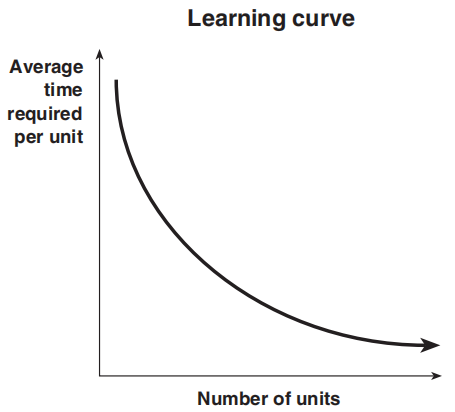
The principle of economy of scale is an important factor when addressing project size. Essentially, as projects get bigger, they get more expensive but at a less rapid rate.. The large the project, the more efficiently the people and equipment can be used. Also as people repeat a task, they get better and faster, reducing the cost of labor, this can be seen from a learning curve(学习曲线).
▷Project quality
An owner may require a high-quality project to create a specific image or for specific concerns. For example a billionaire may require his or her villa to be finished and furnished splendidly; in an uclear plant or missile and rocket launch site, concerns about the public safety will push the design team to specify a higher level of quality. Whatever the reason, the consequences are always the same: an increase in costs.
As the expected quality of a project increases, the cost of providing this quality increases as well but at a progressively greater rate.
Similarly, as the quality of a project increases, the user experiences increased project satisfaction but at a lesser rate.
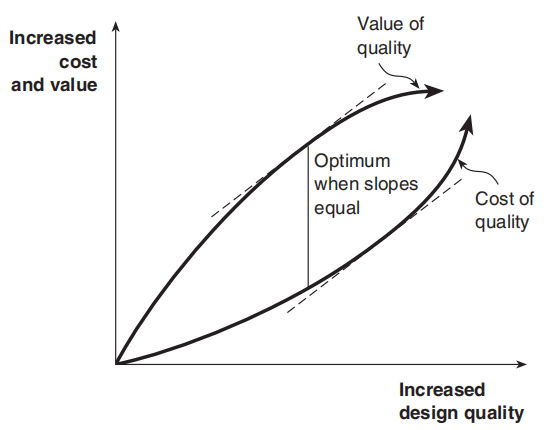
The optimum level of design quality is the point at which the slope of the two curves is equal. Beyond that point the cost of providing one more unit of the value exceeds its corresponding value to the owner.
▷Location
Construction a facility in
Local conditions can influence the costs of the project. The need for citizen involvement, local taxes or fees, and government requirements all can cost the project money. Extreme climate conditions, political instability, and earthquake zones all add to the cost in ways that may not be entirely obvious without some investigation.
Most major design and construction companies have developed an accurate record of location indices (index), which they use for their pricing, or they buy this cost data from national pricing suppliers, or just team up with a local partner who knows how the local atmosphere can affect project costs.
▷Time
A project is estimated at a given point in time, but usually the actual procurement and field construction occur at some point in the future. Sometimes this future can be years away, especially in the case of very large or phased project. The estimate, then must take into consideration when the actual project will be built. Labor and material costs usually increase gradually, so by examining past and current trends, the estimator can predict where these costs will be at the time of actual construction. in addition, the estimator takes pass actual costs and adjusts them to today's costs. ( time/location adjustment)
▷Others
A estimate that incorporates project size, project quality, location, and time reflects the fair value for the project in a normal market without any unusual circumstances, but in an abnormal market, these factors are not enough, for example, in a market without much work, contractors may bid a project with little profit and keep their staff employed. But this can also happen during a flourishing (prosperous) economy if the contractor aims at making significant profit on future changes.
★Common Problems with Cost Estimation
▷Low initial estimates– caused by misperception of the scope of the project to be undertaken, low initial estimates are a double-edged sword; it may be the result of corporate culture and political reasons(低的初始估算——源于对项目范围的误解,低初始估算是一把双刃剑;这可能是企业文化和政治原因的结果 )
▷Unexpected technical difficulties – many projects assume that the technical problems will be minimal(意外的技术困难——许多项目都认为技术问题将是最小的 )
▷Lack of definition – the result of poor initial scope development is often the creation of projects with poorly defined features, goals, or even purpose(缺乏定义——初始范围开发不佳的结果是往往是功能、目标、目的定义不清 )
▷Specification changes – one of the banes of project management cost estimation and control is the mid-course specifications changes(规范变更——项目管理成本估算和控制的祸害之一就是中间发生规范变更 )
▷External factors – inflation and other economic impacts can cause a project to overrun its estimates(外部因素——通货膨胀和其他经济影响可能导致项目超出预期)
视频:如何进行成本估算(How to estimate a project?)
Conclusion
This chapter has discussed why estimates are prepared and how and by whom they are used. An estimate is not static (still) but evolves with the project. Estimates are first used in the conceptual stage. Because little information is available at this stage, they are only able to provide a rough idea about the project's cost. As the design evolves and more is understood about the project, the estimate becomes progressively more accurate.
Every estimate must consider certain basic factors: project size, project quality, location, time, and other market issues. Project time and market considerations are more difficult to qualify since both depend on economic and local issues and must be predict future trends.
Whenever money is a significant factor in a building project, estimates are essential. A good estimate prepared at the right time gives the owner the information needed to make informed decisions. A bad estimate can cause a project to have serious cost overrunning and can bankrupt a contractor. Companies invest significant money in preparing good estimates and building data bases of costs can benefit from that investment in a long term.
Discussion1
Discussion2

