
★Levels of specialization (专业化程度)
The more specialized the function, the few issues a specific work has to pay attention to. By dividing work more narrowly, works should be able to produce a better product at a faster rate, however narrow compartmentalization is not a panacea(万能药), it will create a cumbersome(burdensome 笨重的,累赘的) organization, slowing down organization and decision making. The challenge is to establish the appropriate level of specialization.

★Levels of authority(权力级别)
Closely related to compartmentalization is providing the correct level of authority to the members of the project team. Authority can be defined as decision-making power, or position power(职位权力). Position power should be discriminated(分辨) from personal power, which is based on an individual’s intelligence, resume(简历), or charisma(个人魅力).
There are both line authority (represented by the vertical line)(直线权力) and staff authority (represented by the horizontal line)(参谋权力). Line authority means giving orders down the line about production. Line supervisors direct, supervise, and evaluate the work of their subordinates(下属). Compared to the line position, a person in the staff position does not directly supervise staff. He or she provides advice, and the information necessary to allow line supervisors to make better decisions.
The responsibility is the penalty(惩罚) that comes with the authority. In establishing an organizational structure, managers should strive to match authority with responsibility within the project team.
视频:什么是权力
Every employee should have only one direct supervisor(直接主管). Multiple bosses cause confusion and split loyalties and undermine the authority of the real boss (if there is one). Organizations need to be careful to establish clear lines of authority at all times, especially when the work requires multiple reporting structures.
视频:一个有趣的辨析:权力与权利
★Centralization & decentralization (集权和分权)
Organizations should also pay attention to the balance between centralization and decentralization. Small firms naturally centralized because all the decisions come from the president, but as firms grow, all decisions can no longer be made at the top. Some decisions need to be shifted elsewhere in the organization.
Generally speaking, when most projects begin, they require a strong centralized structure, often with continual guidance from the company’s upper management. Once the project moves into construction and filed office is set up, the focus narrows to construction activities. At this point, a shift to a more decentralized project management style is more effective. Decisions need to be made quickly. Waiting for guidance from the home office would slow decisions and cause a failure on the project because of this slow turn-around.
What's the difference between decentalized and centralized firms?Decentralized firms tend to be more nimble (flexible 灵活) because decisions can be made faster. “Take-charge”managers (负责的管理者)enjoy this type of structure because they become their own boss and do things their own way. Centralized firms tend to run projects in a more methodical and consistent manner because more decisions are elevated to the same people. People tend to get good at what they do when they repeatedly do the same thing.
The ultimate(最终的) goal of every organization is to fully utilize(利用) the skills and creativity of its people. Organizations should not get locked to(固守、锁定) either one philosophy or the other, but should continue to evaluate their people and establish the appropriate system of control to support their leadership style.
★Span of control(管理幅度)
We always confused by a question, that is how many subordinates(下属) a people can control. A concern of every organization is the number of people that any one manager will control. This is called span control. Narrowing one's control span creates additional hierarchy(管理层级). A narrow span of control provides more supervision and control, but also tends to create more specialization.
视频:集权与分权,管理幅度
★Project Scope(项目范围)
Project Scope is the detailed description of the project work necessary to meet the requirements of the stakeholders. Scope defines the boundaries of a project (范围定义项目的边界). It obviously addresses what is included. However, by addressing what is excluded can significantly improve the clarity of the required work. There are two types of scope: Product scope and work scope.
Boundaries aren’t just about safety, they also focus your efforts on desirable and achievable objectives. An artist’s painting is naturally limited by the edge of the canvas(油布), which they carefully select and size according to their initial plan. In the same way, businesses must establish clear boundaries around all sides of their project to keep it moving in the right direction.
Scope creep(范围蔓延) is common, but you can avoid it with a project scope statement. This detailed documentation includes a list of what’s in and what’s out of scope so that, when someone asks you to add to the project, you can politely (but firmly) point that person to the change control process.
Some related questions about scope:
Product -----What do you want? (产品-你想要什么?)
Quality ----- How good do you want it to be? (质量-你希望它有多好?)
Time -----When do you want it? (时间-你想什么时候得到它?)
Cost -----How much are you willing to pay for it? (费用-你愿意为它支付多少钱?)
Resources -----What resources are you willing or able to bring to the table? (资源-你愿意或能够使出多少资源?)
视频:为什么工程范围这么重要?
(Why it is important to identify what's in and what's out)
★Work breakdown structure(工作分解结构)
A Work Breakdown Structure (WBS) is “ a deliverable-oriented grouping of project elements which organizes and defines the total scope of the project.The WBS lays out the individual building blocks that will construct the project.
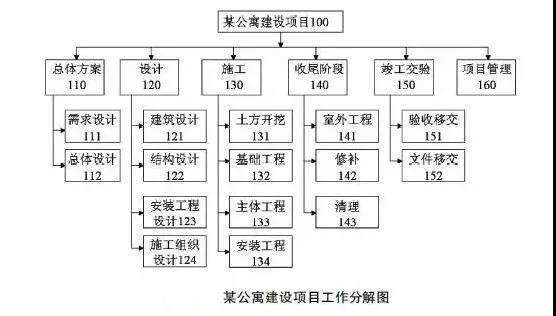
WBS defines the projects contractual elements as well as the definition of tasks and subtasks and their interdependencies(相互依赖关系). The work breakdown analysis establishes the contract, task and time constrain(限制) for the project, which leads to the design of the organizationa breakdown structure(OBS) and Responsibility Assignment Matrix (RAM)(责任分配矩阵). RAM is also called linear responsibility chart, identifies team personnel who will be directly responsible for each task in the project's development .
☛Purposes of the WBS


It echoes(反映、反射) project objectives: given the mission of the project, a WBS identifies the main work activities that will be necessary to accomplish this goal or set of goals
▶It is the organization chart for the project: a WBS offers a logical structure for a project, identifying the key elements that need attention, the various sub-tasks, and the logical flow from activity to activity
▶It creates the logic for tracking costs, schedule, and performance specifications for each element in the project: all project activities indentified in the WBS can be assigned their own budgets and performance expectations
▶It may be used to communicate project status: determine which tasks are on track, which are critical and pending(待办), and who is responsible for their status
▶It may be used to improve overall project communication: WBS not only dictates (规定)how to break the project into identifiable(可识别的) pieces, it also shows how these pieces fit together in the overall scheme of development
▶It demonstrates(展示) how the project will be controlled: the general structure of the project demonstrates the key focus that project control will take on
Discussion

